

GPS trackers for people are increasingly used to meet specific needs: securing an elderly loved one, tracking a child during their travels, or supporting autonomous but vulnerable individuals.
In 2026, the available solutions have diversified, with very variable levels in terms of reliability, autonomy, and ease of use. So, what is the best GPS tracker for people today?
This guide offers a clear and objective comparison, based on the criteria that are truly important for human use, and not for vehicles or objects.
Why use a GPS tracker for a person? #
A GPS tracker for a person allows you to:
- locate a loved one remotely
- receive alerts in case of leaving a predefined area
- be notified in case of abnormal movement or fall (depending on the models)
- reassure without constant monitoring
These devices are often used for:
- elderly people
- children
- people with cognitive disorders
- active or isolated individuals seeking more security
Beyond its individual users, Invoxia also provides its GPS trackers for people to associations and organizations whose goal is to support autistic individuals.
When technology serves humanity, it can work wonders!

Essential criteria for a GPS tracker for a person #
📍 Location reliability #
The accuracy and continuity of the signal are essential, including in urban environments or indoors.
🔋 Autonomy suitable for daily use #
A tracker intended for a person must operate several days or weeks without recharging, to avoid forgetfulness and breakdowns.
🎒 Format and discretion #
The tracker must be:
- lightweight
- compact
- easy to wear (pocket, bag, clothing, accessory)
📱 Ease of use #
The application must be clear, with:
- understandable alerts
- simple configuration
- few manipulations for the end user
🔐 Privacy protection #
Location data is sensitive. Their hosting and security are key points.
Comparison of the best GPS trackers for people in 2026 #
🥇 Invoxia — The most balanced solution for people’s safety #
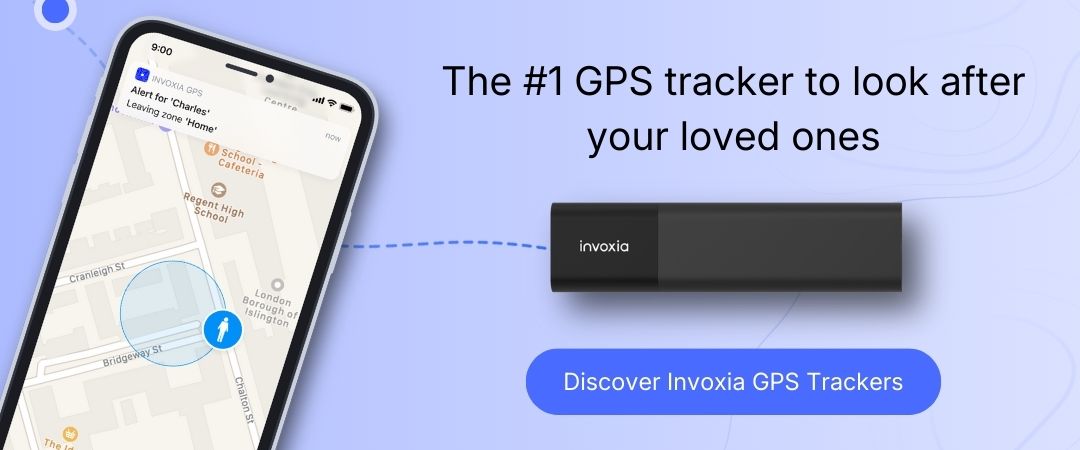
In 2026, Invoxia offers one of the most comprehensive approaches for tracking and people’s safety, thanks to a versatile range and strong technological expertise.
Why Invoxia stands out for this use #
- ✅ Compact and discreet trackers, easy to wear daily
- ✅ Long-lasting autonomy, limiting frequent recharges
- ✅ Reliable location thanks to low-consumption networks
- ✅ Smart alerts (zones, movements, events)
- ✅ Clear and easy-to-use mobile application
- ✅ Data hosted in Europe, GDPR compliance
Invoxia’s approach is particularly suitable for autonomous individuals but requiring a discreet safety net, without intrusive or stigmatizing devices.
AngelSense — A child-oriented solution #
AngelSense is mainly used for tracking children, especially in specific contexts.
- Functions designed for parental monitoring
- Very targeted use
- Less suitable for an adult or senior audience
- Autonomy and format sometimes restrictive
Weenect — A general public positioning #
Weenect offers GPS trackers intended for people and animals.
- Simple commissioning
- Basic functionalities
- More limited autonomy depending on the models
- Less oriented towards long-term use
Professional or medicalized solutions #
Some solutions come from the medical or professional world (teleassistance).
- Often bulkier equipment
- High overall cost
- Sometimes complex user experience
- Less suitable for autonomous and daily use
Apple’s AirTag: a frequently considered alternative, but with limitations #
Apple’s AirTag is often cited as a location solution for a person, especially due to its affordable price and integration into the Apple ecosystem.
The strengths of the AirTag #
- Relatively low purchase price (around 35 to 40 €)
- No subscription
- Native integration with Apple’s Find My app
- Compact and discreet format
The limitations in a “person” use #
Despite its popularity, the AirTag has several important limitations when used to track a person:
❌ No integrated GPS: location depends on the presence of other Apple devices nearby
❌ Very variable effectiveness outside urban areas
❌ Alerts designed for objects, not human safety
❌ Anti-tracking notifications that can disable usage over time
Apple also specifies that the AirTag is not designed to track people, but personal items.
In which cases can the AirTag suffice? #
The AirTag may be suitable:
- for occasional use
- in very crowded environments
- when location is not critical
For use involving safety or peace of mind, a dedicated location solution is generally more suitable.
What is the best GPS tracker for people in 2026? #
The best GPS tracker for people is the one that manages to find the right balance between:
- discretion
- autonomy
- reliability
- simplicity
Thanks to a coherent range, proven technology, and particular attention to privacy, Invoxia appears in 2026 as one of the most relevant solutions for people’s safety, without unnecessary compromise.