

When temperatures drop for good, the motorcycle spends the winter in the garage. A careful winter storage routine saves you from a flat battery, stale fuel, seized brakes or tyres with flat spots on the first sunny weekend of spring. Here is the motorcycle winter storage checklist, step by step, with the advice of UK motorcycle media and a breakdown specialist, plus how to bring the bike back to life in spring.
1. When to put your motorcycle away #
None of the UK guides we read gives a calendar date or a temperature threshold, and there is no need for one: the moment to prepare the bike is when you know it will sit for weeks. The principle is simple. A motorcycle that does not move does not wear, but it ages: the fuel goes stale, damp settles in, the battery drains and the tyres deform. Every step below answers one of those four risks.
2. Wash and dry the bike #
Start with a deep clean. MCN recommends washing the bike with a dedicated cleaner, drying it thoroughly, then applying anti-corrosion spray with a cloth to the metal, spindle ends, bolts and chain adjusters, and to the plastics too. Visordown pays particular attention to the rear shock, the underside of the mudguards and the inside of the brake calipers, and warns to use only a little thin spray on the brake discs and to clean it off in spring.
Honda UK adds a useful step: after washing, check for loose or faulty parts, then protect the metal, especially the underside, with a lubricant or metal-preserving spray. It is easier to spot a problem now than on the first ride in spring.
3. Fuel: full tank or empty? #
This is where the advice conflicts most, so the right answer depends on your bike and its handbook.
Fill the tank. Visordown says to top the tank up, so there is nowhere for rust to start. Honda UK goes further: metal tanks should never be stored empty, and a full tank needs a fuel stabiliser, because fuel can go bad within a month. Start Rescue also recommends filling the tank to drive off airspace, with a fuel treatment added until there is no space left.
Or use stable fuel. MCN takes a different line: storing a bike dry should be avoided, but it suggests ethanol-free or stable fuel, even draining the tank, running the engine dry and filling with a storage fuel. It also warns that some premium petrol now contains up to 5% ethanol, and that storage fuel can leak on perished rubber.
Carburettor bikes. Visordown names old, dirty carburettors as a concern with stale fuel. If your bike has carburettors, follow your handbook for draining them before a long break.
4. Oil: change it or not? #
Opinions differ again. Honda UK is categorical: fresh oil and a new filter are a must before winter storage. Visordown is more relaxed: a fresh oil and filter change is optional, and skipping it is unlikely to cause any massive harm unless the oil is very old. If your last change was a while ago, doing it before storage means you start the next season with fresh oil.
5. Coolant and brakes #
Coolant. On a liquid-cooled bike, Visordown warns that what will cause trouble is frozen coolant, and advises changing the antifreeze if in doubt. Honda UK calls the antifreeze check a crucial step. Start Rescue says to remove the coolant before storage, which contradicts the others: your handbook should have the final say.
Brakes. Visordown suggests checking the inside of the calipers while cleaning. Leave the brakes free: nothing in these guides suggests locking them on for the winter.
6. Chain and moving parts #
Clean the chain first, then lubricate it. MCN says to clean it, dry it, adjust it if needed and lubricate it without missing any links. Start Rescue recommends lubricating it while it is still warm from a ride, to protect it from salt and rust. Honda UK recommends its own chain cleaner and chain lube; any good-quality pair does the same job.
7. Tyres and stands #
A motorcycle left on its tyres all winter ends up with flat spots. Visordown and MCN both recommend putting the bike on stands, front and rear. If you have none, MCN suggests mats under both wheels, and Visordown reminds you that a dark, cool garage helps because UV light is a tyre hazard.
The advice on pressure is vague. MCN goes up 20 psi over the stock figure and rechecks it every two months, Start Rescue says slightly over-inflating, and Honda UK says a bit of extra air. Because the figures differ so much, check your handbook and set the pressure back to normal in spring.
8. Battery: keep it charged #
Start Rescue says a modern bike can drain its battery within two or three weeks, and an older one within two or three months, so a trickle charger is worth having. MCN recommends connecting a battery conditioner or charger, which also prevents the drain from an alarm or a tracker, and tops up lead-acid cells with distilled water first. Visordown says a lithium battery needs a proper lithium charger.
To choose the right charger for your battery type and its charging current, you can compare motorcycle battery chargers. If you remove the battery instead, Start Rescue suggests charging it at home when the bike is kept outside.

9. Choose the place, the cover and the lock #
MCN suggests a dry area, not somewhere someone is going to trip over the bike. Visordown notes that ventilation helps to stop condensation, and Honda UK says a garage, a shed, or outside under a simple cover can all work.
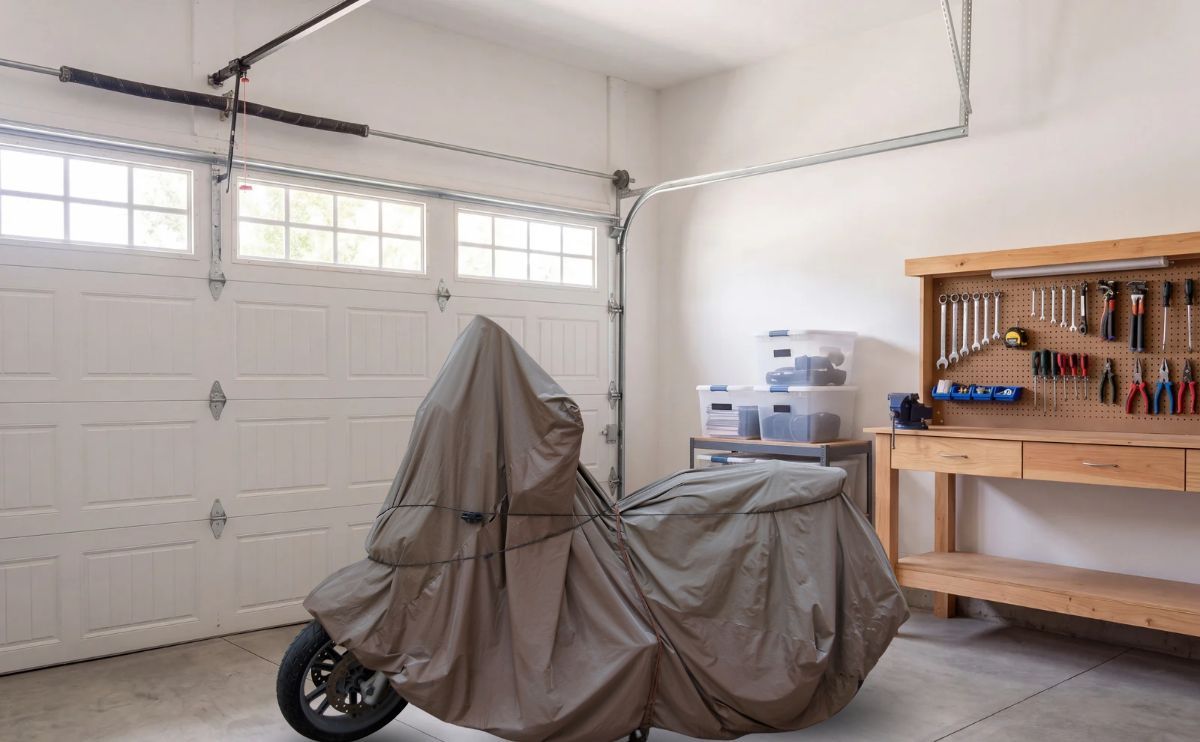
The cover. Use one that is the right size and breathable. MCN adds not to hide the battery charger under it. Start Rescue recommends a breathable, ventilated, water-resistant cover that fits snugly, put on a dry bike. It warns that, outside, a cover can act as a sponge, but that it can also deter theft.
Mice. MCN warns that mice nest in the airbox: use a mousetrap or block the gaps. Honda UK suggests plugging the exhaust with rags and using mothballs.
The lock. MCN recommends a ground anchor with a heavy chain and lock, or an extra lock on the garage door. Start Rescue lists a high-quality lock, a well-lit spot, a lock that is off the ground, the ignition and steering locks, a cable to something fixed, and two different types of lock.
10. Insurance #
None of the UK guides we read covers insurance, so check your policy before you put the bike away: confirm what is covered while it is stored, especially against theft, and whether storage conditions are required.
11. Keep an eye on it over the winter #
Even in storage, a motorcycle is not checked every day, and a lock can be defeated. A battery-powered GPS tracker lets you keep watch without being wired into the bike’s electrics.
The GPS Tracker Classic (€99 for 1 year, €129 for 3 years) weighs 27 g, is dust- and water-resistant (IP67), flags movement and tilt and offers 3 to 6 months of battery life. The GPS Tracker Pro Max (€179, 1 year included) offers up to 6 months; its Absence mode wakes it when the bike moves. To work out which one suits your bike, you can compare GPS trackers for motorcycles before you choose.
12. Getting the bike back on the road in spring #
Honda UK keeps the spring checklist short and sensible: check the fluid levels, remove the rags from the exhaust, and set the tyre pressure back to normal. Start Rescue adds to unblock the exhausts first, and to remove the rags before you start the engine. Check the battery is charged, take the cover off and make sure no mouse has moved in.
FAQ: motorcycle winter storage #
Should I fill the tank before storing a motorcycle? #
Mostly yes. Visordown says to top it up so there is nowhere for rust to start, and Honda UK warns that metal tanks should never be stored empty, with a fuel stabiliser. MCN takes another view: use ethanol-free or stable fuel. Follow your handbook.
Should I change the oil before winter storage? #
Honda UK says it is a must; Visordown says it is optional unless the oil is very old.
Do I need to drain the coolant? #
Not necessarily. Visordown and Honda UK advise checking the antifreeze, while Start Rescue says to remove the coolant before storage. Your handbook has the answer for your bike.
How should I protect the battery over winter? #
Connect a battery conditioner or trickle charger (MCN, Start Rescue). Lithium batteries need a lithium charger (Visordown).
What tyre pressure should I use for storage? #
The guides disagree: MCN goes up 20 psi over the stock figure, others say slightly more. Check your handbook and set the pressure back to normal in spring.
How do I stop mice getting into my motorcycle? #
MCN suggests a mousetrap or blocking the gaps, because mice nest in the airbox. Honda UK recommends plugging the exhaust with rags and using mothballs.
Which lock should I use for a stored motorcycle? #
MCN recommends a ground anchor with a heavy chain and lock. Start Rescue suggests two different types of lock, a lock off the ground and a well-lit spot.
How can I keep an eye on a motorcycle in storage? #
With a battery-powered GPS tracker. The GPS Tracker Classic flags movement and tilt; the GPS Tracker Pro Max has an Absence mode that wakes it on movement.
How do I get a motorcycle ready after winter storage? #
Check the fluid levels, remove the rags from the exhaust and set the tyre pressure back to normal (Honda UK). Check the battery and make sure nothing is nesting in the airbox.