

In 2024, a vehicle was stolen every five minutes in the UK according to Thatcham Research and the National Vehicle Crime Intelligence Service — and the pattern is similar across continental Europe. Thieves are increasingly well-equipped: keyless entry relay attacks, signal jammers, flatbed tow truck theft — mechanical anti-theft devices alone are no longer enough. That’s why more and more drivers are turning to a GPS car anti-theft device: a discreet tracker that locates the vehicle in real time, alerts you at the first sign of suspicious movement, and significantly increases the chances of recovery if the worst happens.
Unlike a visible deterrent, a GPS tracker works over time. It doesn’t just slow a thief down — it lets you follow the car after it’s been taken, identify a suspicious parking location, and pass a useful position on to the police. For cars parked on the street, vehicles left in car parks for days at a time, high-demand models, or cars used only occasionally, it has become an essential layer of protection.
Why mechanical anti-theft devices are no longer enough #
Steering wheel locks, wheel clamps, factory alarms — these devices still have a role to play in deterring opportunistic thieves. They make theft more difficult, slower and more visible. A good mechanical device can make a real difference, especially when it’s certified and correctly used.
But they have a fundamental limitation: they slow theft down, without ever preventing it entirely. A determined thief equipped with a relay attack device, a signal jammer or a flatbed tow truck can take a car in under two minutes. In some cases, the vehicle is loaded directly onto a truck without the lock ever needing to be neutralised.
Once the car is gone, the mechanical anti-theft device is useless. That’s precisely where a GPS car anti-theft device comes in — it takes over at the moment when every other device has already failed, letting you know exactly where your vehicle is. For a full breakdown of the strengths and weaknesses of classic anti-theft devices, read our complete guide: car anti-theft devices.
What is a GPS car anti-theft device? #
A GPS car anti-theft device is a small, self-contained unit, discreetly fixed inside the vehicle, that combines several layers of protection:
- real-time location of the car via a mobile app;
- movement alerts sent to your smartphone the moment an unauthorised movement is detected;
- journey history to reconstruct the vehicle’s route;
- post-theft tracking to pass a usable position on to the police.
Unlike a physical lock, the tracker is invisible. That’s precisely what makes it so effective: the thief doesn’t know they’re being followed. They may think they’ve neutralised the car’s main protection — while the vehicle continues transmitting its location.
A GPS car anti-theft device typically works with a mobile app. From your smartphone, you can check where your car is, receive notifications about suspicious movement, and review recent journeys. Some models also let you set up safety zones — around your home, your garage, or your workplace.
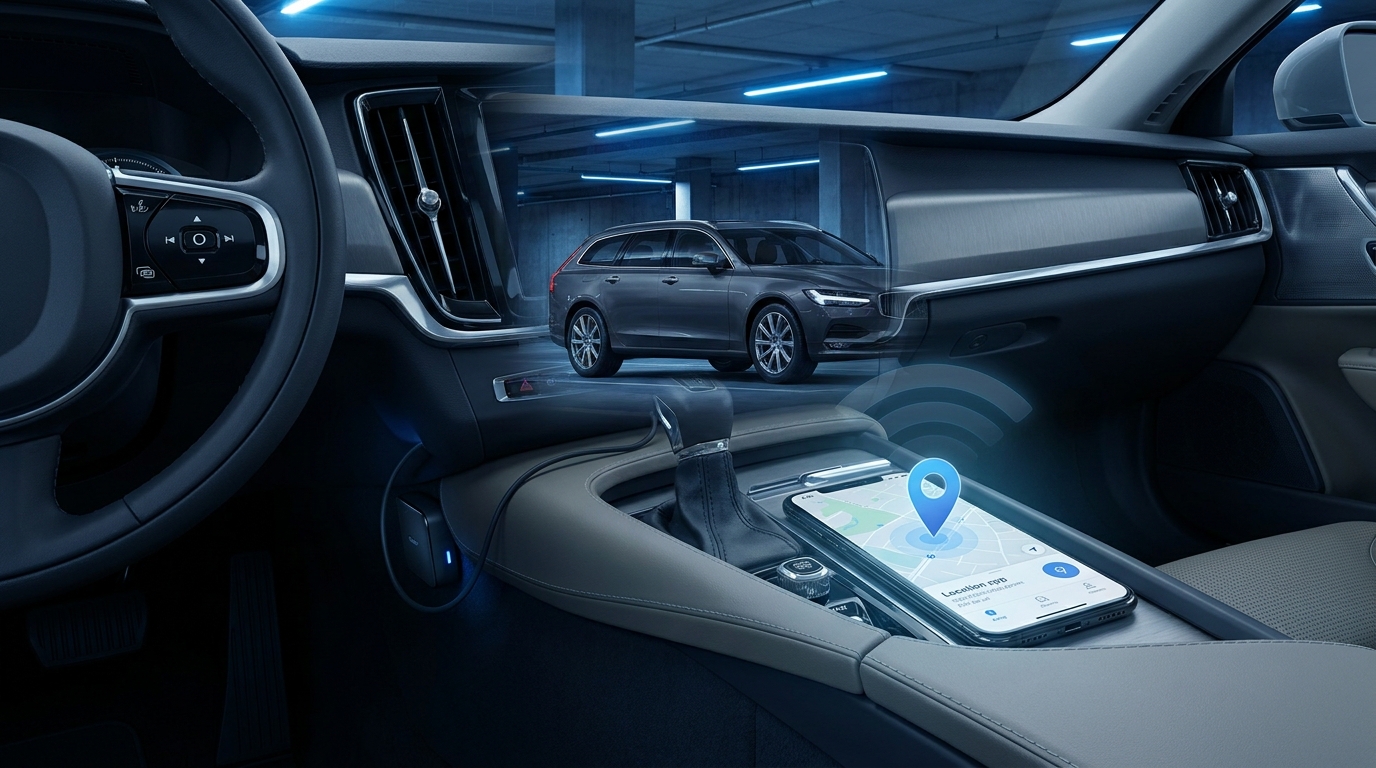
GPS car anti-theft: how it works against theft #
Immediate detection #
The moment the car moves without authorisation, the motion sensor triggers an alert. You’re notified quickly — whereas a classic theft often goes unnoticed for hours, especially at night, over a weekend, or when a vehicle is left in a shared car park.
This alert is one of the key advantages of a GPS tracker over a traditional device. It lets you act within the first few minutes: check the position, confirm an unusual movement, contact the police, and avoid discovering the theft hours or days too late.
Continuous tracking #
The tracker combines multiple location technologies to regularly transmit the vehicle’s position. Depending on conditions, it can use GPS, low-power networks or other location methods to keep following the car.
Even if the car has been moved and hidden in a lock-up, a garage, a private yard or a lorry, it can continue to transmit. This is particularly useful when thieves leave the vehicle somewhere for a few hours or days to check whether it’s fitted with a tracking system.
Easier recovery #
In the event of theft, the recorded position lets you act quickly and give the police something concrete to work with. An approximate address, a suspicious parking area, or a journey history can all help point the investigation in the right direction.
Several thefts have been resolved thanks to a simple tracker, as recounted in our case study on a theft ring dismantled using an Invoxia GPS tracker.
💡 A vehicle fitted with a GPS tracker is far more likely to be recovered than one without — often within hours rather than never.
Why combine a mechanical lock with a GPS tracker #
The best protection never relies on a single device, but on complementary layers:
- The mechanical device — steering wheel lock, wheel clamp — deters and slows the thief.
- The alarm attracts attention and complicates the attack.
- The GPS car anti-theft device takes over once the vehicle has been moved and helps you find it.
The GPS tracker is not a substitute — it’s the link that makes the whole chain truly effective. It’s this combination that maximises your chances of never losing your car.
The ideal approach protects a car across three objectives: prevent, alert, recover. The lock prevents or slows. The alarm attracts attention. The GPS tracker recovers. This layered approach makes protection more robust against all the methods thieves use today.
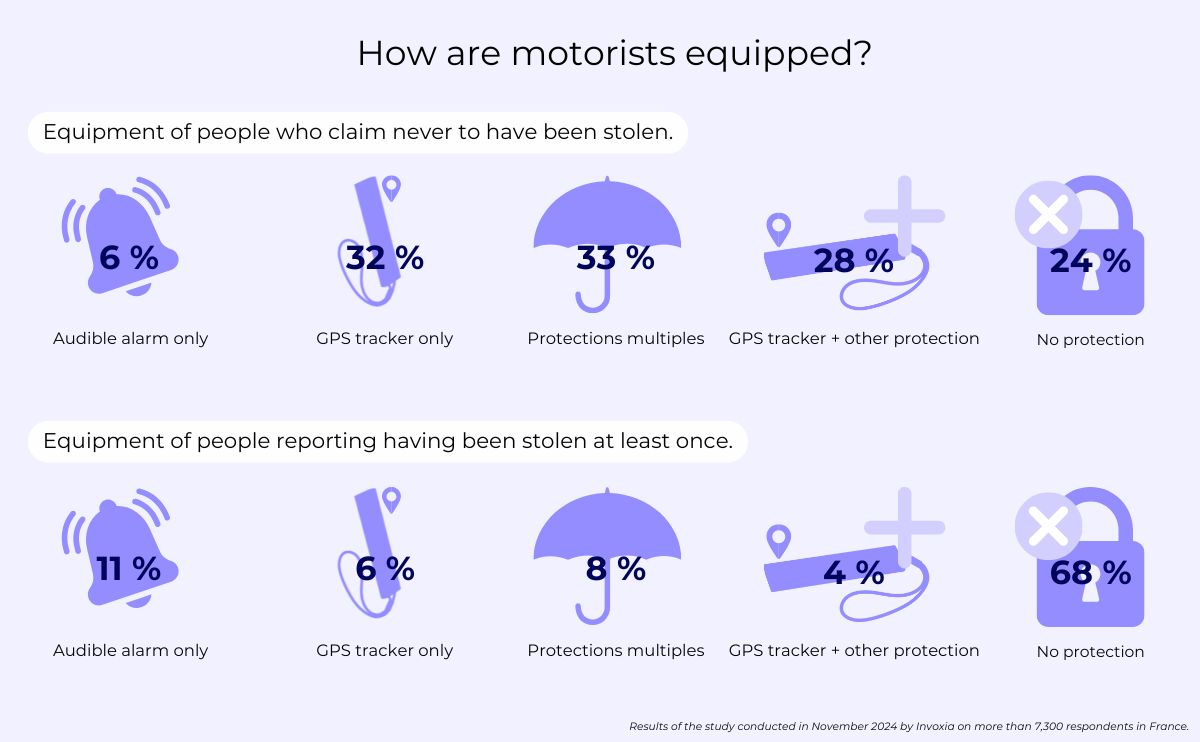
The everyday benefits of a GPS car anti-theft device #
A GPS car anti-theft device isn’t only useful in the event of theft. It also provides peace of mind on a daily basis, particularly when the vehicle is parked in the same spot for an extended period.
Remote monitoring #
You can keep an eye on your car even when you’re not nearby. That’s particularly useful if you leave it on the street, in an underground car park, outside a train station, at a second home, or with a garage.
For drivers who don’t use their car every day, this remote visibility is especially reassuring. You don’t need to physically check that the car is still there — the app lets you check its position at any time.
Alerts for suspicious movement #
A simple displacement, a towing attempt or an unusual interaction can trigger a notification. You don’t need to constantly check on your car — the tracker does it for you.
This matters because car theft can be very fast. The earlier the alert arrives, the better your chances of reacting effectively. Even if you can’t intervene yourself, you can immediately check the position, follow the movement and pass useful information to the police.
A discreet solution #
A good GPS car anti-theft device needs to be easy to hide. The more discreet it is, the harder it is to spot and neutralise. Unlike a visible alarm or a mechanical lock, it gives no indication of its presence.
This discretion is one of the great strengths of a GPS tracker. If a thief doesn’t know the car is equipped, they won’t necessarily look for the device. The tracker can then keep transmitting information during and after the theft.
Invaluable for vehicles used infrequently #
Some cars don’t go out every day: weekend vehicles, classic cars, a second family car, a vehicle left in the city for several days or laid up over winter. In these situations, the owner may take a while to notice a theft. The tracker reduces that delay.
For a car that stands still for days or weeks at a time, battery life becomes a key criterion. A model designed to last for a long time without recharging is better suited than one that needs constant attention.
Where to place a GPS anti-theft device in your car #
To remain effective, the tracker must be hidden and hard to spot, while still maintaining a good signal. The most common locations are:
- under a seat;
- in the glove compartment or a storage pocket;
- in the boot, under the carpet or near the spare wheel well;
- behind an interior trim panel;
- in the centre console;
- in an area that requires partial disassembly to access.
The right spot depends on the car model, available space and the type of tracker. The goal is to find a balance between concealment, signal reception and accessibility for recharging if the tracker runs on battery.
Avoid surrounding it entirely with metal, which risks creating a Faraday cage and degrading location accuracy. An overly enclosed, low or isolated position can reduce signal quality and delay position updates.
For more detail on placement, read our dedicated guide: where to place your GPS tracker.
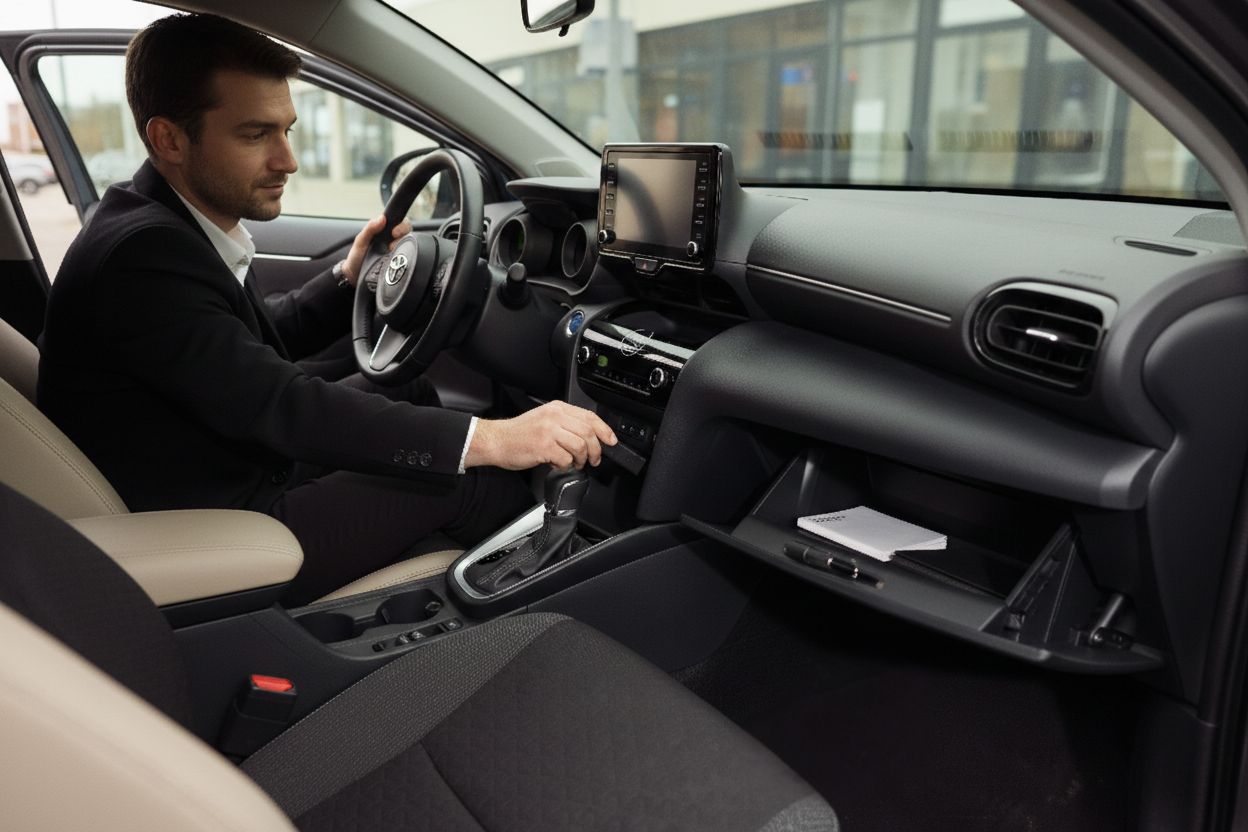
Common mistakes to avoid with a GPS car anti-theft device #
Fitting a tracker is a smart decision — but it needs to be used properly. Some mistakes can reduce its effectiveness.
Placing it somewhere too obvious #
The glove compartment is convenient, but it’s also one of the first places a thief might check. If you choose that location, make sure the tracker isn’t visible at first glance.
The ideal spot is discreet but not completely cut off from the signal. A good location is one you can find easily but that a thief won’t notice straight away.
Pressing it against a large metal surface #
Metal can disrupt GPS reception and limit signal transmission. Avoid areas that are entirely enclosed in metal or under a reinforcing plate.
If in doubt, test a few positions before fixing the tracker permanently. Place it, close up the interior, then check in the app that the position is coming through correctly.
Forgetting to check the battery #
A GPS car anti-theft device needs to stay operational precisely when you need it most. Choose a model with good battery life and make a habit of checking the battery level in the app.
Battery life matters even more if your car often sits unused. A tracker that lasts several weeks or months reduces the risk of discovering too late that it’s run flat.
Not activating notifications #
A tracker with notifications turned off loses much of its value. Make sure movement alerts, push notifications and app permissions are all properly configured on your phone.
Also check that your smartphone isn’t blocking the app from sending background notifications — battery-saving settings can sometimes delay or suppress alerts.
Attempting to recover the car yourself #
Even if you know where your car is, never go alone. In the event of theft, pass the information to the police and let them handle the response.
A GPS position can make recovery seem straightforward, especially if the car appears to be nearby. But the situation can be dangerous — the vehicle may be under surveillance, hidden on private property, or linked to an organised network.
How to choose your GPS car anti-theft device #
Before buying, check the following criteria:
- battery life: look for a wire-free model that lasts several weeks to several months;
- discretion: a compact form factor is easier to conceal;
- alert reliability: motion detection must be fast and accurate;
- app quality: clear map, journey history, reliable notifications;
- total cost: factor in any subscription and the product’s lifespan;
- network coverage: verify the tracker works well in your country and areas of use;
- ease of installation: a self-contained model avoids touching the vehicle’s wiring;
- durability: the car is exposed to temperature variations and sometimes moisture — the unit needs to be up to real-world conditions.
A good GPS car anti-theft device must above all be reliable at the critical moment. It’s not enough to locate the vehicle accurately under ideal conditions — it must remain useful when the car is moved quickly, parked in a less well-covered area, or hidden somewhere unusual.
If you’re weighing up several models, our comparison of the best GPS car trackers covers the main options on the market.
GPS car anti-theft with or without a subscription: which is better? #
Most GPS car trackers use mobile or low-power connectivity to transmit their location. That connectivity has a cost, usually built into a subscription.
A tracker with a subscription may seem less attractive upfront, but it generally delivers a more complete service: app, notifications, connectivity, updates and remote tracking. For anti-theft use, it’s often the most reliable choice — the tracker needs to be able to transmit its position even when the car is far from home.
Subscription-free solutions, on the other hand, sometimes rely on community networks or proximity to other devices. They can be useful for finding a lost item, but they’re less suited to actively protecting a vehicle against theft.
For a car, the real question isn’t just the subscription price — it’s the level of service delivered: position frequency, alert reliability, app quality, network coverage and unit battery life.
AirTag, alarm or GPS tracker: what’s the difference? #
Many drivers wonder whether they can replace a GPS car tracker with an AirTag or another Bluetooth accessory. The answer depends on what you need.
An AirTag can help locate an object nearby or in an area with a high density of Apple devices. But it isn’t designed as a car anti-theft device. It doesn’t transmit a position autonomously and on a continuous basis, and it can alert a person being tracked to its presence.
A car alarm, meanwhile, is useful for making noise and attracting attention. But if nobody reacts, or if the vehicle is quickly loaded onto a flatbed, the alarm gives no indication of where it’s gone.
A dedicated GPS tracker is different: it’s designed for remote location, movement alerts and post-theft tracking. For a genuine anti-theft strategy, the ideal approach remains combining several solutions rather than relying on any single device.
Can a GPS car anti-theft device help with insurance? #
A GPS car tracker doesn’t replace theft insurance, but it can play an important role in the event of a claim. First, it lets you respond faster, which increases the chances of recovering the vehicle. Second, it provides concrete evidence: last known position, journey history, time of the suspicious movement.
Depending on the policy, insurers — particularly for high-value vehicles — may require specific security devices: certified locks, glass etching, secure parking, or particular protection conditions. In the UK, Thatcham-rated devices are recognised by most major insurers. Before buying a tracker, it’s worth re-reading your policy and checking your insurer’s requirements.
Even when a tracker isn’t explicitly required by your insurer, it remains a valuable addition. Recovering your car quickly can avoid lengthy admin, extended immobilisation and significant financial loss — especially if the vehicle is found damaged only after a long delay.
Which cars benefit most from a GPS anti-theft device? #
A GPS car anti-theft device is useful for almost any vehicle, but it becomes particularly important in certain situations:
- cars parked on the street;
- vehicles used in urban areas;
- cars left in shared car parks;
- high-end, recent or electric models;
- vehicles used only at weekends;
- cars left unattended for several days;
- vehicles parked near stations, offices or second homes;
- classic cars or models that would be hard to replace.
The longer a car sits without supervision, the more valuable the GPS tracker becomes. It keeps you connected to the vehicle even when you’re not there.
It’s also particularly recommended for cars that attract thieves: recent models, vehicles that are easy to sell for parts, or models that frequently feature on most stolen car lists. In those cases, a mechanical device alone is rarely enough.
What to do if your car is stolen #
A GPS anti-theft device delivers its full value when you react quickly and methodically. If your car disappears:
- check the last position and recent movements in the app;
- verify whether the car is still moving or appears stationary;
- take screenshots of the position and journey history;
- never attempt to recover the car yourself;
- report the theft to the police, providing the registration, colour, photos, V5C and the position recorded by the tracker;
- if you have an Invoxia GPS tracker, generate your Theft File;
- contact your insurer within the timeframe specified in your policy.
The priority is to act fast — but without taking risks. A GPS position can be very useful, but it needs to be acted on by the authorities. Even if the car appears to be close by, going there alone is strongly inadvisable. For a more detailed step-by-step guide, read our article on what to do if your vehicle is stolen.
FAQ: GPS car anti-theft #
Is a GPS car anti-theft device really effective against theft? #
Yes. Unlike a mechanical device, it acts after the theft by locating the car, tracking its movements and sending real-time alerts. For optimal protection, it works best alongside a classic mechanical device.
Where should I hide a GPS tracker in my car? #
Under a seat, in the centre console, in the boot or behind a trim panel. The key is that it remains invisible while maintaining good signal reception. Avoid areas entirely enclosed in metal, which can reduce location quality.
Do I need a subscription for a GPS car anti-theft device? #
Most trackers use a mobile or low-power network to transmit their location, which involves a subscription covering connectivity, the app and real-time alerts. For anti-theft use, this connectivity is essential to follow the car even when it’s no longer nearby.
Can an AirTag replace a GPS car anti-theft device? #
No. An AirTag relies on the proximity of Apple devices to relay its position and is not designed as a vehicle anti-theft system. A dedicated GPS tracker is more reliable — it sends independent alerts and transmits its location remotely.
Can I install a GPS car anti-theft device myself? #
Yes, if the tracker is self-contained and wire-free. Simply place it in a discreet spot, pair it with the app and check that the location is transmitting correctly. For hardwired models, professional installation may be preferable.
Does a GPS car tracker work in an underground car park? #
Signal quality may be reduced in some underground car parks, closed garages or metal-heavy environments. A good tracker can, however, continue to transmit information as soon as it finds network coverage again, or when the car moves to a better-covered area.
What’s the difference between a car alarm and a GPS tracker? #
An alarm makes noise to deter the thief in the act. A GPS tracker lets you locate the car after it’s been taken. The two solutions are complementary: the alarm attracts attention, the tracker helps recover the vehicle.
Does a GPS car anti-theft device drain the vehicle’s battery? #
A self-contained tracker runs on its own battery and draws nothing from the car’s. That makes it a practical solution for vehicles that don’t move much or sit parked for long periods. You simply need to monitor the tracker’s battery level in the app.
What is the best GPS anti-theft device for a car? #
The best GPS car anti-theft device is the one that combines good battery life, a discreet form factor, reliable alerts, a simple app and connectivity suited to your area. For a car, discretion and the speed of alerts are particularly important.
Is a GPS tracker useful against keyless relay attacks? #
Yes. A relay attack exploits keyless entry technology to clone the key signal and unlock the car — often in seconds, without any physical force. The GPS tracker doesn’t prevent the attack, but it takes over once the car is moving: it detects movement, sends an alert and lets you track the vehicle — where the factory immobiliser has already failed. Models such as BMW, Ford and Range Rover are frequently targeted in the UK; fitting a tracker alongside a signal-blocking key pouch is the recommended combination.
Is a GPS car anti-theft device useful if the car is in a garage? #
Yes. Even in a garage, a car can be moved, loaded onto a flatbed or taken out without you noticing immediately. The tracker alerts you to any movement and maintains a usable position if the vehicle disappears.