

You check your tracking app… and the position has disappeared. No movement, no alert, just no signal.
In some cases, it’s neither a failure nor a network problem. It’s the effect of a GPS jammer.
These devices, also known as GPS jammers, exploit a well-known weakness of satellite geolocation systems: the fragility of the signal. Increasingly used in theft or tracking circumvention contexts, they highlight a major limitation of traditional trackers.
Does this mean that GPS has become useless? No. But it can no longer, by itself, guarantee reliable tracking.
What is a GPS jammer? #
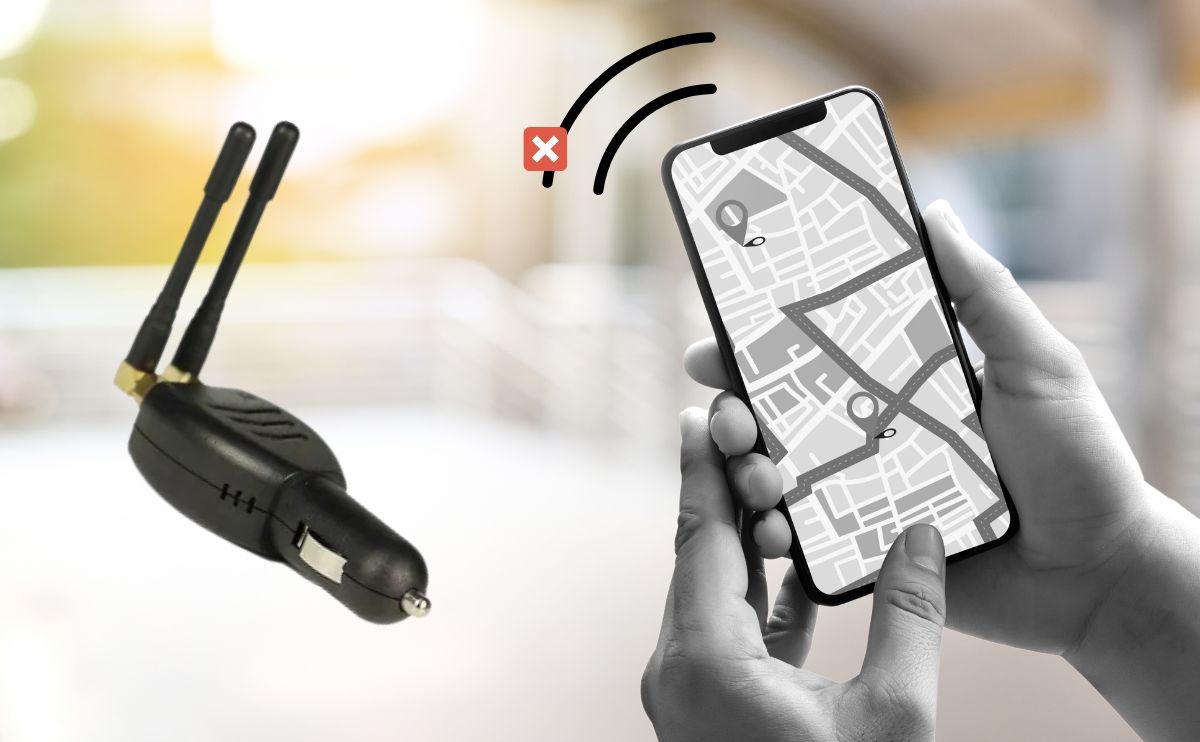
A GPS jammer is a device that emits a radio signal on the same frequencies as navigation satellites (notably the L1 band at 1.575 GHz), preventing receivers from capturing the signals necessary for position calculation.
This phenomenon is called GNSS (Global Navigation Satellite System) jamming and affects all satellite navigation systems (GPS, Galileo, Glonass).
According to the National Frequency Agency (ANFR), this type of interference can disrupt any equipment relying on geolocation, including in critical contexts such as aviation or transportation.
Why GPS is structurally vulnerable #
GPS is based on a simple principle: capturing signals from several satellites located about 12,427 miles from Earth.
The problem is that these signals arrive on the ground with extremely low power. They are therefore particularly sensitive to local interference.
A jammer, even a low-powered one, can:
- saturate the GPS frequency
- prevent satellite reception
- cause an immediate loss of position
Can a GPS tracker really be neutralized? #
Yes, in many cases. A GPS jammer can suffice to:
- block real-time location
- prevent tracking of an object or vehicle
- render a tracker inoperative if it relies solely on GPS
But it’s important to specify an essential limitation. Indeed, a GPS jammer does not necessarily block:
- radio communications (cellular or low consumption)
- onboard sensors
- already recorded data
In other words, it all depends on the architecture of the GPS tracker.
A very real threat in the field #
GPS jamming is not a theoretical case. It is regularly observed in cases of vehicle theft, logistics fraud, or circumvention of geolocation systems.
The ANFR reports several cases in France where jammers used in vehicles have disrupted navigation systems, including near airports.
These devices have another peculiarity: they do not target a device, but an entire area.
This makes them:
- difficult to detect
- impossible to contain precisely
- potentially dangerous for other systems
Why traditional GPS trackers reach their limits #
Not all trackers are equal in the face of jamming.
A traditional GPS tracker relies mainly on:
- satellite reception
- position transmission
In case of GPS signal loss, it can no longer locate, communicate a reliable position. In short, it becomes partially or totally unusable!
This unique dependence is today its main weakness.
GPS anti-jamming: what really works #
Faced with these limitations, the most advanced tracking systems adopt a different approach.
Multiplying location sources #
Modern solutions combine several technologies:
- GPS
- long-range radio networks
- Wi-Fi or Bluetooth
- motion sensors
This redundancy allows maintaining service even in case of signal disruption.
Detecting signal anomalies #
Some systems are capable of identifying:
- a sudden loss of GPS signal
- abnormal radio interference
This allows triggering alerts and signaling suspicious behavior.
Maintaining service continuity #
Even without GPS position, a robust system can:
- continue to transmit data
- exploit the last known position
- provide movement or activity indicators
A different approach: designing tracking beyond GPS #
This is precisely where some recent technologies stand out. Rather than relying solely on GPS, they rely on:
- low-consumption radio networks independent of satellites
- embedded intelligence capable of analyzing the context
- sensors allowing continued collection of useful data
This approach allows maintaining visibility, even in degraded situations.
What this changes concretely #
| Criterion | Traditional GPS Tracker | Multi-technology Approach (e.g., Invoxia) |
|---|---|---|
| GPS Dependence | Total | Partial |
| Jamming Resistance | Low | High |
| Communication without GPS | No | Yes |
| Anomaly Detection | Limited | Advanced |
| Service Continuity | Low | High |
In a real context (loss, theft, jamming), this difference becomes decisive.

GPS Jammer vs GPS Tracker: the real issue, resilience #
The GPS jammer highlights a major evolution in tracking. The question is no longer just whether a signal can be disrupted. It is whether the system as a whole can continue to function despite this disruption.
The most efficient systems today no longer rely on a single technology but on a combination of signals, data, and intelligence.
FAQ on GPS jammers #
What is a GPS jammer? #
A GPS jammer (or GPS jammer) is a device that disrupts geolocation satellite signals by emitting radio interference on the same frequencies. This prevents GPS receivers from determining their position.
Is a GPS jammer legal? #
No. In most European countries and in the United States, the use, possession, or sale of GPS jammers is strictly prohibited.
These devices can interfere with critical systems such as aviation, emergency services, and communication networks, which is why they are heavily regulated.
Can a GPS jammer block a tracker? #
Yes, a GPS jammer can prevent a tracker from capturing satellites and thus calculating its position. However, it does not necessarily block other technologies used by some trackers (radio networks, sensors, etc.).
What is the range of a GPS jammer? #
The range depends on the power of the device:
- a few feet for basic models
- up to several hundred feet for the most powerful
All GPS devices in the area can be affected.
How to detect GPS jamming? #
GPS jamming can be suspected in case of:
- sudden loss of location
- unstable or absent GPS signal
- repeated interruptions without apparent reason
Some advanced trackers are capable of detecting these anomalies automatically.
How to protect against a GPS jammer? #
The best protection relies on using a multi-technology tracking system, combining:
- GPS
- independent radio networks
- onboard sensors
This allows continuing to function even in case of jamming.
Are all GPS trackers vulnerable? #
No. Trackers relying solely on GPS are the most vulnerable. Systems integrating multiple technologies are much more resistant to interference.
Does a GPS jammer also block smartphones? #
Yes. A GPS jammer disrupts all GPS receivers in its area, including those of smartphones, vehicles, or connected objects.
Can an object be tracked without GPS? #
Yes, with some modern systems. Alternative technologies (radio networks, Wi-Fi, motion sensors) allow maintaining partial tracking even without a GPS signal.
What is the difference between GPS jamming and spoofing? #
- Jamming: blocks the GPS signal
- Spoofing: sends false position information
Both are known threats to satellite navigation systems.
The GPS jammer is not an exception, but a real constraint in the field.
It mainly reveals a fundamental limitation: a system relying solely on GPS is vulnerable by design.
Conversely, solutions that combine multiple technologies and integrate embedded intelligence today offer better resilience against disruptions.
This evolution is redefining the standards of modern tracking.