

It’s been raining for three days, the evening walk has shrunk to a quick loop around the block, and your dog is pacing around the living room. How can you keep him busy without going out? Which games really tire him out?
A dog needs to burn off energy, but he also needs to think: search, sniff, solve a little problem. Nose work and brain games keep him busy, tire him out and help him stay calm, especially when walks get shorter. Most of them can be done with things you already have at home.
Why your dog needs mental stimulation #
Contrary to what many people think, a walk isn’t always enough. A bored dog looks for his own ways to stay busy, and not always the way you’d like. The RSPCA Victoria lists several signs of boredom: excessive barking, digging, chewing everything in sight, and even destructive behavior. It also points out that mental stimulation matters as much as physical exercise, and that a play session can tire a dog out faster than a 30-minute walk.
Sniffing, in particular, has a special place. In a study on nose work in dogs, researchers compared two groups of family dogs over two weeks: one did nose work exercises every day, the other did heelwork. Only the dogs in the nose work group became more “optimistic” when faced with an ambiguous situation. Letting your dog use his nose is also a matter of well-being.
Nose work games: the easiest way to start #
Smell is your dog’s main sense. These games are easy to set up and suit almost every dog, from puppies to seniors.
1. The snuffle mat #
Scatter part of his daily kibble in a snuffle mat and let your dog find it. The American Kennel Club recommends it to turn a meal into a treasure hunt. If you don’t have one, a bath towel works too: sprinkle some kibble on it, roll it up loosely, and let your dog unroll it. If you’d like to give him one, a snuffle mat is one of the gifts that keeps a dog busy the longest.
2. The treat hunt #
Show your dog a treat, ask him to stay, then hide it in the room. At first, hide it in plain sight, then behind a chair leg, under a cushion, in another room. You can help him with a game of “hot and cold”: a calm voice when he moves away, a more excited one when he gets closer.
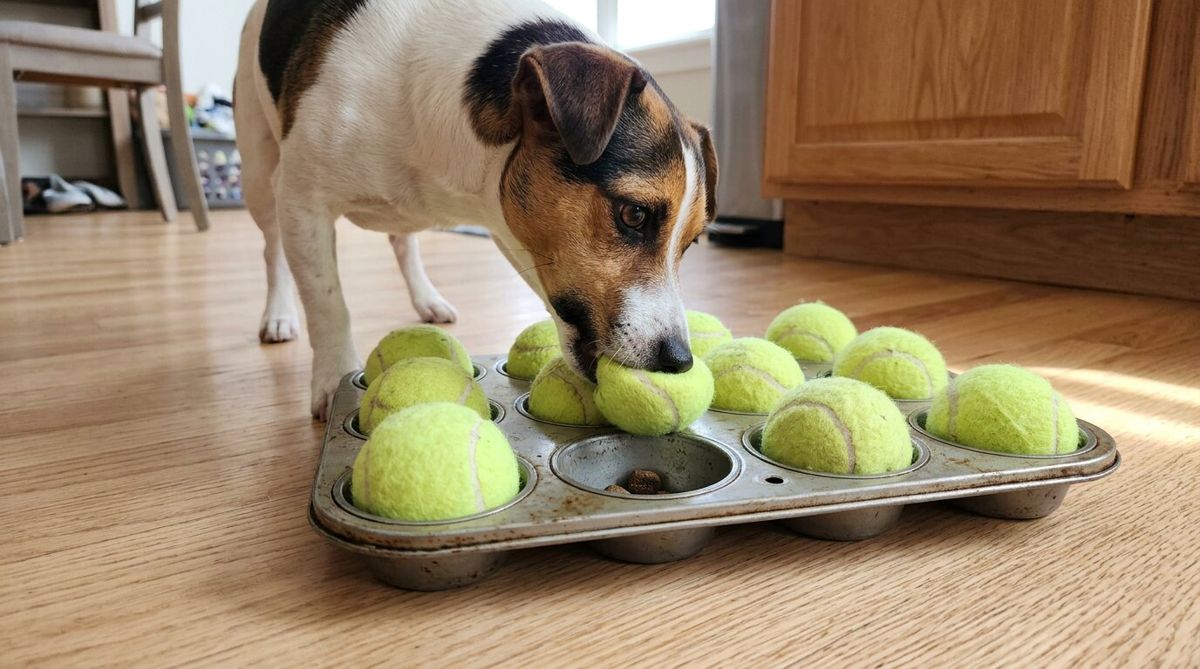
3. The muffin tin game #
Put a treat in a few cups of a muffin tin, then cover all the cups with tennis balls. Your dog has to figure out which ones hide a reward and remove the balls to get it.
4. The three-cup game #
Hide a treat under one of three upside-down cups, in front of your dog. Let him find the right one. Once he gets it, shuffle the cups before letting him search: he’ll have to trust his nose rather than his eyes.
Brain games: thinking to earn a reward #
These games ask your dog to solve a little problem. Always start with a very easy version, so he succeeds quickly and stays motivated.
5. The upside-down basket #
Put a treat or his favorite toy under an upside-down laundry basket. Your dog has to figure out how to lift or push it to reach the reward.
6. Nesting bowls #
Put a treat in a plastic bowl, place a second bowl on top with another treat, then a third. Your dog has to remove them one by one. Stay with him during this game, as with any game involving objects he could chew.
7. Pull the string #
Tie a treat or a toy to a ribbon and slide it under a low piece of furniture, out of reach, leaving the ribbon sticking out. Your dog learns to pull on it to get his reward.
8. Food puzzles and stuffed toys #
A puzzle feeder or a hollow rubber toy stuffed with kibble or wet food turns a meal into an activity. Freeze it to make the game last longer. Take the kibble from his daily ration so he doesn’t gain weight.
Games to play together #
Some games work your dog’s brain while strengthening your bond.
9. Hide-and-seek #
Ask your dog to sit and stay, hide in another room, then call him. Reward him when he finds you. Pick harder hiding spots over time. This game also reinforces his recall, which is useful on walks.
10. Learning a new trick #
Shake, spin, crawl under your legs, touch your hand with his nose: learning a trick is a great mental workout at any age. The AKC notes that problem-solving is useful for puppies and older dogs alike. A few repetitions, a reward for each success, and stop before he gets bored.
💡 Good to know
Walks can become a game too. Change your route, let your dog sniff at his own pace, or hide a treat in the grass: a new route full of smells stimulates him far more than the usual loop done at a brisk pace. To go further, discover dog sports you can practice together, such as tracking.
A few rules to keep games fun #
- Start easy: a dog who fails several times in a row gives up. Increase the difficulty little by little.
- Supervise him with objects he could chew or swallow: bottles, bowls, ribbons, balls.
- Stop before he gets bored, on a success.
- For tug-of-war, first teach him to let go on cue, and stop the game if he gets too excited or mouths you, as the RSPCA advises.
- Adapt the games to his age and health: a senior dog or a dog with arthritis will enjoy nose work games, which require little physical effort.
- Keep treats within his daily ration: use part of his kibble rather than extra treats.
Games and activity: finding the right balance #
Brain games don’t replace walks: they complement them. Your dog needs both to feel good, and the right balance depends on his age, breed and energy level. To adapt exercise to your dog through the seasons, start from his habits.
That’s exactly what the Biotracker helps you see. Attached to his collar, it measures his activity every day, compares it to his usual habits and tracks the quality of his sleep. A rainy week when he burned much less energy? You see it in the app, and you can make up for it with a few play sessions at home. With the Plus and Max GPS plans, the daily report sums up his day. And if your dog is moving much less than usual for no reason, games or not, it’s a change worth mentioning to your vet.
FAQ — brain games for dogs #
How can I keep my dog busy when I’m not home? #
A stuffed toy or a puzzle feeder can keep him busy for a while. Only leave him sturdy toys that he can’t swallow, and let him practice with them while you’re there first.
What brain games are good for puppies? #
Simple nose work games, like a kibble hunt or a rolled-up towel, and learning small tricks are great for puppies. Keep sessions short and very easy at first.
Do nose work games really tire a dog out? #
Yes, they require a lot of concentration. According to the RSPCA, a play session can tire a dog out faster than a 30-minute walk. They don’t replace walks, but they’re a great complement on days when he goes out less.
Can my senior dog still play brain games? #
Yes. Nose work and learning tricks suit dogs of all ages and require little physical effort. Just adjust the difficulty and avoid jumping if your dog has joint pain.
Do I need to buy puzzle toys? #
Not necessarily. A towel, a muffin tin, some cups or a laundry basket are enough for many games. Store-bought toys, like snuffle mats or puzzle feeders, simply add variety.
In summary #
Your dog needs to burn off energy, but he also needs to think. Nose work games (snuffle mat, treat hunt, muffin tin, cups), brain games (upside-down basket, nesting bowls, string) and games to play together (hide-and-seek, new tricks) keep him busy and tire him out, even without going out. Start easy, supervise him with objects he could chew, stop on a success, and keep treats within his daily ration. These games complement walks without replacing them.