

When we talk about hunting dogs, the same names always come up: Labrador, Pointer, Cocker, Setter. Yet, in a territory like Extremadura, on the plains of Castile, or in the scrubland of Ibiza, these are not the dogs that work. Spain retains one of the richest collections of indigenous hunting breeds in Europe, selected over centuries for a dry climate, difficult terrain, and hunting methods that exist nowhere else.
This guide reviews these hunting dog breeds one by one: origin, temperament, working terrain. And it ends where breed guides usually stop: these dogs are made to work out of your line of sight — and that’s exactly why they get lost more than others.
For an overview of international breeds, our top 10 best hunting dog breeds remains the best starting point.
What distinguishes a Spanish hunting dog breed? #
Three factors explain why the Spanish hunting dog does not resemble the continental pointing dog:
- The climate and terrain. Heat, dryness, stone, thorny scrubland. Hence, dry dogs with tough skin, resistant pads, capable of working long with very little water.
- The hunting methods. Stalking hares, flushing small game, rabbits in dense cover, boar drives with packs of hounds. So many practices where the dog decides alone on the essential part of its work.
- A functional, not aesthetic selection. Many of these breeds have been bred in the field for their performance, not for the show ring. This is one reason why several of them remain unknown outside Spain.
The Spanish hunting dog breeds are divided into three main working families:
| Family | Representative Breeds | Working Mode | Usual Distance from Hunter |
|---|---|---|---|
| Podencos | Ibizan Podenco, Andalusian, Canarian | Hunts autonomously combining sight, smell, and hearing: searches, flushes, and retrieves | 100 to 800 yards, often out of sight |
| Hounds | Spanish Hound, boar packs | Follows a cold trail for hours while giving voice | No real limit: several miles |
| Pointing Dogs | Burgos Pointer, Pachón Navarro | Locates game and holds point waiting for the hunter | 30 to 150 yards, frequent visual contact |
This difference in autonomy is crucial: not all breeds present the same risk of getting lost, as we will discuss further below.
Spanish hunting dog breeds, one by one #
1. The Ibizan Podenco (Balearic Dog) #
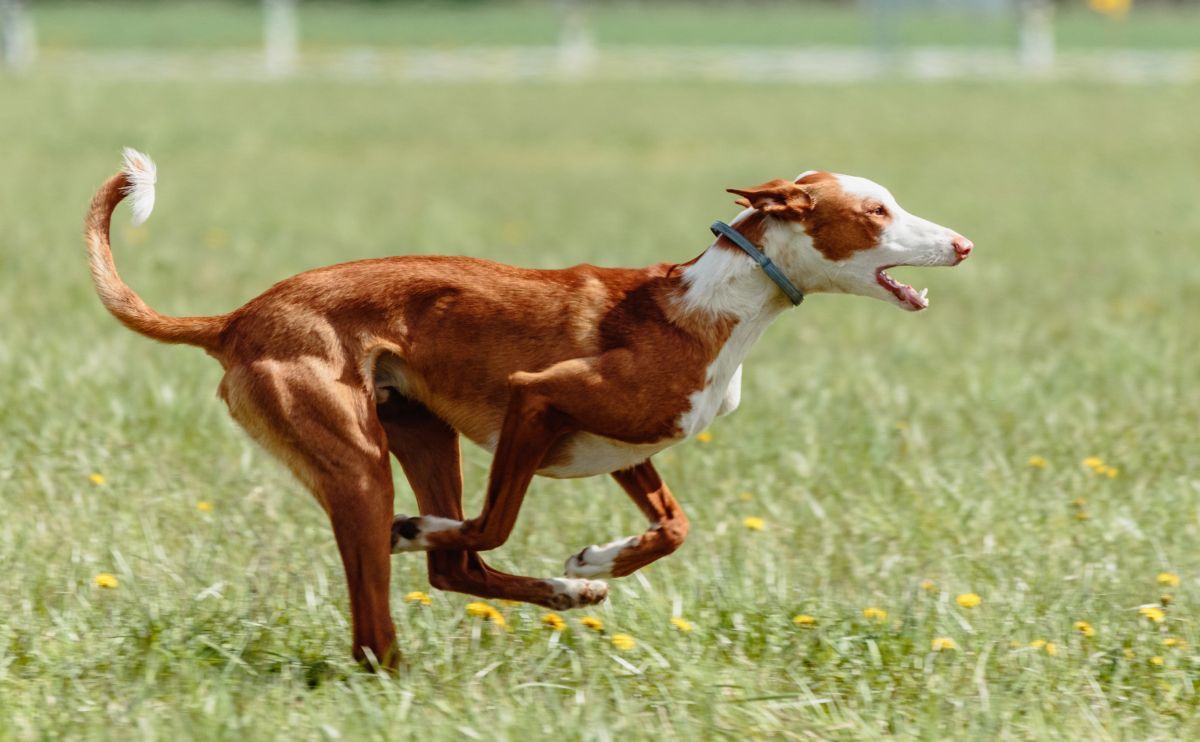
Lean silhouette, huge upright ears, amber gaze: the Ibizan Podenco is undoubtedly the most recognizable of the Spanish hunting dog breeds. Originating from the Balearic Islands, it hunts rabbits in almost total autonomy, combining sight, smell, and remarkable hearing. It holds the scrubland for hours, jumps over dry stone walls, and moves silently.
At home, it is surprisingly calm and affectionate, but it needs a lot of exercise and remains a hunter in all circumstances: a rabbit starting at 200 yards is enough to make it disappear from the horizon.
2. The Andalusian Podenco #
Less known than its Balearic cousin, the Andalusian Podenco comes in three sizes (large, medium, small) assigned to different game. The small size specializes in rabbits in thick cover; the large one also works boar. Rustic, tireless, and very attached to its human group, it is a discreet dog that has sustained small Andalusian hunting for generations.
3. The Canarian Podenco #
Considered one of the oldest dogs in the archipelago, the Canarian Podenco is a rabbit specialist in volcanic terrain: unstable stone, lava flows, impossible slopes. Extremely heat-resistant, it often works in a small pack of two or three dogs. Its temperament is nervous and very active — it is a dog not well-suited to a sedentary life.
4. The Spanish Greyhound #
The Spanish Greyhound is a sighthound: it hunts by sight, in pure chase, after hares. It reaches nearly 37 mph, meaning it can cover several hundred yards in seconds. It is the most numerous Spanish hunting breed and also the most exposed to abandonment at the end of the season — a problem that associations denounce every year.
Off the field, it is a surprisingly calm dog, almost phlegmatic, that enjoys a couch as much as a run. However, it needs a closed and safe place to relax: its pursuit instinct cannot be trained away, it must be managed.
5. The Burgos Pointer (Perdiguero de Burgos) #
The Burgos Pointer is the quintessential Spanish pointing dog and one of the oldest pointing breeds in Europe. Powerful head, long ears, steady gait: it works slowly, very close to the hunter, and offers firm and readable points on partridges and quail. It is also an excellent retriever.
Its steady pace and balanced character make it one of the easiest Spanish hunting dog breeds to handle for a novice hunter.
6. The Spanish Hound (Sabueso Español) #
With its legendary sense of smell and deep voice, the Sabueso Español is the national trailing dog. It follows cold trails for several hours on hare, boar, or roe deer, and is used both for blood tracking and in packs. Its work literally consists of moving away while giving voice until the hunter catches up.
It is a stubborn dog, calm at home, but whose nose commands: on a trail, a Sabueso no longer hears the recall.
7. The Andalusian Rat Terrier #
Small, white with a tan head, extremely lively: the Andalusian Rat Terrier was born in the cellars of Jerez to eliminate rats between barrels. Today it also serves for rabbits and as an auxiliary for small game hunting. It is a terrier in the purest sense: courageous, tireless, always ready to slip where it doesn’t fit.
8. The Pachón Navarro #
Recognizable by its characteristic split nose, the Pachón Navarro is a heavy and methodical pointing dog, almost extinct in the mid-20th century and saved by a handful of breeders. It works at short distances, with a very expressive point, and remains particularly appreciated in rugged terrain, where power counts more than speed.
Comparative table: which breed for which hunter? #
| Breed | Main Use | Terrain | Temperament | Risk of Straying |
|---|---|---|---|---|
| Ibizan Podenco | Rabbit, small game | Scrubland, stone walls | Sensitive, silent | High |
| Andalusian Podenco | Rabbit, boar (large size) | Dense cover | Rustic, attached | High |
| Canarian Podenco | Rabbit | Volcanic, high heat | Nervous, very active | High |
| Spanish Greyhound | Hare by sight | Plain, crops | Calm at home | Very high |
| Burgos Pointer | Partridge, quail | Cereals, hills | Balanced, close | Low |
| Sabueso Español | Trail, boar, blood | Mountain, woods | Stubborn, calm | Very high |
| Andalusian Rat Terrier | Vermin, rabbit | Cellar, bushes | Lively, courageous | Medium |
| Pachón Navarro | Pointing, small game | Rugged terrain | Calm, methodical | Low |
The blind spot of breed guides: the hunting dog gets lost #
Here’s what no list of hunting dog breeds tells you. All the qualities that make a good Spanish hunting dog are exactly those that make it difficult to locate:
- It works out of sight. A Podenco searching in the Mediterranean scrub disappears at 50 yards. It is not running away: it is doing its job.
- Speed works against you. A Greyhound at 37 mph covers 500 yards in 30 seconds. By the time you lower the gun and look up, it’s gone.
- On a trail, it no longer hears. A hound on a cold trail can follow it for hours and several miles. Whistle and voice cease to exist.
- The terrain doesn’t help. Unfenced territories, closed cover, ravines, irregular mobile cover. And outings take place at dawn or dusk, when there are few daylight hours left to search.
- The season concentrates the risk. From October to February, the dog spends many more hours off-leash and far away than the rest of the year.
The microchip, mandatory, solves none of this: it is an identity card, not a tracker. It only serves if someone finds the dog and takes it to a vet. We explain this in detail in our article microchip or GPS tracker.
How to locate a hunting dog in real-time #
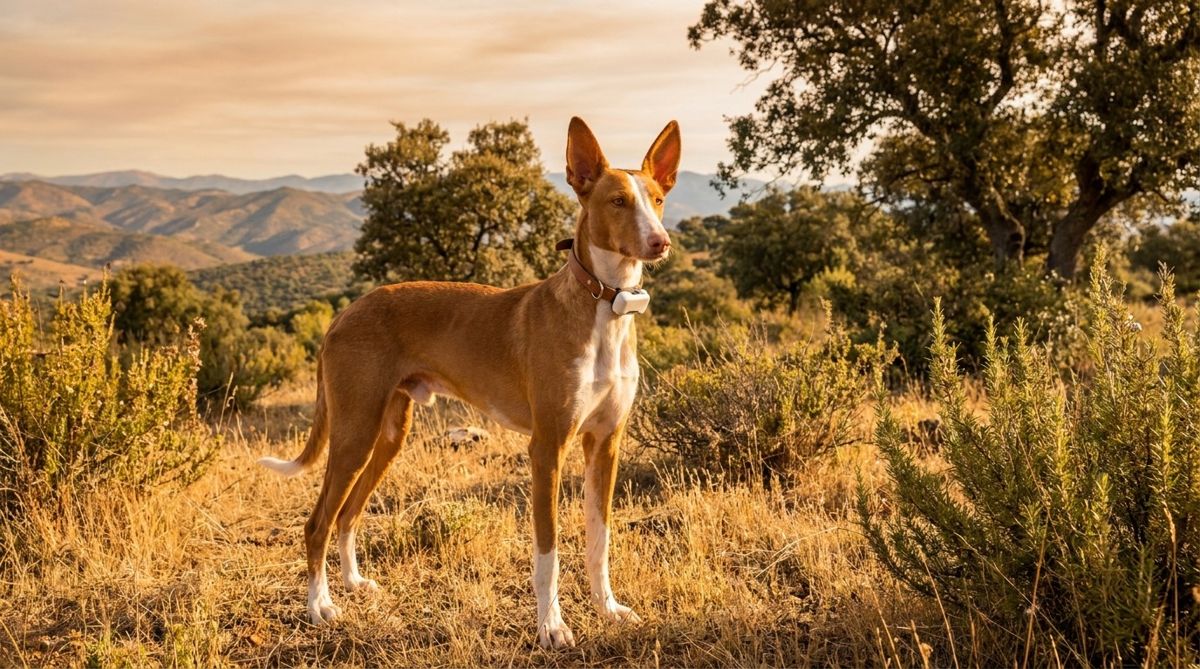
For a dog that works far and out of sight, the only realistic answer is a GPS tracker with no distance limit. Bluetooth tags (like connected keychains) depend on the presence of a nearby phone: in the field, there is no one nearby.
The Invoxia Biotracker is designed precisely for this scenario:
- 4G LTE-M network with included SIM card, coverage in over 35 countries: no distance limit, you don’t need to be near the dog.
- Live Tracking: during a critical outing, the position is updated every second — the mode that turns a search of several hours into a recovery of a few minutes.
- Safety zones (geofencing) to trace around the territory or property, with exit and entry alerts.
- 1.3 oz and IP67: attaches to any collar and withstands mud, water, and thorns.
- Up to 15 days of battery life, so you don’t depend on a recharge mid-season.
- Health monitoring: heart and respiratory rate, heart rate variability, activity, and sleep. On a dog working at the limit in 86°F, it’s an indicator that no classic collar provides.
Many owners discover its usefulness too late; others have told us how they found their dog thanks to the Biotracker.
Frequently Asked Questions about Spanish Hunting Dog Breeds #
What is the best Spanish hunting dog breed? It depends on the hunting method, not a ranking. For partridge with a firm point and a close dog, the Burgos Pointer. For rabbits in scrubland, a Podenco. For hares by sight, the Spanish Greyhound. For trailing and boar, the Sabueso Español.
Can a Podenco or a Greyhound live in an apartment? Yes, both are surprisingly calm indoors. The condition is not the space, but daily exercise and a closed and safe space to let them off-leash, as their pursuit instinct does not disappear.
How far does a hunting dog stray? A pointing dog generally works between 30 and 150 yards. A Podenco, between 100 and 800 yards. A hound on a trail, several miles. This is why the range of the tracker matters so much.
Is the microchip mandatory for a hunting dog? Yes, identification is mandatory. But it does not allow you to locate the animal: for that, you need a GPS.
So, which breed to choose? #
The Spanish hunting dog breeds form a living heritage: each responds to a specific terrain, climate, and hunting method. Choose the one that matches your way of hunting — not the prettiest picture.
And whatever it is, remember that a good hunting dog is a dog that strays. That it always comes back is largely a matter of preparation: recall training, terrain you know well, and a GPS tracker on the collar.