

Massive yet elegant, the Cane Corso — officially “Italian courtyard dog” — is increasingly winning over French households. It now ranks among the top registrations at the LOF according to the Société Centrale Canine and stands out for its historical role as a guardian, inherited from Roman mastiffs. A study relayed by PetMD involving 232 individuals in 25 countries sets its median life expectancy at 9.29 years, a solid score for a dog of its size.
Origins of the Cane Corso #
Before delving into the morphological or educational specifics, it is essential to understand where the Cane Corso comes from. Descended from Roman mastiffs used for war, big game hunting, and estate protection, its modern standard was set by the FCI (standard no. 343). In the United States, the AKC only officially recognized it in 2010, proof of its recent expansion ( The Spruce Pets).

Physical Characteristics of the Cane Corso #
The Cane Corso is an athlete: powerful, muscular, yet agile. Its strong bone structure should never equate to excessive heaviness. The standard emphasizes the harmony of proportions.
Size and Weight of the Cane Corso #
The figures below come from the official FCI standard no. 343:
| Gender | Height at withers | Weight |
|---|---|---|
| Male | 25 to 27 inches (±0.8) | 99 to 110 pounds |
| Female | 24 to 25 inches (±0.8) | 88 to 99 pounds |
Weight depends on size, musculature, and body condition (BCS).
Coat Color of the Cane Corso #
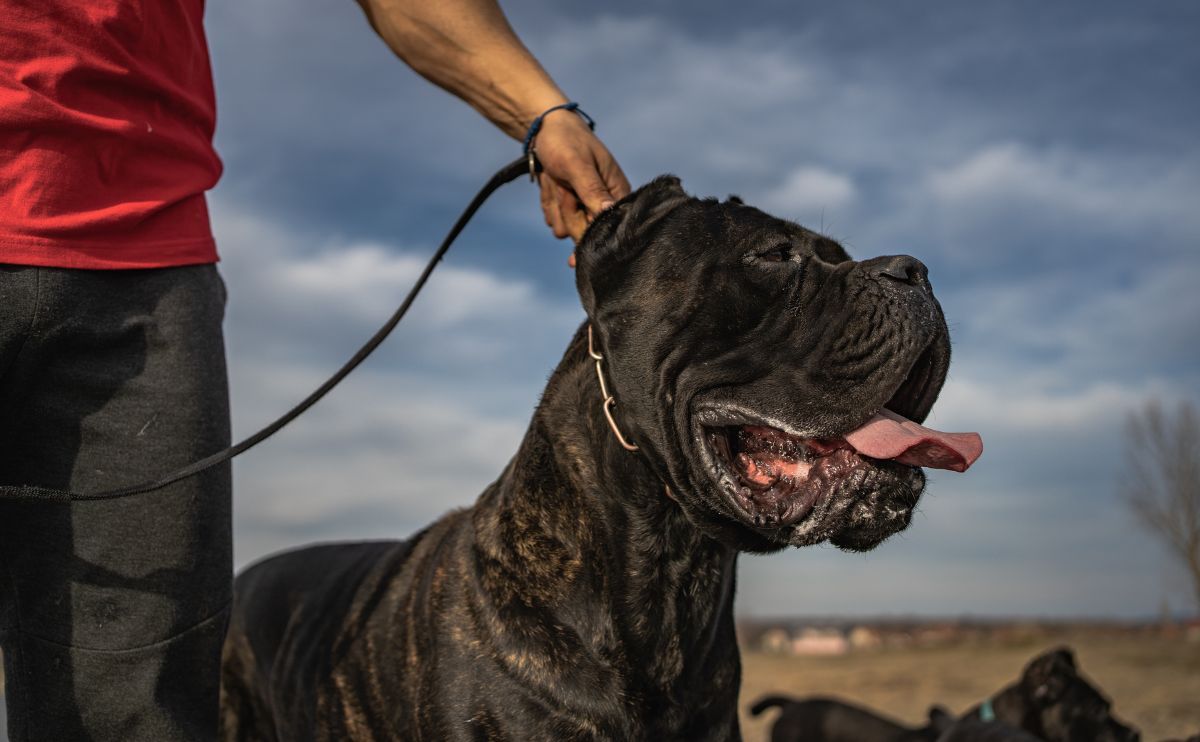
The coat is short, dense, and shiny. Accepted colors: black, gray (slate to light), fawn (light to red), brindle. Small white markings are tolerated on the chest, fingertips, or muzzle.
Specificities of the Cane Corso #
A few details distinguish the Cane Corso from other dog breeds of its size, notably:
- Its massive head and square muzzle, with slightly converging facial lines.
- Its black or gray mask depending on the coat, not extending beyond the eye line.
- Its broad chest and supple gait: trotting is its preferred pace.
Behavior of the Cane Corso #
The Cane Corso is known for its calmness, vigilance, and loyalty. Well-socialized, it shows a stable temperament, but its guarding instinct remains very present.
Behavior of the Cane Corso with Children #
Protective, the Cane Corso can be gentle with children, especially if they are respectful and supervised. Its size, however, requires caution and supervision. Several experts, including those from PetMD, recommend reserving it for families familiar with large dogs.
Behavior of the Cane Corso with Other Animals #
With peers, everything depends on early socialization. A poorly socialized Cane Corso can be reactive. Cohabitation with cats or small pets is possible if established early and positively.
Health of the Cane Corso #
The impressive physique of the Cane Corso does not shield it from certain common pathologies in large dogs. Prevention is key.
Life Expectancy of the Cane Corso #
The median of about 9.3 years (multi-country study) is consistent with the dog’s size. Good hygiene, weight management, and regular screenings extend its longevity ( PetMD).
Common Diseases of the Cane Corso #
As with many breeds, the Cane Corso is prone to certain diseases that can be hereditary or simply quite common:
| Disease / Problem | Quick Description | Estimated Frequency | Recommended Prevention / Monitoring |
|---|---|---|---|
| Hip Dysplasia | Joint malformation → limping, arthritis | High in large dogs | X-rays (OFA/PennHIP), controlled growth, stable weight |
| Bloat / Torsion (GDV) | Stomach dilation-torsion, life-threatening emergency | High | Fractioned meals, avoid exercise around meals, possible gastropexy |
| Dilated Cardiomyopathy (DCM) | Heart muscle disease → fatigue, arrhythmias | Medium | Cardiac ultrasounds if at-risk lineage, veterinary follow-up, daily monitoring with the Biotracker GPS |
| Entropion / Ectropion / Cherry Eye | Abnormal eyelids or gland prolapse | Medium | Eye checks, surgical intervention if needed |
| Demodicosis | Parasitic skin condition (mite) | Low to medium | Dermatological monitoring, immune support |

Training the Cane Corso #
The Cane Corso requires patient, structured, and positive training. Each subsection below details a pillar of this training.
✔️ Positive Training Methods for the Cane Corso #
Positive reinforcement (treats, games, clicker training) is preferred. Punitive methods, on the other hand, can lead to mistrust and reactivity. An inexperienced or poorly informed owner might even make it a reactive dog!
✔️ Importance of Early Socialization for the Cane Corso #
Expose it, from a puppy, to varied environments: urban noises, people of all ages, balanced dogs. The goal? A Cane Corso capable of staying calm in the face of stimuli!
✔️ House Training the Cane Corso #
Plan regular outings, reward immediately in the right place. No unnecessary punishment: consistency and anticipation are key.
✔️ Teaching Basic Commands to the Cane Corso #
“Sit,” “Stay,” “Leave it,” “Heel”: these commands are essential for managing a mastiff. Train it in different contexts to generalize their use and get it used to responding everywhere.
❌ Managing Undesirable Behaviors of the Cane Corso #
Alert barking, resource guarding, leash pulling… Redirect rather than punish. For example: “Go to your mat” to replace jumping on guests.
Examples of Training Exercises #
- Self-control: wait for the signal before crossing a door.
- Nose targeting: touch the hand to divert attention.
- Loose leash walking: reward each look towards the owner.
- Scent games: object search, treat hiding to mentally tire it out.
Character and Lifestyle of the Cane Corso #
The Cane Corso loves to participate in family life, as long as its needs are met. Mental balance comes through physical and cognitive activity.
Physical Activity and Exercise for the Cane Corso #
Like all dogs, big or small, it needs daily outings. Add to that controlled exercises and mental stimulation (nosework, rhythmic obedience, light tracking), and your Cane Corso will be the happiest! However, be careful with joint impacts before growth ends (about 18 months).
Character of the Cane Corso Indoors #
It is calm, composed… provided it has exercised well. It likes to observe and stay close to “its” human. So don’t hesitate to put a cushion in your room so it can stay close to you even when you sleep.
Character of the Cane Corso with Family and Other Animals #
Very attached to its circle, it can be reserved with strangers. Good socialization facilitates cohabitation with dogs and cats.
Ideal Living Environment for the Cane Corso #
Ideally, a house with a fenced yard is preferred. An apartment is not impossible but requires impeccable organization (multiple outings, mental work). Also check local regulations: some municipalities have lists of monitored breeds.
Grooming and Hygiene of the Cane Corso #
The short coat makes routine easier, but some points require regularity.
Grooming and Routine Care for the Cane Corso #
- Weekly brushing to remove dead hair.
- Occasional bath with suitable shampoo.
- Regular checks of eyes and ears (ocular predispositions).
- Nail trimming if natural wear is insufficient.
Feeding the Cane Corso #
Divide meals, choose a balanced diet (FEDIAF / AAFCO standards) and avoid exercise just before/after to limit the risk of GDV. Adjust portions according to age, activity, and target weight, and don’t hesitate to seek advice from your veterinarian.
Adoption and Cost of the Cane Corso #
Adopting a Cane Corso involves an initial budget… and a significant annual budget. It’s better to anticipate to avoid surprises.
Price to Adopt a Cane Corso #
A LOF puppy generally costs 900 to 2,000 € in France, depending on lineages, health tests, and guarantees.
Annual Cost for the Care and Maintenance of the Cane Corso #
Between premium food, health prevention, and unforeseen events, count about 1,150 to 1,300 € per year, or more if you opt for insurance (on average ~341 €/year according to dog insurance comparators). Here is an example of distribution:
| Expense Item (annual) | Indicative Range |
|---|---|
| Food (large dog, premium quality) | 500 – 700 € |
| Health prevention (vaccines, dewormers, antiparasitics) | 150 – 250 € |
| Hygiene & routine care (shampoos, ear/eye cleaners) | 40 – 80 € |
| Health insurance (optional but relevant) | ~341 € |
| Unforeseen / health savings (hip x-rays, gastropexy, cardio/dermato spec) | 200 – 400 € |
In Brief: Is the Cane Corso Right for You? #
The Cane Corso is suitable for people ready to invest time in training, provide a clear and stable environment, and assume a large dog health/food budget. In return, this intelligent and protective mastiff becomes an extremely loyal companion.