

Is your dog constantly shaking their head, scratching their ear with a back paw, or giving off an unpleasant smell when they come close? These signs often point to an ear infection.
Is it serious? Can you treat it yourself? How do you stop it from coming back? Otitis externa is an inflammation of the ear canal, and it’s common in dogs. It should be examined by a veterinarian, who will look for its cause, because a poorly treated ear infection tends to come back.
What is an ear infection in dogs? #
Otitis is an inflammation of the ear. The most common form in dogs is otitis externa: according to the Merck Veterinary Manual, it’s the most common disorder of the ear canal in dogs, and it’s an inflammation of the lining of that canal.
It can affect one ear or both, appear suddenly or become long-lasting. In some cases, the inflammation also involves the middle ear, located behind the eardrum.
Dog ear infection symptoms #
The Merck Veterinary Manual describes several signs to watch for:
- the dog often shakes their head;
- they scratch their ear;
- the ear smells bad;
- the skin is red or swollen;
- there’s discharge;
- the skin of the ear becomes scaly.
The ear can be painful or itchy.
Does a dog scratching their ear always mean an ear infection? #
Not necessarily, but it’s one of the most common signs. Occasional scratching is nothing to worry about. However, if it keeps happening, or comes with head shaking, a smell or discharge, it’s best to have the ear examined. The Merck Veterinary Manual also notes that deformed ear flaps and repeated head shaking can be signs of long-term discomfort.
Causes of ear infections in dogs #
Contrary to popular belief, an ear infection isn’t just a simple infection: it’s often the result of another problem. The Merck Veterinary Manual lists several direct causes:
- parasites;
- a foreign body stuck in the canal, such as a foxtail picked up on a walk through tall grass;
- an allergy;
- a bacterial or yeast infection;
- middle ear involvement.
The shape of the ear flap or ear canal can also make some dogs more prone to ear infections.
That’s the key: all possible causes need to be identified, because as long as they aren’t all treated, the infection often comes back. A recurring ear infection in an allergic dog, for example, will only heal for good if the allergy is managed.
Breeds most prone to ear infections #
Dogs with floppy ears are indeed more at risk. A large study by the Royal Veterinary College, based on the records of 22,333 dogs in the UK, found that 7.3% of dogs had otitis externa within a year, or about one in fourteen. Risk varies considerably with ear shape:
- dogs with pendulous ears are 1.76 times more at risk than dogs with erect ears;
- dogs with V-shaped drop ears are 1.84 times more at risk.
Compared with crossbreeds, the study identified 16 breeds at higher risk. The top five are:
- the Basset Hound;
- the Chinese Shar Pei;
- the Labradoodle;
- the Beagle;
- the Golden Retriever.
Poodle breeds overall are nearly twice as likely (1.91) to be affected as other breeds, and spaniels slightly more likely (1.24). On the other hand, Chihuahuas, Border Collies, Yorkshire Terriers and Jack Russell Terriers are less affected than crossbreeds. Dogs under 10 kg (22 lb) also have a lower risk than larger dogs.
Having a dog from an at-risk breed doesn’t mean they’ll necessarily get ear infections, but it’s a good reason to keep a closer eye on their ears and clean them regularly.
Why you shouldn’t treat a dog ear infection yourself #
It’s tempting to clean the ear or use a product from the medicine cabinet. It’s a bad idea, for several reasons.
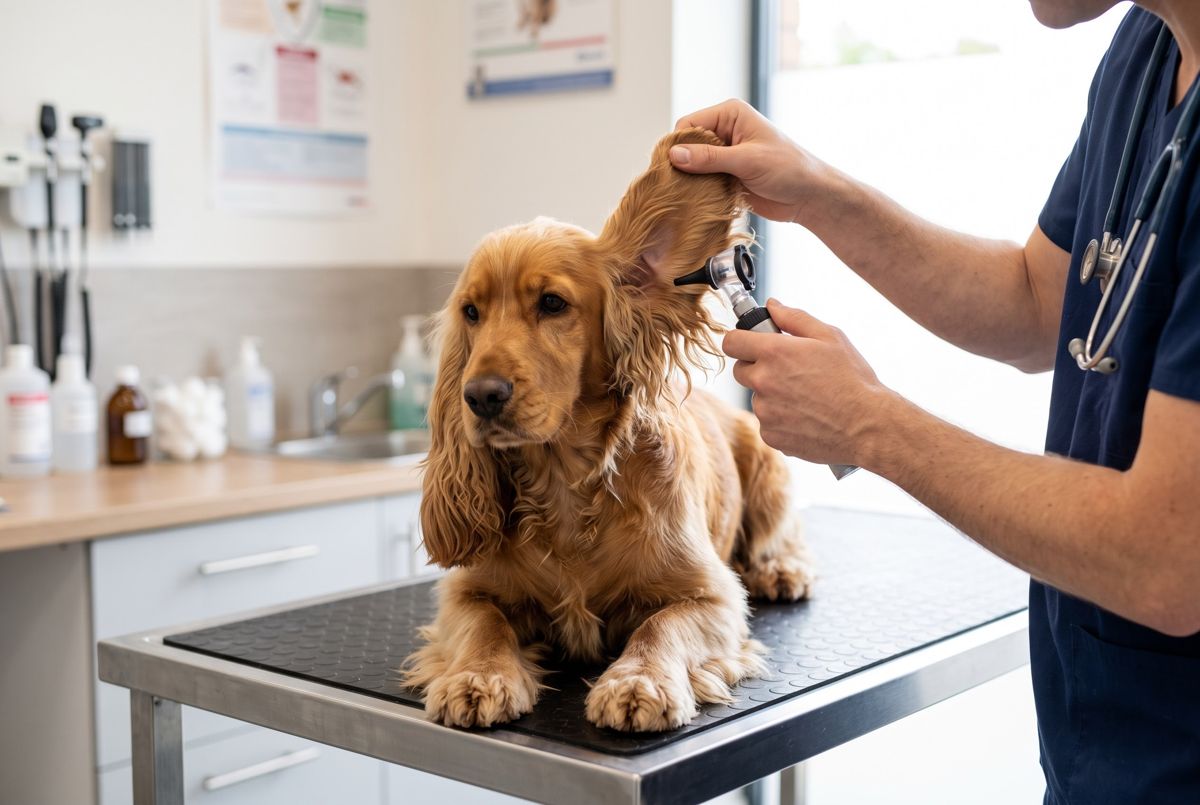
First, examining the ear lets the vet check things you can’t see with the naked eye. With an otoscope, the veterinarian looks for a foreign body, built-up debris or parasites, and checks the eardrum. If the ear is very painful or blocked, sedation is sometimes needed.
Second, treatment depends on the cause. The veterinarian often takes a sample of the discharge to look at under the microscope (cytology), or to culture it. The Merck Veterinary Manual notes that dark discharge often indicates yeast or parasites, but can also appear with bacterial or mixed infections: there’s no way to tell by eye what needs treating.
Finally, home remedies can make things worse. The Merck Veterinary Manual specifically advises against irritating vinegar mixtures, which can increase swelling and secretions.
How the vet treats an ear infection #
Treatment has two goals: correcting the causes and relieving pain. Generally, the veterinarian will:
- clip the hair around the ear if needed;
- clean and dry the canal, because wax and discharge can make ear drops ineffective;
- prescribe ear drops, which usually combine an antibiotic, an antifungal and an anti-inflammatory;
- sometimes add oral medication, for long-standing inflammation or middle ear involvement.
Treatment must continue until the infection has fully cleared, even if your dog seems better before then. For bacterial or yeast infections, rechecks are often scheduled every 2 to 4 weeks. Some dogs, especially those whose underlying cause can’t be removed, need lifelong treatment.
💡 Good to know
After every walk through tall grass, take a few seconds to check the entrance of your dog's ears. If you see a foxtail, don't try to remove it if it's deep in the canal: leave it to your veterinarian.
How to clean your dog’s ears to prevent infections #
Good ear care helps prevent recurrences:
- use an ear cleaner recommended by your veterinarian, not a product made for humans;
- never use cotton swabs (Q-tips), or anything that could push debris deeper into the canal;
- fill the canal with the cleaner, gently massage the base of the ear, then dry with a cotton ball;
- if a treatment has been prescribed, wait a few minutes after cleaning before applying it.
As for frequency, follow your veterinarian’s advice: they may suggest daily cleaning at first, then once or twice a week for maintenance.
The Merck Veterinary Manual also recommends keeping ear canals dry and well ventilated:
- avoid getting water inside the ears during baths;
- if your dog swims often, ask your veterinarian whether to use a drying agent;
- ask them before trimming the hair around the canal.
Finally, get into the habit of checking your dog’s ears regularly: redness, a smell or unusual moisture are simple warning signs.
Sleep as an everyday indicator #
Signs of an ear infection are easy to spot during the day. At night, though, while you’re asleep, a dog that scratches or wakes up more often easily goes unnoticed.
It’s precisely because these restless nights are hard to notice that sleep tracking can help. Biotracker analyzes your dog’s sleep and tracks their activity, as well as their heart rate and respiratory rate at rest, comparing them to their usual values. Sleep that’s more restless than usual doesn’t mean it’s an ear infection: Biotracker doesn’t make a diagnosis. But it’s one more indicator to help you decide to have your dog examined, and to discuss it with your veterinarian.
To learn about other common health problems, from skin to heart, see our article on the most common dog diseases.
FAQ — dog ear infections #
How do I know if my dog has an ear infection? #
The most common signs are head shaking, ear scratching, a bad smell, redness or swelling, and discharge. The ear may be painful. Only an examination by your veterinarian can confirm an ear infection and find its cause.
Is a dog ear infection serious? #
It can be painful, involve the middle ear too and keep coming back if all its causes aren’t treated. Some dogs even need lifelong treatment. So don’t let it drag on: see your vet at the first signs.
Can I treat my dog’s ear infection at home without a vet? #
No. Your veterinarian needs to examine the canal and the eardrum, and identify what’s causing the infection (bacteria, yeast, parasites, a foreign body, an allergy) before prescribing the right treatment. Home remedies, like vinegar, can make the inflammation worse.
Which dog breeds get the most ear infections? #
According to a Royal Veterinary College study of more than 22,000 dogs, the breeds most at risk include the Basset Hound, Chinese Shar Pei, Labradoodle, Beagle and Golden Retriever, as well as poodles and spaniels. Dogs with pendulous or V-shaped drop ears are almost twice as likely to be affected as those with erect ears.
Why does my dog’s ear infection keep coming back? #
Most often, because an underlying cause, such as an allergy, hasn’t been treated, or because treatment was stopped too early. Care needs to continue until the infection has fully cleared, with the rechecks planned by your veterinarian.
Should I clean my dog’s ears? #
Yes, with a product recommended by your veterinarian, and without cotton swabs. How often depends on your dog: your vet may suggest daily cleaning at first, then once or twice a week for maintenance.
In summary #
Otitis externa is an inflammation of the ear canal and is very common in dogs. Signs include head shaking, scratching, a smell, redness or discharge. Its causes vary (parasites, a foreign body such as a foxtail, allergies, bacteria or yeast), and it often comes back if they aren’t all treated. That’s why it’s important to see your vet rather than treat it yourself, to complete the treatment, and to clean your dog’s ears without cotton swabs, using a product recommended by your veterinarian.
This article is for information only and does not replace a visit to your veterinarian.