

Every year, at the end of winter and the beginning of spring, the pine processionary caterpillars reappear in many French regions. Their progression is monitored by health authorities, notably by ANSES (French Agency for Food, Environmental and Occupational Health & Safety), which regularly warns about the risks associated with their urticating hairs.
Processionary caterpillars are part of a broader context of seasonal dangers related to spring for pets, a period when parasites, allergies, and environmental risks simultaneously increase.
While these insects can already cause severe reactions in humans, they pose an even greater danger to dogs due to their exploratory behavior.
🌲 What is a processionary caterpillar? #
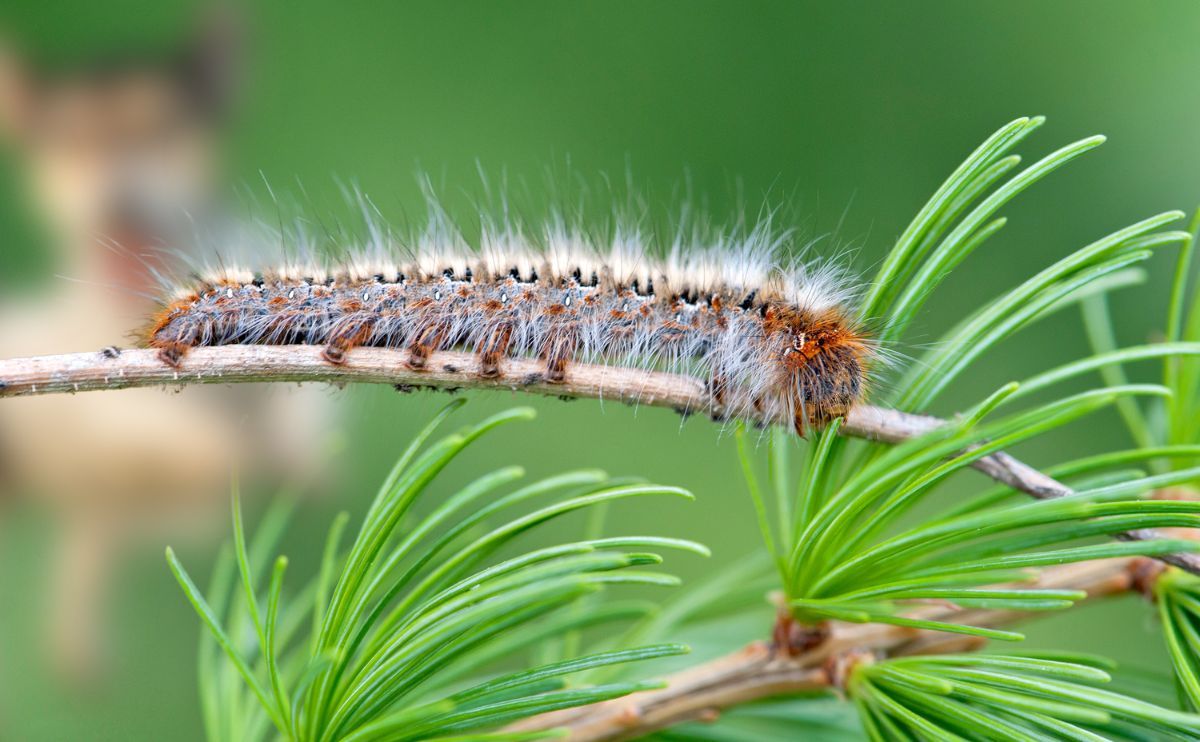
The pine processionary caterpillar is the larva of a nocturnal moth that primarily develops in pines and some cedars. The French Ministry of Agriculture specifies that these caterpillars descend from trees in the spring to bury themselves in the ground, a period during which they are particularly visible… and dangerous.
Their peculiarity lies in their thousands of microscopic urticating hairs, containing a toxin called thaumetopoein. These hairs detach very easily and can be carried by the wind, contaminating the environment far beyond direct contact.
🐶 Why processionary caterpillars are dangerous for dogs #
Dogs are naturally exposed: they sniff, lick, and explore the ground. When they come into contact with a processionary caterpillar—or even with scattered hairs—the consequences can be immediate.
Veterinarians report that contact at the mouth level is the most common. According to recommendations issued by French veterinary networks like the National Order of Veterinarians, the impact can cause:
- sudden inflammation of the tongue,
- swelling of the muzzle,
- intense hypersalivation,
- acute pain,
- in severe cases, partial necrosis of the tongue.
Unlike a simple insect sting, the reaction is chemical and toxic. It can quickly escalate to a veterinary emergency.
🚨 Symptoms of contact with a processionary caterpillar #
The first signs often appear within minutes of exposure.
You may observe:
- excessive salivation,
- a dog trying to rub its mouth,
- abnormal swelling of the tongue,
- difficulty swallowing,
- a state of agitation or obvious pain.
In the most severe cases, inflammation can compromise breathing. ANSES also reminds that the urticating hairs retain their toxic power even after the caterpillar’s death, making exposure particularly insidious.
🌡 Why spring is the most risky period #
The descent of caterpillars from nests to the ground corresponds to the phase when dogs are most likely to encounter them. This period varies by region but generally extends from February to May.
Climate change has contributed to expanding their geographical range. Areas previously less affected are now seeing nests appear, as reported by agricultural authorities.
In spring, the risk is amplified by:
- increased outdoor walks,
- the presence of caterpillars on the ground,
- the dispersion of hairs in the air.
🛑 How to identify a risk area #
The nests resemble whitish clusters attached to pine branches. Their presence should immediately alert you.
If you observe:
- silky cocoons in trees,
- lines of caterpillars moving on the ground,
- municipal warning signs,
it is recommended to completely avoid the area.
The Ministry of Agriculture strongly advises against any attempt to destroy nests manually due to the toxic risk.

🆘 What to do in case of contact? #
In case of suspicion:
- Prevent your dog from licking itself.
- Rinse abundantly with clear water (without rubbing).
- Contact a veterinarian immediately.
Every minute counts.
🔎 Sometimes invisible signs after exposure #
Not all contacts cause an immediate dramatic reaction. In some cases, more subtle signs are first observed:
- unusual fatigue after a walk,
- slightly faster breathing,
- a decrease in activity level,
- increased physiological stress.
These variations can precede visible symptoms.
Continuous monitoring of activity, resting heart rate, or heart rate variability (HRV) can help detect an abnormal reaction related to stress or pain earlier.
🐾 In summary #
Processionary caterpillars pose a real danger to dogs in spring, as confirmed by French health authorities.
Their toxicity, the speed of reactions, and the difficulty in spotting urticating hairs make vigilance essential.
Observe your environment.
React quickly.
And monitor subtle signals.
Because in spring, it’s better to prevent than cure.
❓ FAQ – Processionary Caterpillars and Dogs #
Are processionary caterpillars deadly for a dog? #
Yes, in some severe cases, contact with a processionary caterpillar can cause a severe inflammatory reaction, anaphylactic shock, or necrosis of the tongue. Immediate veterinary care greatly reduces the risk of complications.
When are processionary caterpillars dangerous? #
The risk is highest between February and May, during which caterpillars descend from trees to bury themselves in the ground. However, depending on climatic conditions, the period may vary.
How to recognize a processionary caterpillar? #
They move in single file (in “procession”) and are covered with urticating hairs. Their white silky nests can also be spotted in pines or cedars.
What to do if my dog licked a processionary caterpillar? #
Immediately rinse the mouth with clear water without rubbing, prevent your dog from licking further, and contact a veterinarian urgently. Do not try to remove the hairs by hand.
Do the hairs remain dangerous after the caterpillar’s death? #
Yes. The urticating hairs retain their toxic power even when the caterpillar is dead or the hairs are dispersed in the environment.