

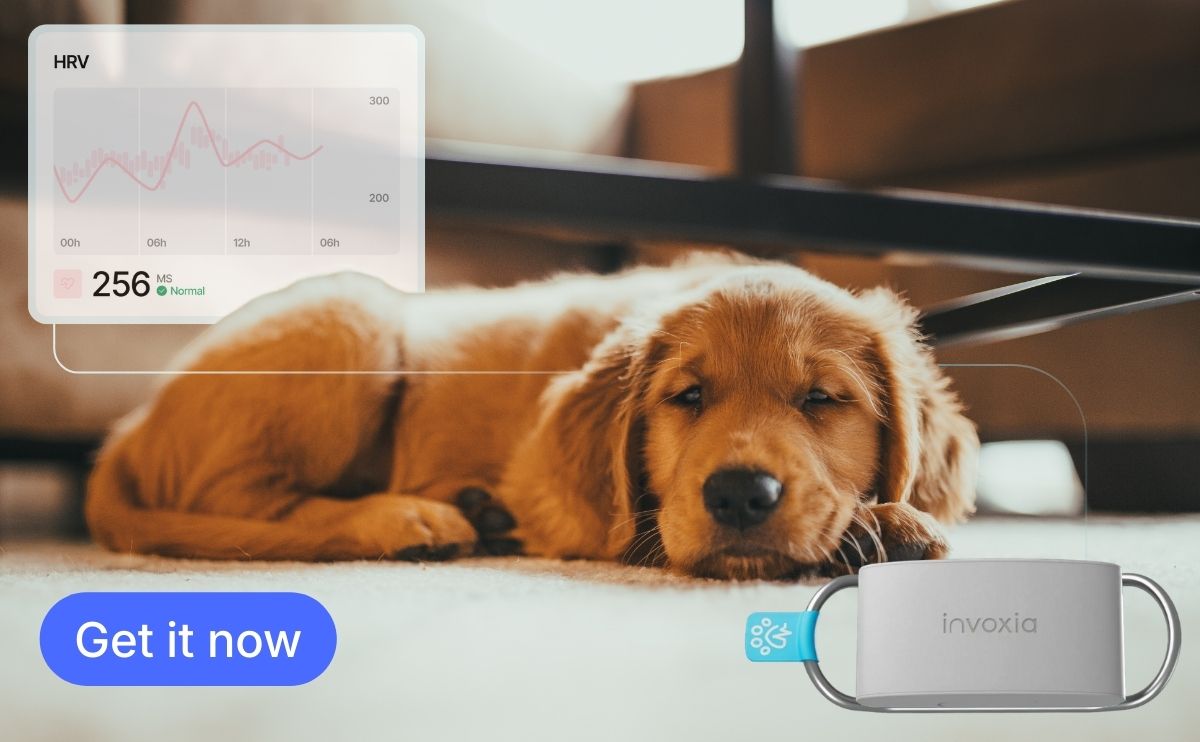
Good news: the Invoxia Biotracker now includes the measurement of heart rate variability (HRV).
Already available on the new 2026 Edition and also deployed on previous versions, this feature marks an important step: it allows for a deeper understanding of your dog’s stress, recovery, and physiological balance.
But concretely:
👉 What is heart rate variability in dogs?
👉 Why is it a key indicator in medicine?
👉 How to interpret high or low HRV?
We explain everything.
Discover the Biotracker and its heart rate variability measurement
What is heart rate variability (HRV) in dogs? #
Contrary to what one might imagine, the heart never beats in a perfectly regular manner. Heart rate variability corresponds to the natural variations in time between two beats.
Even at rest, the interval between two beats changes slightly — and that’s normal.
👉 This variability reflects the ability of the autonomic nervous system to adapt continuously.
In dogs, as in humans, HRV is considered a marker of physiological balance.
HRV is a different metric from heart rate itself, and the two are worth telling apart. Heart rate tells you how fast your dog’s heart is beating; HRV tells you how evenly it’s beating — and tracking both together gives a fuller picture of your dog’s cardiac and overall health, especially valuable as part of regular at-home heart monitoring.
Why is HRV important data? #
HRV has long been used in human medicine and scientific research. It provides an indirect indication of:
- 🧘 Stress management
- 💤 Recovery capacity
- 💪 Adaptation to effort
- 🤕 Sometimes, the presence of pain
- ❤️ Overall balance of the autonomic nervous system
With the arrival of this new feature on the Biotracker, this data becomes accessible at home, in your dog’s real life.
High or low HRV: how to interpret the variations? #
While it is generally considered that a heart beating at a regular and rather slow pace is healthy, this is not the case for HRV. In fact, the opposite correlation is observed!
✅ High HRV #
High HRV is often associated with:
- good recovery status
- a relaxed dog
- good physiological balance
This generally means that the body is adapting effectively to its environment.
⚠️ A drop in HRV #
A temporary drop can occur in cases of:
- fatigue
- stress
- intense emotion
- change of environment
- unusual activity
- discomfort or pain
👉 An isolated variation is not worrisome.
However, a progressive and lasting decrease may signal:
- chronic stress
- insufficient recovery
- an underlying health problem
In this case, it is recommended to talk to your veterinarian.
Why observe trends? #
HRV naturally varies from day to day. That’s why it’s essential to:
✔️ Observe the data over several days ✔️ Compare with your dog’s usual baseline ✔️ Consider the context (activity, environment, emotions)
The strength of this new feature lies not in a single value, but in the analysis of trends over time.
How is HRV measured by the Biotracker? #
The HRV displayed in the application corresponds to a scientific metric called RMSSD (Root Mean Square of Successive Differences). This method is widely used in research to analyze heart rate variability.
The calculation is made from rest periods, when the measurements are most reliable. This allows for relevant and comparable data over time.
🐶 Biotracker 2026 Edition #
The new reference for health & GPS tracking for dogs #
Heart rate variability is now integrated. An additional data point to understand your companion’s stress, recovery, and physiological balance.
❤️ Advanced Health #
- Resting heart rate
- Resting respiratory rate
- Heart rate variability (HRV – RMSSD)
- Analysis of trends over time
📍 Next-generation Safety #
- Real-time GPS
- Live Tracking updated every second
- Journey history
- Custom zone alerts
HRV and pain in dogs: what is the link? #
Several scientific studies show that a drop in HRV can be associated with:
- physiological stress
- inflammation
- pain
Caution: a low HRV does not automatically mean a dog is suffering.
But a lasting decrease, associated with behavioral changes (unusual fatigue, loss of appetite, isolation), can be a useful signal to share with your veterinarian.
A new step in home health monitoring #
With the addition of heart rate variability, the Biotracker takes a new step.
After resting heart rate and resting respiratory rate, HRV provides an additional dimension:
- more refined
- more dynamic
- more representative of overall balance
This new feature strengthens the approach of longitudinal home monitoring: observe, understand, act if necessary.
In summary #
Heart rate variability in dogs is:
- A key indicator of stress and recovery
- Sensitive to physiological imbalances
- Relevant when analyzed over time
Now integrated into Invoxia’s Biotracker (2026 Edition and previous versions), it allows for a deeper understanding of your companion’s well-being and health.
Because a few well-interpreted data points can make all the difference.