

Monitoring your dog’s heart at home relies on three indicators to be tracked together — resting heart rate, resting respiratory rate, and heart rate variability (HRV) — and on a simple rule: what matters is not an isolated value on a given day, but its evolution compared to your dog’s usual trend. A one-time measurement at the vet, skewed by the stress of the visit, doesn’t tell the whole story; regular monitoring at home can detect a lasting change sometimes several weeks before visible symptoms appear. Here’s how to set up this monitoring, with or without a connected tool, and when a trend should prompt you to consult.
Why monitor your dog’s heart between vet visits? #
A veterinary consultation captures a precise moment, often biased by the stress of the clinic, which can artificially raise your dog’s heart rate. Home monitoring, in the dog’s usual environment, provides a more accurate picture of their real condition — and above all, it allows you to compare a measurement to your dog’s own trend rather than a general norm. This individual trend logic is most valuable for detecting a developing heart problem, especially in a senior dog, already monitored for heart disease, or belonging to a predisposed breed.
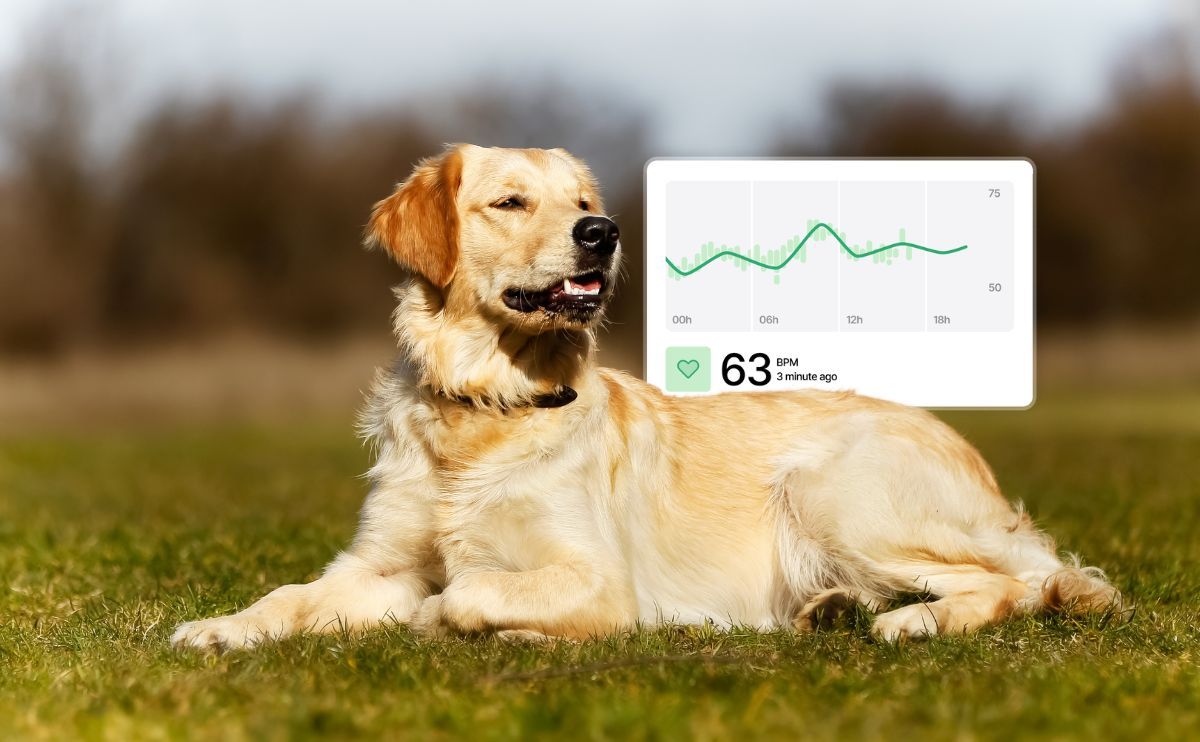
3 indicators to track together #
Three indicators, tracked together, provide a complete picture of your dog’s cardio-respiratory balance: resting heart rate, resting respiratory rate, and heart rate variability (HRV).
According to the largest home study ever conducted on the subject, a healthy adult dog has a median heart rate of about 60.5 beats per minute at rest — a figure that varies little by weight or breed, but rises significantly (67.3 bpm on average) in dogs already monitored for heart disease.
Heart rate variability, on the other hand, is not read the same way: a high HRV indicates a relaxed and well-recovered dog, while a gradual decrease may signal chronic stress or a developing health problem — the opposite of the logic applied to heart rate.
| Indicator | What it measures | Benchmark for a healthy dog at rest | Warning signal |
|---|---|---|---|
| Heart rate | Speed of heartbeats | ~60.5 bpm on average | Progressive and lasting increase compared to the usual reference |
| Respiratory rate | Number of breaths per minute | ~16 rpm on average, generally under 30/min | More than 30 breaths/minute, or progressive increase even below this threshold |
| Heart rate variability (HRV) | Regularity of time between beats | Stable, rather high | Progressive and lasting decrease over several days |
What monitoring routine to adopt based on your dog’s profile #
The frequency at which to monitor these indicators depends mainly on your dog’s profile, not a single rule applicable to all.
- Young and healthy dog, non-predisposed breed: a few measurements per month are enough to maintain a general benchmark; daily monitoring is not necessary.
- Senior dog, or a breed predisposed to heart diseases: weekly monitoring of heart and respiratory rates is reasonable to build a reliable reference over time, before a problem arises.
- Dog already diagnosed (heart murmur, valvular disease, cardiomyopathy): daily monitoring of resting respiratory rate is recommended, especially under diuretic treatment, as it is the most responsive indicator for detecting ongoing decompensation.
In all three cases, automatic and continuous monitoring like that of the Biotracker simplifies the routine: there is no need to schedule or manually repeat measurements, data accumulates in the background, and the trend builds itself.
How to establish your dog’s reference (“baseline”) #
A single measurement means nothing: it’s the comparison to your dog’s own reference, built over several days, that provides a reliable signal. Ideally, take several measurements per week, always under comparable conditions (calm dog, at rest, if possible at the same time of day), for at least two to three weeks to establish a usual range. Once this reference is known, an isolated one-time deviation is generally not a cause for concern — however, a progressive and confirmed drift over several days should be reported to your veterinarian, even before other symptoms appear.
With the Biotracker, the baseline draws itself: the tracker takes several measurements during the day when the dog is at rest and sends the data to the app. Thanks to the history, you can finally see trends and deviations that may occur.
Manual measurement or automatic monitoring: two methods, two uses #
Manual pulse taking is possible, but not well-suited for long-term trend monitoring. It involves placing two fingers on the inner thigh or chest, counting beats for 15 seconds, then multiplying by 4. The problem: difficult to repeat several times a day without disturbing the dog, and skewed by simple handling, which often slightly raises the heart rate.
For respiratory rate, the manual method is simpler and remains reliable: just count chest movements for 30 seconds, sleeping dog, then multiply by 2 — no handling, so no stress bias.
For combined monitoring (heart rate, respiratory rate, HRV, activity), a connected collar like the Biotracker measures these parameters continuously and non-invasively, without handling the dog, allowing for a real trend to be built over time rather than a series of isolated measurements.
Common mistakes that skew home monitoring #
The most common is comparing a measurement taken at the vet to a “home” benchmark: the two are not comparable due to the stress of the consultation. This phenomenon, sometimes called “white coat effect,” is documented in dogs as well as humans: according to the Animal Medical Center of New York, an anxious dog’s heart rate can rise up to 200 beats per minute in the clinic, and nearly 41% of animals show artificially elevated blood pressure at the clinic compared to a measurement taken at home.
Other common mistakes reduce monitoring reliability: measuring right after play or a walk rather than at complete rest, constantly changing the time or position of measurement (which prevents building a truly comparable reference), or reacting to a single unusual measurement instead of waiting for confirmation over several days. Avoiding these pitfalls is as important as choosing the right indicators to track.
How to share this data with your veterinarian #
Home monitoring takes on its full value when shared with a professional capable of interpreting it. The Biotrack platform allows you to give your veterinarian access to this data, which receives AI-sorted alerts based on their deviation from your dog’s reference value rather than a raw list of numbers — enough to turn weeks of continuous monitoring into actionable information during a consultation, rather than just a history to browse.
Otherwise, the PDF report is also available for download directly in the app.
When should a trend be alarming? #
What should be alarming is not an isolated number, but a confirmed drift over several days compared to your dog’s usual reference. Specifically: a resting heart or respiratory rate that progressively increases, an HRV that decreases steadily, an irregular rhythm, or the appearance of an associated symptom (cough, unusual fatigue, shortness of breath, fainting).
If your dog already has a diagnosed heart murmur or valvular disease, this type of monitoring is particularly useful for detecting a progression to heart failure before visible signs appear — just as a heart murmur detected during auscultation justifies setting up this monitoring without delay.

FAQ #
What indicators should be tracked to monitor your dog’s heart at home? Three complementary indicators: resting heart rate, resting respiratory rate, and heart rate variability (HRV). Tracked together and compared to your dog’s usual trend, they provide a more reliable picture of their cardio-respiratory balance than an isolated measurement.
How long does it take to establish your dog’s reference (“baseline”)? Count on two to three weeks of regular measurements, under comparable conditions (calm dog, at rest), to obtain a reliable usual range. It’s this individual reference, more than a general norm, that allows for detecting a significant change.
Can you monitor your dog’s heart without connected equipment? Yes, partially: respiratory rate can be easily counted manually (chest movements over 30 seconds, sleeping dog, multiplied by 2), without stress bias. Manual heart rate is possible but unreliable for repeated monitoring, as handling the dog often skews the measurement. For combined and continuous monitoring, a connected collar like the Biotracker facilitates building a real trend.
When should you consult a veterinarian? When a drift is confirmed over several days compared to your dog’s usual reference — resting heart or respiratory rate that progressively increases, HRV that decreases steadily, irregular rhythm — or upon the appearance of an associated symptom (cough, unusual fatigue, shortness of breath). An isolated variation on a single measurement is generally not concerning.
Does home monitoring replace vet visits? No, it complements them. Home monitoring allows for detecting a trend between consultations and sharing concrete data with your veterinarian, but it does not replace auscultation, echocardiography, or veterinary diagnosis.
Is home heart monitoring useful even for a healthy dog? Yes, especially for a senior dog or a breed predisposed to heart diseases: establishing a reference while the dog is healthy makes a deviation more visible if a problem appears later.
Why are measurements taken at the vet different from those taken at home? Due to the stress of the consultation: an anxious dog can see their heart rate rise up to 200 beats per minute at the clinic, and nearly 41% of dogs show artificially elevated blood pressure in the clinic compared to a measurement taken calmly at home. This is precisely why home monitoring is more reliable for establishing a true reference.
How often should you measure your dog’s cardiac indicators? It depends on the dog’s profile: a few measurements per month are enough for a young and healthy dog, weekly monitoring is reasonable for a senior dog or a predisposed breed, and daily monitoring of respiratory rate is recommended for a dog already diagnosed with heart disease.
Dog Heart Monitoring at Home: In Summary #
Home heart monitoring is not complicated once the right method is in place: three indicators tracked over time, a well-established individual reference, and vigilance on trends rather than isolated numbers. Combined with regular veterinary monitoring, it’s one of the simplest ways to detect a heart problem before it becomes symptomatic.