

Elegant, athletic, and fiercely loyal: the Doberman is one of the most admired dog breeds in the world. But behind that impressive stature lies a vulnerability that few owners discover before it’s too late. Dilated cardiomyopathy (DCM) is the most common — and by far the most serious — cardiac disease in Dobermans. A study published in the Journal of Veterinary Internal Medicine (PubMed) estimates that 58% of Dobermans will be affected at some point in their lives. And in the vast majority of cases, the disease progresses with no visible symptoms for 2 to 4 years.
This guide covers everything: what DCM is, why Dobermans are so vulnerable, how to detect it as early as possible, and what role home cardiac monitoring can play in the fight against a disease that cannot be cured — but can be delayed.
The Doberman’s Heart: A Documented Genetic Predisposition #
If you have a Doberman or are considering adopting one, the first thing to know is that DCM is not a rare disease. Unfortunately, it is a statistical reality for this breed.
A study published in Scientific Reports (Nature) recently identified a region on chromosome 16 associated with DCM in Dobermans, confirming the hereditary genetic nature of the disease. This is why all breeding Dobermans should be screened before any mating.

How common is DCM in Dobermans, really? #
This risk climbs sharply with age: the same study (Wess et al., 2010, LMU Munich) found prevalence rising from 3.3% in Dobermans aged 1–2 to 44.1% past age 8. In North America, where the breed’s gene pool is more diverse, Morris Animal Foundation-funded research and the ESVC screening guidelines put the figure anywhere from roughly 40% to 63%.
DCM often progresses silently before any visible symptom appears, which is why regular monitoring matters so much in this breed. Tracking your Doberman’s heart rate over time, rather than relying on a single reading taken at the vet, is one of the most effective ways to catch early warning signs.
What Is Dilated Cardiomyopathy? #
DCM is a disease of the heart muscle (myocardium) in which the heart gradually enlarges and weakens. The heart walls thin, the chambers dilate, and the heart’s ability to pump blood decreases. The result: insufficient cardiac output, which ultimately leads to congestive heart failure.
In Dobermans, DCM almost always follows a two-stage pattern:
Phase 1: The Occult Stage (2 to 4 years) #
This is the longest — and the most dangerous — phase. The Doberman appears perfectly healthy. It eats, plays, and sleeps normally. Nothing in its behaviour hints at what is happening inside its heart. Yet beneath the surface, the heart muscle is silently deteriorating. Ventricular arrhythmias begin to appear — without ever producing a visible symptom.
This is the phase in which sudden death is the most unpredictable. A Doberman can die during physical exertion or intense excitement without any prior warning to its owner.
Phase 2: The Clinical Stage #
The disease becomes visible. The most common symptoms are:
- Breathlessness with minimal effort, respiratory difficulties
- Persistent cough, often at night
- Fatigue, weakness, reduced activity
- Distended abdomen (ascites due to fluid accumulation)
- Syncope or faintness during exertion or excitement
- Abnormal resting heart rate
At this stage, treatment can prolong the animal’s life, but the window of action is narrow. This is why everything hinges on detecting the disease at the occult stage.
During the occult phase, signals are invisible or very subtle. That is why it is important to know how to recognise the signs that should raise concern about your dog’s health.
Screening: The Recommended Protocol for Dobermans #
Given the danger of the occult phase, the European Society of Veterinary Cardiology (ESVC) recommends a strict annual screening protocol for all Dobermans from the age of 2 years, combining two complementary examinations (Journal of Veterinary Internal Medicine, PubMed).
Echocardiography #
Echocardiography is a cardiac ultrasound that measures the heart’s dimensions, evaluates wall thickness, chamber size, and the fractional shortening (an indicator of muscle contractility). In Dobermans, clinicians watch for an increase in the left ventricular end-diastolic diameter — the first structural sign of DCM.
24-Hour Holter Monitor #
The Holter is a continuous recording of the heart’s electrical activity over 24 hours. It is the key test for detecting ventricular arrhythmias at the occult stage. In Dobermans, a threshold of 50 ventricular premature complexes per 24 hours warrants closer monitoring, and more than 300 is considered diagnostic of occult DCM, regardless of echocardiographic findings (ESVC Guidelines, PubMed).
From the age of 6, some cardiologists recommend moving to six-monthly screening, as the disease can progress rapidly as the dog ages.
One screening is not enough — DCM can develop at any time. Monitoring must be lifelong and annual.
Day to Day: The Invoxia Biotracker #
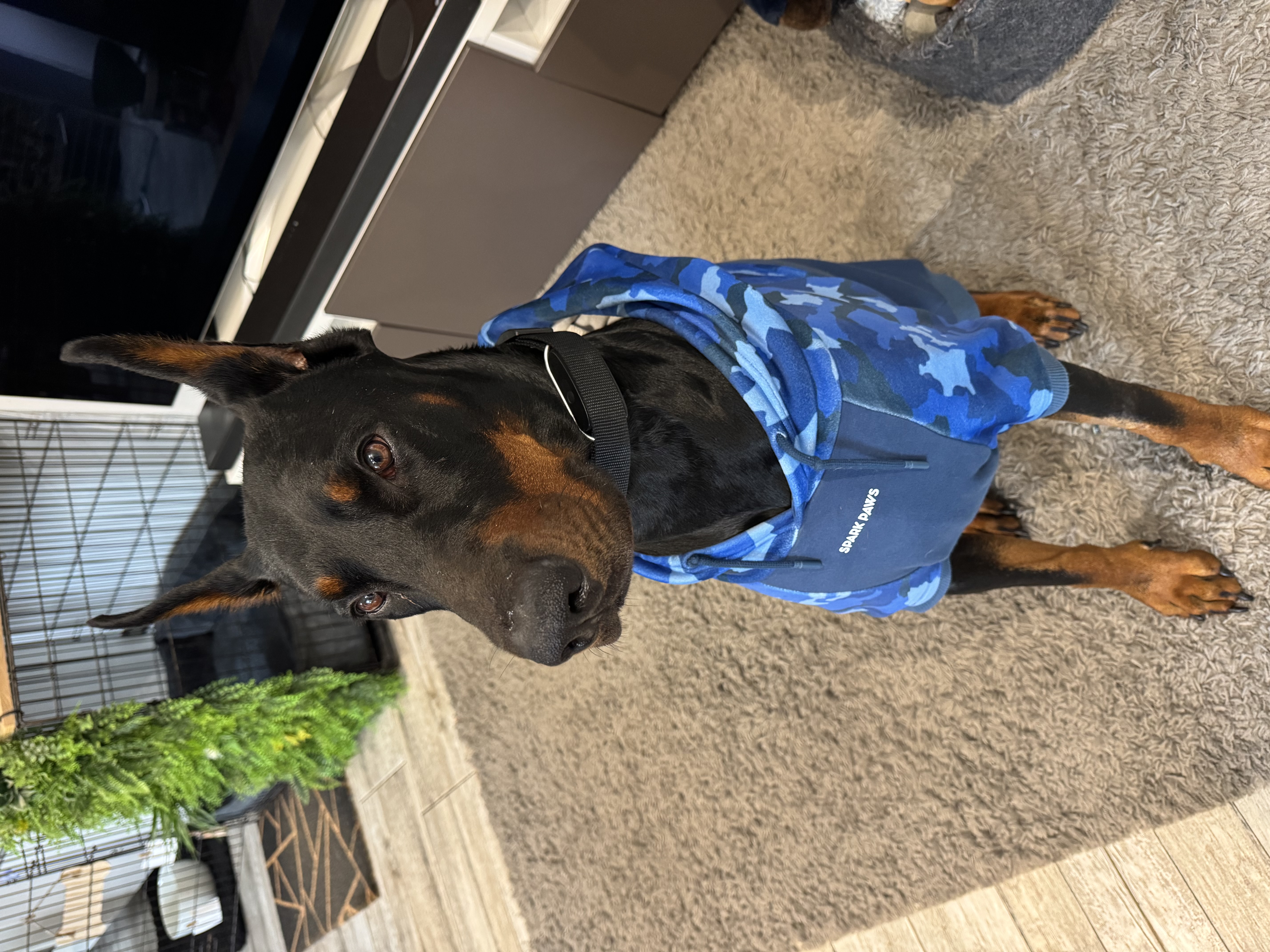
While echocardiography and Holter monitoring remain essential for confirming a diagnosis, the Biotracker can help you detect the earliest signs. Through its daily heart rate and respiratory rate measurements, it establishes a baseline for your dog and alerts you as soon as readings deviate from normal.
Without being a diagnostic tool, it is a powerful way to anticipate disease development and monitor it once it has been identified.
Treatment: Delaying Progression, Improving Quality of Life #
DCM has no curative treatment. However, early medical management can delay the onset of the clinical stage and significantly extend life expectancy.
- At the arrhythmic occult stage: anti-arrhythmics (sotalol, mexiletine) reduce arrhythmic burden and the risk of sudden death.
- At the structural occult stage: some cardiologists prescribe pimobendan, a positive inotropic agent that improves cardiac contractility. The PROTECT study, whose results are available on PubMed, showed that it significantly delays the onset of heart failure.
- At the clinical stage: combined treatment with diuretics + ACE inhibitors + pimobendan to manage heart failure and improve the animal’s comfort.
Median life expectancy after clinical diagnosis in Dobermans is under 2 years (Journal of Veterinary Internal Medicine, PubMed), but this depends on the stage at which the disease is detected and the response to treatment. A Doberman diagnosed at the occult stage and treated promptly can benefit from several additional years of good quality life.
Home Monitoring: A Key Role Between Consultations #
A Holter every 6 to 12 months is valuable — but it is a snapshot taken over 24 hours. Between screenings, your Doberman’s heart keeps working, evolving, and potentially deteriorating. This is where home cardiac monitoring comes in.
The Biotracker: Daily Cardiac Monitoring for Dogs #
The Invoxia Biotracker is a connected collar that continuously measures your dog’s resting heart rate, respiratory rate, and heart rate variability (HRV) — 24/7, with no intervention required from you. This data is accessible in the Invoxia app, with a daily history and alerts when an anomaly is detected.
The technology captures cardiac and respiratory vibrations directly through the dog’s body. It has been clinically validated with a precision of 99% for heart rate and 97% for respiratory rate, including in thick-coated dogs.
Why HRV Is a Key Indicator for Dobermans #
Heart rate variability (HRV) measures the variation between each heartbeat. High HRV reflects a healthy autonomic nervous system; HRV that gradually decreases can signal silent deterioration of cardiac function — exactly what happens during the occult phase of DCM.
By tracking your Doberman’s HRV over time, you have a longitudinal biomarker that you can share with your veterinary cardiologist to refine their interpretation.
Atrial Fibrillation Detection #
The Biotracker also includes atrial fibrillation (AFib) detection, a supraventricular arrhythmia that can occur in advanced stages of DCM. Any AFib detection constitutes a warning sign requiring urgent consultation.
What the Data Actually Shows #
A study conducted with Professor Valérie Chetboul on over 700 dogs showed that a healthy dog’s resting heart rate sits between 50 and 80 bpm — well below the values commonly cited in clinical settings. These new reference values change how data is interpreted and make it easier to identify anomalies.
Testimonials: When the Biotracker Alerts Before the Vet #
The power of the Biotracker lies not just in its sensors — it lies in the continuity of measurement. Where a Holter captures 24 hours, the Biotracker captures every day, every night, in the dog’s real environment.
Recently, we noticed her average respiration was getting higher and higher. We made an emergency appointment with the vet and confirmed after an X-ray that she had pulmonary oedema. It couldn’t be heard with a stethoscope but it was definitely there. It allowed us to act quickly and adjust her treatment.
DCM, MVD, Heart Murmur: Understanding the Different Cardiac Diseases in Dogs #
While dilated cardiomyopathy is by far the most common cardiac disease in Dobermans, it is not the only risk for the breed. Like all dogs, Dobermans can also be affected by other canine diseases, both cardiac and otherwise.
The Doberman, Insurance, and the Cost of DCM #
Treatment for DCM — anti-arrhythmics, pimobendan, diuretics, ACE inhibitors — can amount to several hundred euros per month as the disease progresses. On top of annual Holter monitoring and echocardiography. Taking out a health insurance policy for your Doberman before the disease appears is therefore an important financial decision worth considering seriously.

4 Golden Rules for Every Doberman Owner #
- Start screening at 2 years old (Holter + echocardiography) and repeat annually — without exception.
- Never trust appearances: a Doberman that “looks fine” may have been in the occult phase of DCM for months.
- Equip your Doberman with a Biotracker to ensure continuous cardiac monitoring between vet check-ups.
- Share Biotracker data with your veterinary cardiologist: heart rate, HRV, and AFib alerts can significantly enrich their monitoring.
💡 With Biotrack Vet, Invoxia’s veterinary platform, your healthcare professional can also directly follow your dog’s health data from their clinic and be alerted when a predefined threshold is exceeded. This access also allows treatment to be adjusted and DCM in Dobermans to be better managed.
DCM is a serious disease — but it does not mean your Doberman cannot live long and well. It means you need to monitor it better, and earlier, than you might have imagined.
Clinically validated precision at 99% · Integrated GPS · Real-time AFib alerts
FAQ — Doberman and Dilated Cardiomyopathy #
At what age should cardiac screening start in Dobermans? #
Screening is recommended from 2 years old, using a combination of echocardiography and 24-hour Holter monitoring. It must be renewed annually — or every 6 months after the age of 6. One screening is not enough: DCM can develop at any point in the animal’s life (ESVC Guidelines, PubMed).
What percentage of Dobermans develop dilated cardiomyopathy? #
Around 58% of European Dobermans will develop dilated cardiomyopathy (DCM) in their lifetime. In North America, estimates range from about 40% to 63% depending on the study population. Risk increases sharply with age.
What are the symptoms of dilated cardiomyopathy in Dobermans? #
At the clinical stage: breathlessness, cough (often at night), fatigue, distended abdomen (ascites), syncope. But the main danger of DCM in Dobermans is the occult stage, which lasts 2 to 4 years with no visible symptoms. It is during this silent phase that the risk of sudden death is highest — and that screening is most useful.
How can I monitor my Doberman’s heart at home? #
The Invoxia Biotracker continuously measures your Doberman’s resting heart rate, respiratory rate, and heart rate variability (HRV), 24/7. It alerts you to anomalies and detects atrial fibrillation — a major cardiac warning sign. This longitudinal data significantly enriches your veterinary cardiologist’s monitoring between Holter sessions.
Is there a treatment for DCM in Dobermans? #
There is no curative treatment. However, early medical management — anti-arrhythmics, pimobendan, ACE inhibitors, diuretics depending on the stage — can significantly delay the progression to heart failure and improve quality of life. The earlier the diagnosis (occult stage), the more effective the treatment.
How long does a Doberman with DCM live? #
Median life expectancy after a clinical-stage diagnosis is under 2 years in Dobermans (Journal of Veterinary Internal Medicine, PubMed). A Doberman diagnosed at the occult stage and treated promptly can benefit from several additional years. Everything depends on early detection — that is the most important message to take away.
Is DCM in Dobermans hereditary? #
Yes. A study published in Scientific Reports (Nature) identified a region on chromosome 16 associated with DCM in Dobermans, confirming the hereditary genetic transmission of the disease. All breeding Dobermans should be screened before any mating.
Does the Biotracker replace the veterinary Holter monitor? #
No — and it is not designed to. The Holter remains the gold standard for precisely quantifying arrhythmic burden. The Invoxia Biotracker is a daily monitoring tool between check-ups, designed to detect abnormal changes, alert in real time, and provide your vet with continuous data over weeks or months — something a one-off Holter cannot offer.
This article is for informational purposes only and does not replace veterinary consultation. For any cardiac assessment, please consult a qualified veterinary cardiologist.