

Every year, tens of thousands of motorcycles disappear in France, and the vast majority are never recovered. Faced with increasingly organized thieves, mechanical anti-theft devices alone are no longer sufficient. That’s why more and more motorcyclists are adopting a motorcycle GPS anti-theft: a discreet tracker that locates the vehicle in real-time, alerts at the slightest suspicious movement, and increases the chances of recovery in case of theft.
Unlike a simple visible anti-theft device, a GPS tracker acts over time. It doesn’t just slow down the thief: it allows you to track the motorcycle after it has been moved, identify a suspicious parking area, and provide a useful position to law enforcement. For motorcycles parked outdoors, two-wheelers used occasionally, vehicles left for several days in a parking lot, or particularly sought-after models, it has become an essential protection reflex.
Why a mechanical anti-theft is no longer enough #
Disc lock, chain, U-lock: these devices remain essential to deter an opportunistic thief. They make theft more complicated, noisier, and longer. A good mechanical anti-theft can make a difference, especially when it is approved, well-positioned, and attached to a fixed point.
But they have a major limitation: they slow down theft, without ever completely preventing it. A determined thief, equipped with a grinder, a jammer, a van, or simply an organized team, can take a motorcycle in less than two minutes. In some cases, the two-wheeler is lifted directly into a utility vehicle, without even needing to neutralize the anti-theft on site.
Once the motorcycle is gone, the mechanical anti-theft is useless. This is exactly where the motorcycle GPS anti-theft comes in: it takes over when all other devices have failed, allowing you to know where your two-wheeler is. To fully understand the strengths and weaknesses of classic devices, check out our comprehensive guide on motorcycle anti-theft.
What is a motorcycle GPS anti-theft? #
A motorcycle GPS anti-theft is a small autonomous box, discreetly attached to the vehicle, that combines several protection functions:
- real-time location of the motorcycle from a mobile app;
- movement alert sent to your smartphone as soon as unauthorized movement is detected;
- trip history to reconstruct the vehicle’s route;
- post-theft tracking to provide a usable position to law enforcement.
Unlike a physical anti-theft device, the tracker is not visible. This is precisely what makes it a formidable weapon: the thief does not know he is being tracked. He may think he has neutralized the motorcycle’s main protection, while the vehicle continues to send its position.
A motorcycle GPS anti-theft generally works with a mobile app. From your smartphone, you can check where your two-wheeler is, receive notifications in case of suspicious movement, and view the latest recorded movements. Some models also allow you to create security zones, for example around your home, garage, or workplace.

Motorcycle GPS Anti-Theft: How it works against theft #
Immediate detection #
As soon as the motorcycle moves without your authorization, the motion sensor triggers an alert. You are quickly notified, whereas a classic theft often goes unnoticed for hours, especially at night, during a weekend, or when a motorcycle is parked in a communal parking lot.
This alert is one of the great advantages of the GPS tracker compared to a classic anti-theft device. It allows you to react in the first few minutes: check the position, notice abnormal movement, alert authorities, and avoid discovering the theft too late.
Continuous location #
The tracker combines several location technologies to regularly transmit the vehicle’s position. Depending on the conditions, it can use GPS, low-power networks, or other location methods to continue tracking the motorcycle.
Even moved and hidden in a box, garage, inner courtyard, or truck, the motorcycle can continue to emit. This is particularly useful when thieves leave the vehicle for a few hours or days in an intermediate location to check if it is equipped with a tracking system.
Facilitated recovery #
In case of theft, the recorded position allows for quick action and provides authorities with a concrete element. An approximate address, a parking area, or a movement history can significantly help guide the search.
Several thefts have been resolved thanks to a simple tracker, as recounted in our experience report on a theft gang dismantled thanks to an Invoxia GPS tracker.
Why combine mechanical anti-theft and GPS tracker #
The best protection never relies on a single device, but on complementary layers:
- The mechanical anti-theft — U-lock, chain, disc lock — deters and slows down the thief.
- The alarm attracts attention and complicates the action.
- The motorcycle GPS anti-theft takes over once the motorcycle is moved and allows it to be found.
The GPS tracker is therefore not a substitute, but the link that makes the chain truly effective. It is this combination that maximizes your chances of never losing your motorcycle.
Ideally, a motorcycle should be protected according to three logics: prevent, alert, recover. The anti-theft prevents or slows down. The alarm attracts attention. The GPS tracker recovers. It is this complementarity that makes protection more robust against different theft methods.
The advantages of a motorcycle GPS anti-theft on a daily basis #
A motorcycle GPS anti-theft is not only useful in case of theft. It also provides peace of mind on a daily basis, especially when the motorcycle remains parked in the same place for a long time.
Surveillance even from a distance #
You can keep an eye on your motorcycle even when you are not nearby. This is convenient if you leave it on the street, in an underground parking lot, in front of a station, in a secondary residence, or at a mechanic’s.
For motorcyclists who do not ride every day, this remote surveillance is particularly reassuring. You don’t need to physically check that the motorcycle is still there: the app allows you to check its position at any time.
Alerts in case of suspicious movement #
A simple movement, a towing attempt, or unusual handling can trigger a notification. You don’t need to constantly check your motorcycle: the tracker alerts you.
This function is important because a motorcycle theft can be very quick. The sooner the alert arrives, the more likely you are to react effectively. Even if you cannot intervene yourself, you can immediately check the position, track the movement, and provide useful information to authorities.
A discreet solution #
A good motorcycle GPS anti-theft must be easy to hide. The more discreet it is, the harder it is to spot and neutralize. Unlike a visible alarm or mechanical anti-theft, it does not signal its presence.
This discretion is one of the great assets of a GPS tracker. If a thief does not know the motorcycle is equipped, he will not necessarily try to neutralize the device. The tracker then continues to transmit information during or after the theft.
A valuable aid for infrequently used motorcycles #
Some motorcycles are not ridden every day: weekend roadster, collector’s motorcycle, trail used for vacations, scooter left for several days in the city, two-wheeler wintered in a garage. In these situations, the owner may take time to notice a theft. The tracker reduces this delay.
For a motorcycle immobilized for several days or weeks, the tracker’s autonomy becomes a key criterion. A model designed to last a long time without recharging is more suitable than a device that would need constant monitoring.
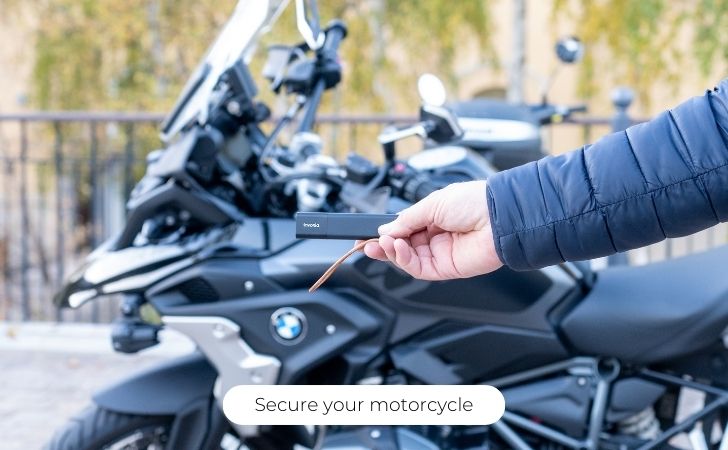
Where to place a GPS anti-theft on your motorcycle? #
To remain effective, the tracker must be hidden and difficult to spot, while maintaining good signal reception. The most common locations are:
- under the seat;
- in the fairing;
- behind a bodywork element;
- in a storage compartment;
- near the wiring, if the location remains discreet;
- in an area not easily accessible without disassembly.
The right location depends on the motorcycle model, available space, and type of tracker. The goal is to find a compromise between discretion, signal reception, and accessibility for recharging if the tracker runs on battery.
Avoid surrounding it entirely with metal, which could create a Faraday cage and degrade location. A location that is too closed, too low, or too isolated can reduce signal quality and delay position updates.
For more information, read our dedicated guide: where to place a tracker on a motorcycle.
Mistakes to avoid with a motorcycle GPS anti-theft #
Installing a tracker is an excellent decision, but it must be used correctly. Some mistakes can reduce its effectiveness.
Placing it in too obvious a spot #
Under the seat can be convenient, but it’s also one of the first places a thief might check. If you choose this location, make sure the tracker is not visible at first glance.
The ideal is to choose a discreet spot, but not completely isolated from the signal. A good location is a place you can easily find, but that a thief will not immediately notice.
Sticking it against a metal mass #
Metal can interfere with GPS reception and limit signal transmission. It’s better to avoid areas entirely enclosed in the frame or in a metal part.
If in doubt, test several locations before permanently fixing the tracker. Place it, close the seat or fairing, then check in the app that the position is correctly reported.
Forgetting to check the battery #
A motorcycle GPS tracker must remain operational when you need it. Choose a model with good autonomy and make it a habit to check its battery level in the app.
Autonomy is even more important if your motorcycle often remains immobilized. A tracker that lasts several weeks or months limits the risk of discovering too late that the battery is empty.
Not activating notifications #
A tracker without activated notifications loses much of its interest. Make sure that movement alerts, push notifications, and app permissions are properly configured on your phone.
Also, check that your smartphone does not prevent the app from sending notifications in the background. Some energy-saving settings can block or delay alerts.
Trying to recover the motorcycle yourself #
Even if you know your motorcycle’s position, never intervene alone. In case of theft, provide the information to law enforcement and let them handle the intervention.
A GPS position may give the impression that recovery is simple, especially if the motorcycle seems close. But the situation can be dangerous: the vehicle may be monitored, hidden in private property, or linked to an organized network.
How to choose your motorcycle GPS anti-theft #
Before purchasing, check the following criteria:
- autonomy: prefer a model without wiring lasting several weeks to several months;
- discretion: a compact format is easier to hide;
- alert reliability: motion detection must be fast and relevant;
- app quality: clear map, history, reliable notifications;
- overall cost: include any subscription and product lifespan;
- network coverage: check that the tracker works well in your country and usage areas;
- ease of installation: an autonomous model avoids touching the electrical wiring;
- resistance: the motorcycle being exposed to vibrations, cold, heat, and sometimes humidity, the box must be adapted to real use.
A good motorcycle GPS anti-theft must above all be reliable at the critical moment. It’s not enough for it to correctly locate the motorcycle under ideal conditions: it must also remain useful when the vehicle is quickly moved, parked in a less covered area, or hidden in an unusual place.
If you’re hesitating between several models, our comparison of the best motorcycle GPS trackers details the main solutions on the market.
Motorcycle GPS anti-theft with or without subscription: what to choose? #
Most motorcycle GPS trackers use mobile or low-power connectivity to send their position. This connectivity has a cost, often included in a subscription.
A tracker with a subscription may seem less attractive at first, but it generally offers a more complete service: app, notifications, connectivity, updates, and remote tracking. For anti-theft use, it’s often the most reliable choice, as the tracker must be able to transmit its position even when the motorcycle is far from you.
Conversely, solutions without a subscription sometimes rely on community networks or the proximity of other devices. They can be useful for finding a lost object, but they are less suited to the active protection of a two-wheeler against theft.
For a motorcycle, the real question is not just the subscription price, but the level of service provided: frequency of positions, alert reliability, app quality, network coverage, and box autonomy.
AirTag, alarm, or GPS tracker: what are the differences? #
Many motorcyclists wonder if they can replace a motorcycle GPS tracker with an AirTag or another Bluetooth accessory. The answer depends on the intended use.
An AirTag can help find an object nearby or in an area frequented by Apple users. But it is not designed as a motorcycle anti-theft. It does not transmit a continuous position by itself and can alert a tracked person of its presence.
A motorcycle alarm, on the other hand, is useful for making noise and attracting attention. But if no one reacts, or if the motorcycle is quickly loaded into a vehicle, the alarm does not allow you to know where it is.
The dedicated GPS tracker is different: it is designed for remote location, movement alerts, and post-theft tracking. For a real anti-theft strategy, the ideal is to combine several solutions rather than relying on a single device.
Can a motorcycle GPS anti-theft help with insurance? #
A motorcycle GPS tracker does not replace theft insurance, but it can play an important role in case of a claim. First, it allows for a quicker reaction, which increases the chances of recovering the vehicle. Then, it provides factual elements: last known position, movement history, time of suspicious movement.
Depending on the contracts, insurers may also require certain anti-theft devices: approved anti-theft, engraving, secure parking, or specific protection conditions. Before buying a tracker, it is useful to review your contract and check your motorcycle insurance requirements.
Even when the tracker is not explicitly required by the insurer, it remains a valuable complement. Recovering your motorcycle quickly can avoid lengthy procedures, prolonged immobilization, and significant financial loss, especially if the vehicle is found damaged too late.
For which motorcycles is a GPS anti-theft recommended? #
A motorcycle GPS anti-theft is useful for almost all two-wheelers, but it becomes particularly relevant in certain cases:
- motorcycle parked on the street;
- scooter or motorcycle used in the city;
- two-wheeler parked in a communal parking lot;
- high-end or recent motorcycle;
- vehicle used only on weekends;
- motorcycle left unattended for several days;
- two-wheeler parked near a station, office, or secondary residence;
- collector’s motorcycle or model difficult to replace.
The longer the motorcycle remains unsupervised, the more interesting the GPS tracker becomes. It allows you to maintain a connection with the vehicle, even when you are not on site.
It is also recommended for motorcycles that particularly attract thieves: recent models, large displacements, motorcycles easy to resell in parts, or two-wheelers very present in the city. In these cases, a simple mechanical anti-theft may not be enough.
What to do if your motorcycle is stolen? #
A GPS anti-theft takes its full value in a quick and structured reaction. In case of disappearance:
- check the last position and recent movements in the app;
- verify if the motorcycle is still moving or seems immobilized;
- take screenshots of the position and history;
- never attempt to recover the motorcycle yourself;
- file a complaint and provide law enforcement with the license plate, color, photos, registration card, and recorded position;
- if you have an Invoxia GPS tracker, generate your Theft File;
- contact your insurance within the deadlines provided by your contract.
The priority is to act quickly, but without taking risks. A GPS position can be very useful, but it must be exploited by authorities. Even if the motorcycle seems close, it is strongly discouraged to go alone to the location.
Also keep all useful elements: serial number, purchase invoice, recent photos, registration certificate, exact model, distinctive signs, and installed accessories. This information can speed up procedures with law enforcement and insurance.
FAQ: motorcycle GPS anti-theft #
Is a motorcycle GPS anti-theft really effective against theft? #
Yes. Unlike a mechanical anti-theft, it acts after the theft by locating the motorcycle, tracking its movements, and sending real-time alerts. For optimal protection, it combines with a classic anti-theft.
Where to hide a GPS tracker on a motorcycle? #
Under the seat, in the fairing, behind a bodywork element, or in a storage compartment. The essential thing is that it remains invisible while maintaining good signal reception. Avoid areas entirely surrounded by metal, which can limit location quality.
Do you need a subscription for a motorcycle GPS anti-theft? #
Most trackers use a mobile or low-power network to transmit their position, which involves a subscription covering connectivity, the app, and real-time alerts. For anti-theft use, this connectivity is essential to track the motorcycle even when it is no longer nearby.
Can an AirTag replace a motorcycle GPS anti-theft? #
No. An AirTag depends on the passage of Apple devices to transmit its position and is not designed as an anti-theft system for vehicles. A dedicated GPS tracker remains more reliable, as it emits alerts and transmits the position remotely.
Can you install a motorcycle GPS anti-theft yourself? #
Yes, if the tracker is autonomous and without wiring. You just need to place it in a discreet spot, associate it with the app, and check that the location works correctly. For wired models, professional installation may be preferable.
Does a motorcycle GPS tracker work in an underground parking lot? #
Signal quality can be reduced in some underground parking lots, closed garages, or metallic areas. However, a good tracker can continue to transmit information as soon as it regains network or when the motorcycle moves to a better-covered area.
What is the difference between a motorcycle alarm and a GPS anti-theft? #
An alarm makes noise to deter the thief at the moment of action. A GPS anti-theft, on the other hand, allows you to locate the motorcycle after it has been moved. Both solutions are complementary: the alarm attracts attention, the tracker helps to find the vehicle.
Does a motorcycle GPS anti-theft drain the battery? #
An autonomous tracker operates with its own battery and does not draw on the motorcycle’s battery. It is a practical solution for motorcycles that are ridden infrequently or remain parked for a long time. You just need to monitor the tracker’s battery level in the app.
What is the best GPS anti-theft for motorcycles? #
The best motorcycle GPS anti-theft is the one that combines good autonomy, discreet format, reliable alerts, easy-to-use app, and connectivity suited to your usage area. For a motorcycle, discretion and alert reactivity are particularly important.
Is a motorcycle GPS anti-theft useful if the motorcycle is stored in a garage? #
Yes. Even in a garage, a motorcycle can be moved, loaded into a utility vehicle, or taken out without you immediately noticing. The tracker allows you to be alerted in case of movement and to maintain a usable position if the vehicle disappears.
How long does it take to install a motorcycle GPS tracker? #
For an autonomous tracker, installation can be very quick: it usually just needs to be activated, associated with the app, and then hidden on the motorcycle. The most important thing is to take the time to choose a good location, discreet but compatible with good signal reception.