

Updated on 18 August 2026
According to the MCIA (Motorcycle Industry Association), over 30,000 motorcycles and scooters are stolen in the UK every year — and across Europe the figure runs into the hundreds of thousands. Fewer than one in four stolen bikes is ever recovered. No region is immune, whether urban or rural. In response, more and more riders are turning to a motorcycle GPS tracker: not to prevent theft outright, but to receive an immediate alert and maximise the chances of recovery in those critical first minutes.
Motorcycles are among the most theft-prone vehicles on the road. Lighter than cars, easier to move, and often parked outdoors or in shared car parks, they make easy targets. That is precisely why a growing number of riders invest in a motorcycle GPS tracker — to locate their vehicle, receive an alert when something suspicious happens, and dramatically improve their chances of getting it back.
Some models are targeted far more than others: France’s own theft data (from Invoxia’s insurance partner base) shows that popular, easy-to-resell-for-parts models make up a disproportionate share of thefts each year. Our analysis of France’s most stolen motorcycles in 2025 breaks down which ones — the patterns it highlights (in-demand models, easy parts resale) tend to hold in the UK too, even if the exact ranking differs.
Why fit a GPS tracker to your motorcycle? #
A motorcycle GPS tracker lets you monitor your bike directly from your smartphone. Unlike a mechanical lock, which is mainly designed to slow down or deter a thief, a GPS tracker really comes into its own once the bike has been moved. It lets you follow its position, review recent journey history and react without delay.
This logic matters even more for urban two-wheelers. Motorcycles and scooters parked in cities need discreet protection that is simple to install and genuinely suited to daily use. Urban bikes are twice as likely to be stolen as those kept in rural areas* — exactly what happened to a Honda PCX 125 scooter stolen in Paris and recovered thanks to its GPS tracker.
A tracker can also work intelligently alongside a more traditional motorcycle anti-theft device. A physical lock is your first line of defence, but no lock is 100% effective. That is where a GPS tracker becomes your best ally: it alerts you the moment something moves and doubles your chances of recovering your motorcycle*.
How to choose the best motorcycle GPS tracker #
Battery life, network, app and total cost: these are the same criteria that define a good GPS tracker in general, but their priorities shift sharply once you’re protecting a two-wheeler rather than a car or a valuable item — discretion and wire-free installation move to the top of the list.
Battery life #
This is one of the criteria that varies most from model to model — from a few days to 6 months depending on the technology used. For a motorcycle, especially one stored away over winter, that gap changes everything.
Location accuracy #
A good motorcycle GPS tracker does not rely on GPS alone. The most effective models typically combine several positioning technologies to improve tracking reliability while keeping energy consumption low.
Anti-theft alerts #
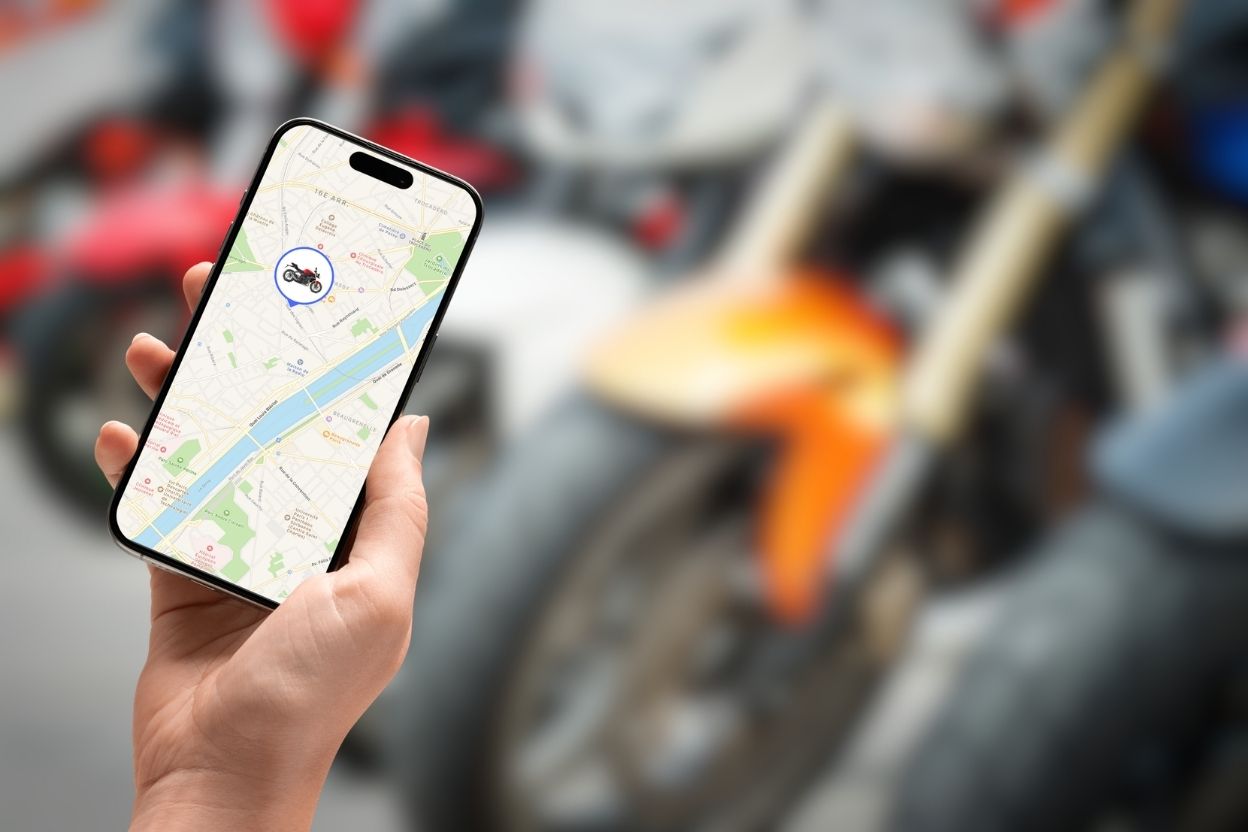
Any tracker intended to protect a motorcycle must be able to notify you immediately if there is any unauthorised movement. The best apps also let you review journey history, follow the vehicle on a map and act without hesitation the moment an alert arrives.
Total cost #
Beyond the purchase price, you need to factor in any subscription fees, the product’s lifespan, app quality and service reliability. The true cost of a tracker is always best assessed over time, particularly if you are looking for a long-term protection solution.
The right benchmark: total cost over three years. A £50 tracker with a £5/month SIM subscription works out at £110 in year one. A £99 tracker with one year’s subscription included costs just £99 in the first year. Always compare over a meaningful timeframe.
This thinking also applies to financially protecting your bike. It’s worth pairing this comparison with our motorcycle insurance guide, which explains how prevention, equipment and cover work together.
The network: LTE-M, 4G or Sigfox? #
The type of network your tracker uses determines its real-world coverage, energy consumption and reliability in challenging locations (underground car parks, rural areas). This is a factor too many comparison guides overlook.
LTE-M (used by Invoxia): a low-power 4G technology designed specifically for IoT devices. It offers coverage equivalent to standard 4G, with the added advantage of better penetration in underground car parks and weak-signal areas. Its very low energy draw is what makes long battery lives possible.
Standard 4G (PAJ GPS, Salind, GeoRide): excellent accuracy and very frequent position updates, but high energy consumption — resulting in shorter battery life (days to weeks). Usually requires a separate SIM card.
Sigfox / LoRa: proprietary low-power IoT networks with very low energy use, but incomplete rural coverage and limited update frequency. These networks remain operational but are losing ground to LTE-M over the long term.
In practice, for a motorcycle used across the UK and Europe, LTE-M is the best all-round choice in 2026: near-total coverage, long battery life, and a durable network run by established mobile operators.
Motorcycle GPS tracker battery life: the criterion that makes the real difference #
On a motorcycle, battery life isn’t just a marketing number — it decides whether the tracker stays genuinely useful all year round, including the months the bike isn’t ridden. A motorcycle stored from October to March, a scooter left parked for weeks during the holidays, a classic bike only ridden at weekends: in every one of these cases, a tracker that needs recharging every fortnight quickly becomes a tracker people forget to recharge — and therefore a tracker that’s dead exactly when it matters most.
Three factors explain the battery life gaps in this comparison:
- Network type: an LTE-M tracker uses noticeably less power than a standard 4G tracker to send the same information, which on its own explains most of the difference between models (see the network section above).
- Update frequency: a tracker that continuously reports its position uses more power than one that only wakes up when it detects movement.
- Power source: a tracker wired to the vehicle’s battery has no technical battery-life limit of its own, but depends entirely on that battery — with a direct risk if a thief disconnects it, or if the bike’s battery drains over winter.
The Invoxia GPS Tracker Pro Max stands out here specifically: up to 6 months of battery life on a single charge, thanks to the low-power LTE-M network, with no wiring to the vehicle’s battery required. In practice, a bike fitted before winter can stay monitored right through to spring without any intervention needed — battery life measured in real-world conditions and compared against the Classic model, which is cheaper but needs recharging more often.
Here’s how the main motorcycle GPS trackers compare on this one criterion:
| Tracker | Claimed battery life | Power source |
|---|---|---|
| Invoxia GPS Tracker Pro Max | Up to 6 months | Built-in rechargeable battery, wire-free |
| Monimoto 9 | Roughly 2–12 months depending on use (minimal use needed to hit the top of the range) | Replaceable battery |
| Beepings Zen | 3–6 months depending on mode | Built-in battery, magnetic mount |
| GeoRide | No fixed limit, but depends on the vehicle | Hardwired to the motorcycle battery |
| PAJ GPS | A few days to roughly 2–3 months depending on the model | Rechargeable battery or wired connection |
| Salind | Up to roughly 90 days (20 4G model) | Built-in battery, magnetic mount or wired connection |
The wide range claimed by Monimoto (2 to 12 months) is worth reading with some caution: as with any tracker, real-world battery life depends heavily on how many alerts and journeys are logged — daily use noticeably shortens the maximum claimed battery life, closer in practice to a few months than a full year. This is worth checking against user reviews rather than the spec sheet alone, whichever tracker you choose — the Pro Max has the advantage of a tighter, more predictable range (up to 6 months).
In practice, for typical use (a bike ridden regularly, parked outdoors or in a garage, stored for a few winter months): a wire-free LTE-M tracker like the Pro Max remains the simplest “fit and forget” option — no trade-off needed between battery life and discreet installation.
Motorcycle GPS tracker with no subscription: myth or reality? #
This question comes up in every comparison. The short answer: a truly subscription-free motorcycle GPS tracker does not really exist.
A GPS tracker needs a network to send its position to your smartphone. That network has an operational cost, presented differently depending on the model:
- “No subscription” with costs built in: some manufacturers include the network cost in the purchase price for one to three years, then charge for renewal. The subscription exists — it is simply prepaid. Always read the terms and conditions.
- “No subscription” with a prepaid SIM: you manage your own data SIM plan. The monthly cost is real, just handled separately. These solutions can end up more expensive if you choose the wrong SIM plan.
- Bluetooth trackers such as AirTag: these are not GPS trackers in the true sense. They do not trigger alerts and can only locate your motorcycle when another device passes nearby — sometimes hours after a theft, sometimes never in a quiet area.
How we compared these motorcycle GPS trackers #
This comparison is based on each manufacturer’s official spec sheets (claimed battery life, network type, IP rating), cross-checked against publicly available user feedback and the real-world conditions offered by partner insurers. Five criteria were chosen because they come up most often in accounts from riders who have experienced a theft: real-world battery life (not just claimed), network reliability in underground car parks, alert speed, wire-free installation, and total cost over three years rather than purchase price alone.
This page is updated as manufacturers evolve their ranges (new certifications, battery life changes, subscription offers) — last checked: 18 August 2026.
Motorcycle GPS tracker comparison #
Invoxia GPS Tracker Pro Max — The benchmark for motorcycle security #
The GPS Tracker Pro Max from Invoxia is the most complete model in the range for motorcycles. Its compact format makes it easy to hide discreetly under the seat or inside the fairing, with no wiring to the vehicle’s battery required. It runs on the LTE-M network, which offers wide population coverage and penetrates underground car parks better than standard 4G.
Its headline features:
- up to 6 months of battery life (low-power LTE-M network)
- wire-free installation — magnetic or adhesive mounting, in under 5 minutes
- intelligent anti-theft alerts that distinguish real movement from accidental nudges in a car park
- clear mobile app with full journey history
- digital theft report exportable for police and insurers
- LTE-M network: wide population coverage, superior penetration in underground car parks
For riders, this is a particularly well-rounded solution when the goal is to protect the bike day to day while also having a reliable tracking tool in the event of theft.
Monimoto — A GPS tracker with a key fob authentication system #
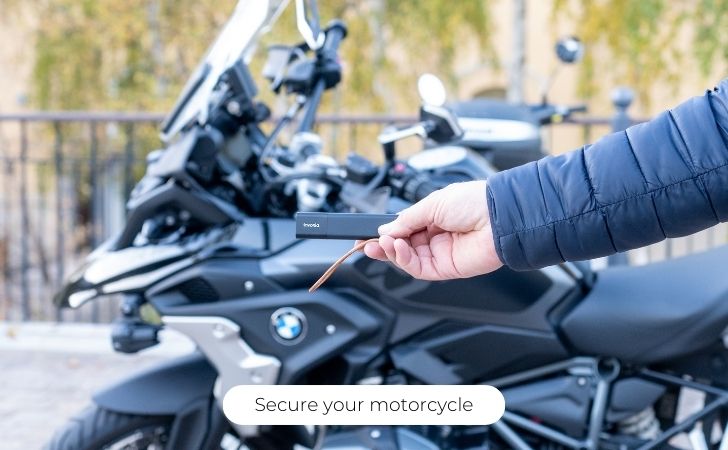
The Monimoto is a GPS tracker built specifically for motorcycles and scooters. It uses an authentication system based on an electronic key fob.
If the motorcycle moves without the key fob nearby, the tracker triggers an alert and sends the vehicle’s position. The Monimoto 9 (2026) adds IP68 certification and rechargeable batteries, with a claimed battery life of up to 12 months.
Key features:
- anti-theft system with Bluetooth key fob
- alerts when the bike moves without the owner present
- replaceable battery, IP68 certification
- straightforward installation, no wiring required
This system can be effective at detecting theft, but it relies on the key fob always being with the owner, which can be inconvenient in some situations. The subscription is not included in the purchase price.
GeoRide — A connected tracker built with riders in mind #
GeoRide is a solution developed for motorcycles. It stands out through a connected ecosystem oriented around riders, with features focused on safety and journey tracking.
The tracker must be wired to the vehicle’s battery, which enables continuous monitoring but requires a more technical installation.
Key features:
- GPS location tracking
- anti-theft alerts
- riding statistics (speed, lean angle, fall detection)
- community features for riders
This type of solution can be appealing for users who want to combine security with journey analysis. One caveat: wiring to the vehicle’s battery means the tracker can lose power if a thief disconnects the cable.
Beepings Zen — The magnetic French-made tracker #
The Beepings Zen is designed in France (Brest) and stands out for its magnetic mounting: it attaches in seconds to the frame or tank and can be moved between vehicles without any tools. IP67 certified, it uses a hybrid LTE-M/Sigfox network depending on local coverage.
Key features:
- magnetic mounting — move between vehicles in seconds
- IP67 certification, weather-resistant
- 3 to 6 months of battery life depending on mode
- push alert as soon as the bike leaves its usual parking zone
An ideal solution for riders with multiple vehicles or anyone who wants a completely tool-free installation. The subscription is not included in the purchase price.
PAJ GPS — A general-purpose tracker, available in several models #
PAJ GPS is a German manufacturer offering a fairly broad range of GPS trackers built for different uses (car, motorcycle, valuables, people), with a more general-purpose positioning than solutions built specifically for two-wheelers.
Key features:
- standard GPS tracking with movement alerts and journey history
- wide range, but battery life varies significantly by model (a few days to roughly 2–3 months depending on the version)
- generally runs on standard 4G, with a SIM card
These trackers are better suited to cars or professional fleets than to motorcycles, where discretion and long battery life are the priority.
For a full breakdown of pricing and plans, see our PAJ GPS vs Invoxia comparison.
Salind — A vehicle-focused tracker with longer battery life #
Salind is a brand distinct from PAJ GPS, focused on GPS trackers dedicated to vehicles (cars, motorcycles, machinery, trailers), often with a magnetic mount. The Salind 20 4G model, for example, claims around 90 days of active battery life (up to 180 days on standby), according to manufacturer data.
Key features:
- real-time GPS tracking, movement alerts, journey history
- magnetic mounting on some models, wire-free installation
- longer claimed battery life than the average standard-4G tracker (up to roughly 90 days depending on the model)
- runs on 4G, subscription required
Worth considering if you want a more battery-efficient 4G tracker than the standard PAJ GPS models, without quite reaching the 6 months offered by LTE-M.
Which motorcycle GPS tracker should you choose? #
Each solution has its strengths depending on what you need:
- Invoxia GPS Tracker Pro Max: best combination of battery life, network coverage and total cost — and the most versatile option overall, since the same range also covers cars, valuables and people tracking
- Monimoto: dedicated motorcycle anti-theft system with Bluetooth key fob detection
- GeoRide: full connected solution for passionate riders
- Beepings Zen: French magnetic tracker, practical for multi-vehicle use
- PAJ GPS: general-purpose multi-vehicle range, battery life varies by model
- Salind: vehicle tracker with magnetic mount, longer battery life for a 4G device
| GPS Tracker | Battery life | Network | Installation | Anti-theft alerts | Subscription included | Best for |
|---|---|---|---|---|---|---|
| Invoxia GPS Tracker Pro Max | Up to 6 months | LTE-M | Wire-free, built-in rechargeable battery, optional wired connection | Movement detection + geofencing + in-app notifications | Yes (1 year) | Riders looking for a discreet, autonomous and versatile tracker |
| Monimoto 9 | Approx. 2 to 12 months depending on model | 4G/LTE | Wireless, replaceable battery | Alert if bike moves without the Bluetooth key fob | No | Dedicated motorcycle anti-theft protection |
| GeoRide | Powered by vehicle battery | 4G | Hardwired to battery | Anti-theft alerts + riding stats | No | Riders wanting a fully connected system |
| Beepings Zen | 3 to 6 months | LTE-M/Sigfox | Magnetic, no tools required | Geofence alert | No | Multi-vehicle use, zero-hassle installation |
| PAJ GPS | A few days to roughly 2–3 months depending on model | Standard 4G | Rechargeable battery or wired connection | Movement alerts | No | Users wanting a general-purpose, multi-use tracker |
| Salind | Up to roughly 90 days (20 4G model) | 4G | Magnetic mount or wired connection | Movement alerts | No | Users wanting a more battery-efficient 4G tracker |
For motorcycles, the most important criteria generally remain:
- discretion
- battery life
- reliability of anti-theft alerts
- ease of installation
- network type (coverage in rural areas and underground car parks)
Motorcycle GPS tracker and insurance: how much can you save? #
This is a benefit that often goes unnoticed: fitting a GPS tracker can reduce your motorcycle insurance premium or excess.
Many insurers factor active security measures into their pricing. A GPS tracker — especially one that is certified or Thatcham-approved — can open the door to:
- Reduced theft excess: some insurers waive or significantly reduce the excess for policyholders with a tracker fitted
- Annual premium discount: typically 5 to 10% depending on the insurer and tracker model
- Faster claims processing: the digital theft report (GPS history exported from the app) makes it easier to substantiate a claim
UK insurers known to recognise GPS trackers as a positive security factor include MCE Insurance, Bennetts, BeMoto and Devitt, among others. Conditions vary by policy — always check directly with your insurer.
The golden rule: always mention your tracker when taking out or renewing a policy, and ask explicitly whether it qualifies you for better terms. Some insurers only apply the discount if you ask for it, and discounts vary noticeably between insurers — it’s worth shopping around before you renew.
AirTag or motorcycle GPS tracker: what is the difference? #
The comparison comes up frequently, but an AirTag does not serve the same purpose as a dedicated motorcycle GPS tracker. An AirTag depends on nearby Apple devices to relay its position, whereas a dedicated GPS tracker is built for vehicle security, active alerts and continuous tracking.
An AirTag triggers no alerts. In an isolated car park or a quiet area, the position update can take several hours to come through — or may never update at all. A dedicated motorcycle GPS tracker sends an immediate alert and tracks the bike continuously, independently of any other devices nearby.
For a detailed breakdown of the differences in use, reliability and anti-theft logic, see our full comparison: Apple AirTag vs Invoxia GPS Tracker.
What to do if your motorcycle is stolen #
A GPS tracker delivers its full value when it forms part of a fast, structured response. If your bike disappears, act methodically: check the most recent movements, gather all relevant information, contact the police and provide as much usable detail as possible:
- registration plate
- vehicle colour
- photographs
- V5C logbook
- last known location and GPS history exported from the app
With Invoxia, the Theft Report compiles all this information to help law enforcement act quickly. It also gives officers access to live location tracking via a QR code.
This becomes even more tangible when you see how effective tracking has helped resolve real theft cases. Our account of a stolen motorcycle recovered thanks to an Invoxia GPS tracker shows exactly what is possible.
What is the best motorcycle GPS tracker? #
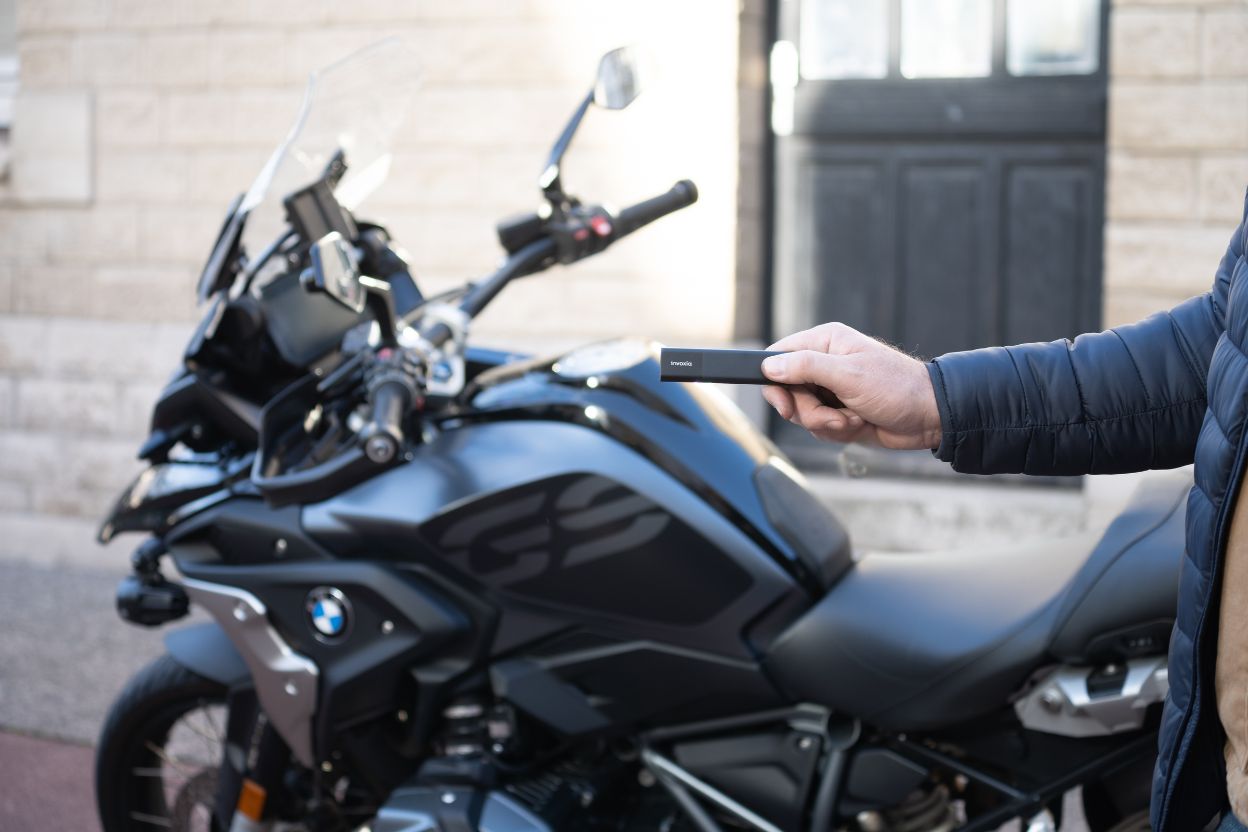
The best motorcycle GPS tracker depends on your priorities, but certain criteria are non-negotiable: solid battery life, reliable alerts, a clear app, accurate positioning and discreet installation. For most riders, the goal is not simply to buy a gadget, but to add a genuine layer of protection to their vehicle.
It’s on the combination of all these criteria — not just one of them — that the Invoxia GPS Tracker Pro Max stands out in this comparison: wide LTE-M coverage, up to 6 months of wire-free battery life, installation in minutes, subscription included from day one, and a digital theft report to speed up the paperwork. Some models do better on a single, isolated criterion (Monimoto’s claimed maximum battery life, for instance), but none combines as many strengths at once without a trade-off on discretion or budget.
FAQ: motorcycle GPS tracker #
What is the best motorcycle GPS tracker? #
The best motorcycle GPS tracker depends on several factors: battery life, location accuracy, ease of installation and the quality of the mobile app. Most riders want a discreet, autonomous tracker capable of sending alerts whenever the bike moves suspiciously.
The Invoxia GPS Tracker Pro Max stands out as the most balanced option across the board (battery life, network coverage, installation, subscription included). Monimoto (dedicated motorcycle anti-theft with Bluetooth key fob, though inconvenient if the fob isn’t always to hand) and GeoRide (full ride tracking, though wired to the vehicle’s battery) remain worth considering for more specific needs.
How does a motorcycle GPS tracker work? #
A motorcycle GPS tracker uses several technologies to determine the vehicle’s position:
- GPS for location
- mobile network (LTE-M or 4G) to transmit the position
- motion sensors to detect movement
When the motorcycle moves, the tracker can send an alert to your smartphone and display its position directly within the app.
Where should you hide a GPS tracker on a motorcycle? #
To be effective, a GPS tracker should be placed somewhere discreet and hard to spot.
Common locations include:
- under the seat
- inside the fairing
- behind a body panel
- inside a storage compartment
It’s important the tracker stays hidden while still maintaining good GPS reception. Avoid spots surrounded by metal, which can create a Faraday cage effect that blocks the signal.
Is a motorcycle GPS tracker effective against theft? #
Yes, a GPS tracker can significantly increase the chances of recovering a stolen motorcycle. Fewer than one in four stolen motorcycles in the UK are ever recovered. With an active GPS tracker and a fast response from the moment an alert comes in, recovery rates improve considerably.
Unlike a traditional mechanical lock, it lets you:
- locate the motorcycle after it has been stolen
- follow its movements in real time
- receive instant alerts
For the best protection, it’s recommended to combine a GPS tracker with a physical anti-theft device.
Can you use an AirTag to track a motorcycle? #
An Apple AirTag can help locate a lost item, but it isn’t designed as a vehicle anti-theft system. It triggers no alerts and relies on nearby iPhones to relay its position. If no Apple device passes by, the location won’t update.
A dedicated motorcycle GPS tracker remains significantly more reliable, since it sends alerts and transmits the vehicle’s position continuously, without depending on other devices.
Are there motorcycle GPS trackers with no subscription? #
Not in the strict sense: every GPS tracker needs a network to transmit its position, which involves a connectivity cost. Some models include this cost in the purchase price for one to three years (like Invoxia); others require a separate prepaid SIM card. Solutions marketed as “lifetime no subscription” often rely on networks with limited features, or charge for renewal after the initial period. Total cost over three years is the right benchmark for comparison.
Can a motorcycle GPS tracker reduce my insurance premium? #
Yes, with certain insurers. Fitting a GPS tracker can qualify you for a reduced theft excess and an annual premium discount of 5 to 10%. UK insurers known to recognise GPS trackers include MCE Insurance, Bennetts, BeMoto and Devitt, among others. Always mention your tracker when taking out or renewing a policy to make sure you benefit.
What is the LTE-M network coverage for motorcycle GPS trackers? #
In 2026, the LTE-M network (used by Invoxia) offers coverage broadly equivalent to standard 4G across the UK and Europe, with one added benefit: better penetration in underground car parks and areas of weak signal. In rural areas, LTE-M coverage broadly follows standard 4G mobile coverage.
How much does a motorcycle GPS tracker cost? #
The price of a motorcycle GPS tracker typically ranges from £50 to £200, depending on the technology and features on offer.
You should also factor in:
- any subscription costs
- battery life
- the quality of the mobile app
The real cost therefore depends primarily on the tracking service and how reliably the product performs over time. Always calculate the total cost over three years to objectively compare subscription-included and subscription-excluded options.
*Invoxia study on theft risk across different modes of transport, conducted in October 2024 with 7,325 respondents in France.