

Your dog has just disappeared and you don’t know where to start: it’s normal, and it’s even the most common reaction. A lost dog usually stays close to the place where it escaped — the first few minutes are therefore precious, but they are not a panicked race against time. Here, in order, are the actions to take immediately, followed by the complete method to find it, hour by hour and day by day.
Lost Dog: Actions for the First 30 Minutes #
Before launching into a frantic search, a few simple reflexes really increase your chances — and prevent your dog from running further away.
- Do not run after him and do not shout. A scared dog associates the chase with a game or danger, and moves further away. Call him calmly, with his usual “positive” voice (the one for meals or walks).
- Search the immediate perimeter first: garden, street, building lobbies, under cars, bushes. Many “lost” dogs are found just a few feet away, simply hidden or stuck somewhere. Don’t hesitate to take his favorite treats and shake them from time to time.
- Leave a door or gate open, and put out his bowl, bed, or a piece of clothing you wear: the familiar smell can guide him home, especially at night.
- Immediately inform the people around you: neighbors, shopkeepers, passersby, delivery people. The faster the information circulates, the more you increase your chances of someone reporting a sighting. Apps like Animou even allow you to extend the alert to unknown people nearby.
- If your dog is wearing a GPS collar, open the app without delay. With the Biotracker, Live Tracking can be activated with one click to follow his position in real-time and head directly in the right direction, instead of waiting for someone else to find him.
Reporting the Loss: Administrative Steps Not to Forget #
Once the immediate search is underway, you need to initiate official procedures — these are what will allow a third party or a shelter to contact you if your dog is found far from home.
Report the loss to I-CAD, the national identification file for domestic carnivores, as soon as possible. Have the chip or tattoo number (indicated on the identification card) ready and make the declaration from your online holder space, by phone, or via the FILAPLAT app. This declaration allows a veterinarian, a town hall, or a shelter to link the found dog to you, provided it is scanned.
Then:
- Contact your veterinarian: they can report the disappearance and advise you on local procedures.
- Call shelters and refuges within a 12 to 18 miles radius, providing a precise description (breed, size, color, distinctive signs, chip number). Renew the call regularly, as found dogs sometimes pass through quickly.
- Notify the town hall and the gendarmerie or municipal police of your town: municipal agents are often the first informed of a stray animal.
Reminder: just because you have an electronic chip (and not a GPS tracker) doesn’t mean it will help you find your dog. It serves to identify you once he is found and scanned — not to know where he is.
How to Find a Lost Dog: The Complete Method, Hour by Hour #
After the very first minutes, the rest depends mainly on method and regularity, not haste. Here’s how to structure the search over the hours and days that follow.
The First 24 Hours #
- Grid the area on foot, methodically. Have a plan (mental or real) and walk street by street around the disappearance point, gradually widening the radius. A frightened dog rarely moves in a straight line: he follows fences, hides in corners, crosses gardens.
- Favor quiet hours: early morning and at dusk, when there is less noise, fewer people, and more chances for a stressed dog to come out of hiding.
- Leave olfactory markers at the disappearance site: a worn piece of clothing, his bed, a toy. Some dogs return alone to this scent in the hours that follow.
- Drive slowly with windows down, calling him regularly — useful for covering a wider radius without exhausting foot searches.
- Check surveillance cameras of shops, residences, or individuals on the probable route: many agree to share footage if you explain the situation.
Expanding the Search: Posting, Networks, and Dedicated Apps #
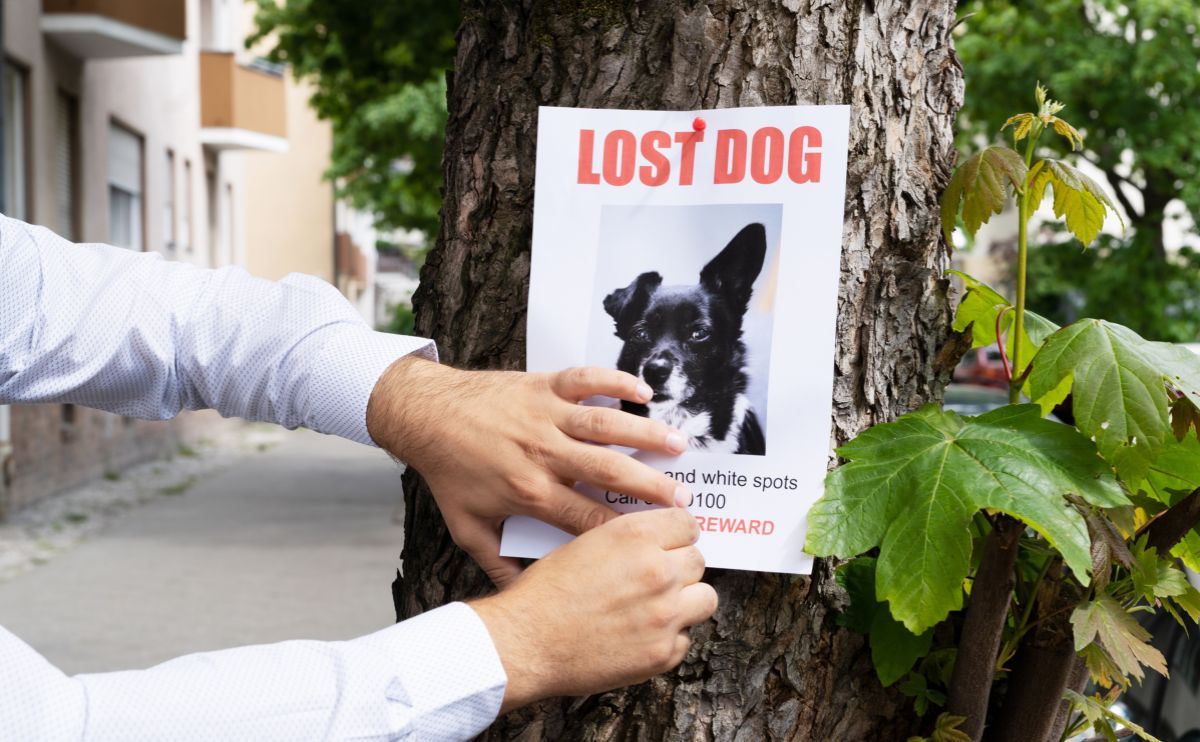
Posters remain remarkably effective. A clear and readable flyer, with a close-up photo, the mention “Lost Dog”, the name, description, and a phone number (yours or a close one, not an address), placed at shops, schools, bus stops, and building entrances around the disappearance site, reaches exactly the people likely to encounter your dog.
Mobilize local social networks: neighborhood or lost animal Facebook groups, neighborhood apps. Post a clear photo, the exact date and place of disappearance, and explicitly ask for sharing.
Apps dedicated to finding lost animals are a good complement: they automatically match “lost” ads with “found” or “seen” reports in the same geographic area, without you having to share your personal details before connecting with the right person. This is the case with Animou, whose algorithm continuously compares loss and discovery ads: Invoxia has partnered with them precisely because GPS and community complement each other well in such situations.
A point of caution: lost dog ads sometimes attract malicious people. Avoid offering a cash reward and sharing your complete personal details in a public ad — prefer a dedicated number or the secure messaging of a reporting platform.
If the Search Lasts Several Days #
Don’t give up too quickly: most dogs are only missing for a few hours, but some remain untraceable for several days without being far away.
- Continue returning to the area, ideally at the same quiet hours, for several days in a row: a dog that has hidden often eventually comes out in the same perimeter.
- Recontact shelters and refuges every 2-3 days, with the updated photo and description — found dogs sometimes pass through quickly and files don’t always automatically match.
- Reach out to volunteers who specialise in finding lost dogs if the search drags on: some organisations have handlers with tracking dogs, or even drones, to cover larger areas or hard-to-reach terrain such as woodland and overgrown land. If your dog ran off during a driven hunt, notify the hunt organiser first.
- Stay optimistic: the vast majority of declared lost dogs are eventually found, even after several days or weeks.
Why Do Dogs Run Away? #
Fear of a sudden noise (fireworks, thunderstorm), reproductive instinct, following a scent or prey, separation anxiety, change of environment (moving, vacation, staying with a relative): the causes are multiple, and often combined. Understanding the most likely trigger for your dog helps both to find him faster and to prevent the situation from happening again.
> Runaway Dog: Why He Escapes and How to Prevent It
How to Prevent a Runaway from Happening Again #
Once your dog is found — or as a prevention if you want to avoid getting there — a few reflexes significantly reduce the risk: ensuring the identification is up to date in the I-CAD holder space, securing the garden and exit points, working on recall, and meeting his exercise and stimulation needs. We’ve detailed all this, point by point, in our article How to Prevent Dog Runaways?
A GPS tracker does not replace education, vigilance, or microchip identification — but it adds a concrete layer of security, especially for an explorer dog, recently adopted, or one that has already run away. With the Biotracker, you define a safety zone and receive an alert as soon as your dog crosses it: you can act in minutes, without waiting for someone else to find him or for a veterinarian to scan his chip.
🐾 The Biotracker, to Never Experience This Again #
A lost dog means hours or days of searching, worrying, and “if only I had known sooner”. The Invoxia Biotracker is designed to prevent reaching that point:
- Customizable Safety Zone — an instant alert as soon as your dog leaves it, before he even has time to get far
- Real-Time Live Tracking — in an emergency, his position appears directly on your phone, no need to wait for someone else to find him
- Long Battery Life — on average 7 days so he is always locatable, even after several days outside
The Biotracker does not replace I-CAD identification or your daily vigilance — it adds to the reflexes mentioned in this article, to react in minutes rather than hours.
Frequently Asked Questions #
How long does a lost dog stay outside? Most dogs are found within a few hours, often very close to the disappearance site. Beyond 24 to 48 hours, expand the search without stopping the steps already taken: returns several days, or even weeks later, are still possible.
Can a lost dog find his way home alone? It happens, especially on a familiar route and at a short distance, but it is not systematic. A stressed dog or one in an unfamiliar environment can easily become disoriented, especially on vacation, far from his usual landmarks — it’s better not to rely solely on that.
Should you offer a reward to find your dog? It is not recommended: ads with rewards sometimes attract malicious people who demand money without actually having the animal. Prefer the widest possible dissemination of the ad rather than a financial incentive.
What to do first: I-CAD, veterinarian, or posters? All three can be launched in parallel from the first hours. The I-CAD declaration is the most valuable in the long run, as it remains active until your dog is found and scanned.
Does a GPS collar really help find a lost dog? Yes, provided it is equipped before the runaway. A tracker like the Biotracker allows you to follow the position in real-time and receive an exit zone alert, which greatly reduces search time compared to a simple chip or tag, which identifies but does not locate.