

A PAJ tracker for about $40 or an Invoxia for $179? On the price tag, it looks like an easy call. In practice, the subscription, the power source and the battery life change both your 3-year bill and how well your car or motorcycle is protected.
PAJ GPS, an online tracker brand with stores in seven countries including the US, sells a hardwired box for vehicles: the Vehicle Finder 4G 2.0, which works on cars, motorcycles and vans. Invoxia makes battery-powered trackers you can drop in place without touching the vehicle’s electrical system. Here’s how they compare, point by point: real 3-year cost, installation, battery life, alerts, network and theft protection.
PAJ GPS or Invoxia: which one fits your situation? #
| Your situation | Best fit | Why |
|---|---|---|
| Vehicle parked for weeks (motorcycle in winter storage, classic car, vacation-home car, RV) | Invoxia Pro Max | Its own battery lasts up to 6 months, with no drain on the vehicle battery |
| Car or motorcycle you drive every day, always powered | PAJ Vehicle Finder 4G 2.0 | Constant power, low upfront price, alerts for power cuts and ignition |
| Live tracking every second after an alert | Invoxia Pro Max | Switches automatically to 1 location per second |
| Lowest upfront price | PAJ Vehicle Finder 4G 2.0 | About $40 for the device, plus a required plan |
| Lowest total cost over 3 years (Europe) | Invoxia Classic | €129 with 3 years of service included (sold in Europe only) |
| Discreet tracker, no wiring | Invoxia | Nothing to connect to the battery |
| Car or work van, no trip to the shop | Invoxia | Slip it into the cabin or trunk, no installation |
| Widest advertised coverage | PAJ | 100+ countries advertised |
The two brands in a nutshell #
PAJ GPS is a 4G tracker maker that claims over 500,000 customers in more than 30 countries, with a very wide range: hardwired vehicle trackers (Vehicle Finder), battery-powered trackers (Power Finder, Allround Finder), a solar tracker (Solar Finder 4G, launched in April 2026), and trackers for pets and people.
Invoxia is a French company with more than 400,000 users worldwide. It designs versatile battery-powered GPS trackers with the SIM card and the first year of service included. For a car, a motorcycle, valuables or even a loved one, Invoxia offers two models: the GPS Tracker Pro Max, on LTE-M and sold in the US and Europe, and the GPS Tracker Classic, on LoRa/Sigfox and sold in Europe only.
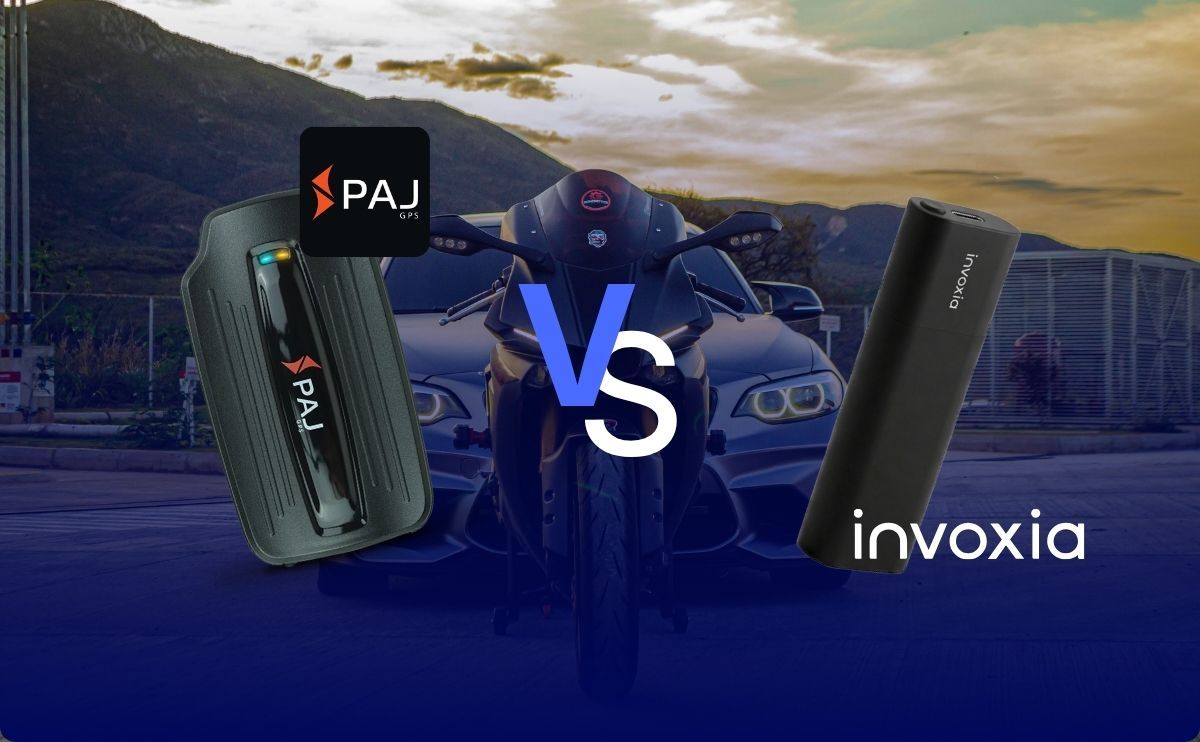
Side-by-side: PAJ Vehicle Finder 4G 2.0 vs Invoxia Pro Max and Classic #
| Feature | PAJ Vehicle Finder 4G 2.0 | Invoxia GPS Tracker Pro Max | Invoxia GPS Tracker Classic |
|---|---|---|---|
| Device price | $39.99 in the US, €49.99 in Europe | $179 in the US, €179 in Europe (1 year included) | €99 with 1 year or €129 with 3 years (Europe only) |
| Subscription | Required: Basic or Premium plan (see below) | 1 year included, then $66.95/year (€59.85 in Europe) | 1 or 3 years included, then €29.95/year (or €49.95 for 2 years) |
| Power | Hardwired to the vehicle battery (9 to 75 V) | Rechargeable battery (USB-C), no wiring | Rechargeable battery (USB-C), no wiring |
| Battery life without vehicle power | 12 to 24 hours on the backup battery, depending on the source | Up to 6 months | Up to 6 months |
| Network | “4G”, 100+ countries advertised | LTE-M, the US and 35+ countries (not the UK) | LoRa (France) / Sigfox (other European countries) |
| Tracking after an alert | Live tracking, refresh rate not specified | 1 location per second | One location every 2 minutes at best |
| Water resistance | IP67 | IP67 | IP67 |
| Size and weight | About 3.9 × 2 in (10 × 5 cm), 2.8 to 4.2 oz (80 to 120 g) | 4.4 × 1.5 × 0.7 in (113 × 39 × 19 mm), 2.5 oz (70 g) | 4.1 × 1 × 0.4 in (103 × 25 × 10 mm), about 1 oz (27 g) |
| Monitoring modes | Vibration, motion, geofence exit, speed, power cut, ignition and low-voltage alerts | Away mode and Alert mode, unlimited geofences, motion and tilt alerts, theft report | Motion and tilt alerts, theft report |
| Where to buy | PAJ stores in the US, the UK, France, Germany, Spain, Italy and Portugal | invoxia.com, in the US and Europe | Europe only, works in the country where it’s set up |
What does a PAJ really cost compared with an Invoxia over 3 years? #
PAJ’s upfront price is low, for a car or a motorcycle, but the subscription is mandatory and it makes up most of the bill. PAJ’s US store offers two plans: Basic (tracking and alerts, 3 days of trip history) and Premium (365 days of history, satellite maps, priority support, and lifetime device replacement as long as the plan is active). The tracker and the plan are sold separately, and each tracker needs its own license.
| Tracker | 3-year math (US) | Total in the US | Total in Europe |
|---|---|---|---|
| Invoxia GPS Tracker Classic | Europe only: €129 with 3 years included | — | €129 |
| Invoxia GPS Tracker Pro Max | $179 + 2 years at $66.95 | about $313 | about €299 |
| PAJ Vehicle Finder 4G 2.0 + Basic, yearly | $39.99 + 3 years at $90 | about $310 | about €300 |
| PAJ Vehicle Finder 4G 2.0 + Premium, yearly | $39.99 + 3 years at $102 | about $346 | about €340 |
With comparable features, the gap narrows: a PAJ on a yearly Basic plan costs about the same as a Pro Max over 3 years, and a PAJ Premium costs more. In Europe, only the Classic stays clearly cheaper. PAJ keeps an edge if you prepay 2 years: with the 2-year Basic plan ($132), the 3-year bill drops to about $262 in the US.
Hardwired or battery-powered: the real difference for a car or motorcycle #
This is where the two approaches differ most.
The PAJ Vehicle Finder 4G 2.0 connects to the vehicle battery (red wire with a fuse on the positive terminal, black wire on the negative). It never needs charging and tracks with no time limit as long as the vehicle has power. The trade-offs:
- if the vehicle sits for weeks or goes into winter storage, its battery can run down, leaving only the tracker’s backup battery (a car battery gives you more margin than a motorcycle battery, but the principle is the same);
- it’s easier for a thief to find, since they know where to look for a hardwired tracker;
- if a thief disconnects the battery, or strips the vehicle, only the small internal backup battery is left, good for 12 to 24 hours depending on the source;
- it requires an electrical install, best left to a pro if you’re not comfortable with wiring, and dirt bikes without a 12 V circuit are out.
PAJ’s strong point is that it warns you when power is cut, when the ignition turns on and when the battery voltage drops, which helps keep the battery from draining.
The Invoxia Pro Max and Classic run on their own battery, for up to 6 months, without touching the vehicle’s electrical system. A motorcycle equipped before winter stays protected until spring, a car left in the garage or in long-term parking too, and a thief can’t disable the tracker by pulling the battery. The trade-off: you need to recharge the tracker every few months depending on use, and pick its hiding spot carefully. For a motorcycle, check out the best places to put a tracker.
To dig deeper, compare long-battery-life motorcycle GPS trackers by how they work and what they cost, or, for a car, the most reliable car GPS trackers without a subscription.
Alerts and tracking: what each tracker triggers #
With PAJ, alerts go through the FINDER portal and the free app: vibration or motion, geofence exit, speeding, power cut, ignition on or off, low voltage. Testers and PAJ itself point to two limits: a geofence radius shouldn’t be smaller than about 1,640 ft (500 m), or you’ll get false alerts, and the vibration alarm sensitivity can’t be adjusted, which sometimes causes false alarms ( The Gadgeteer review, October 2024). The same review also misses SMS alerts.
With Invoxia, the Pro Max adapts monitoring to the situation:
- in Away mode, designed for long-term parking, the tracker sets a safety zone and cross-checks vibrations and distance changes before sending an alert: fewer false alarms, and the battery lasts longer;
- in Alert mode, for short stops, every sensor stays on active standby and the slightest movement triggers maximum monitoring.
As soon as a motion alert goes off, it automatically switches to tracking at 1 location per second. It also creates a digital theft report with a QR code for the police and your insurer: the Invoxia theft report gathers that information and gives direct access to the location.
Both the Classic and the Pro Max send alerts through the free app as soon as they detect motion, vibration or tilt. On the Classic, just switch to Lost mode to get the most frequent location updates. On the Pro Max, Live Tracking turns on automatically in Away or Alert mode.
Network, coverage and the end of 2G #
PAJ advertises coverage in more than 100 countries, with a built-in SIM that connects to the best available network. Invoxia lists the US and more than 35 countries for the Pro Max (LTE-M, no extra cost when you cross borders, but no coverage in the UK) and national coverage for the Classic (LoRa in France, Sigfox elsewhere in Europe). If you drive or ride outside North America and Europe, PAJ’s advertised coverage is wider.
On 2G: according to a reseller’s spec sheet, the PAJ Vehicle Finder 4G 2.0 runs on LTE Cat M1/NB1 networks with an EGPRS (2G) fallback. In the US, that fallback no longer counts for much: AT&T shut down 2G in 2017 and Verizon in 2020, all three major carriers retired 3G in 2022, and T-Mobile scheduled its 2G shutdown for August 2026. LTE-M, which the Pro Max uses, is one of the networks carriers now recommend for connected devices. In Europe, 2G networks are being phased out country by country through 2030. To see how the subscription weighs on the bill, compare the real cost of trackers with and without a subscription.
What about PAJ’s other trackers? Power Finder, Solar Finder #
PAJ’s range doesn’t stop at the Vehicle Finder or at motorcycles. Two models break away from the hardwired design:
- the Power Finder 4G, magnetic, is rated at about 90 days on standby and 40 days with daily use ($39.99 on PAJ’s US store at the time of writing). It’s PAJ’s answer to a battery-powered tracker, with shorter battery life than Invoxia’s 6 months;
- the Solar Finder 4G, launched in April 2026, packs a 15,600 mAh battery and a solar panel, rated IP67, with 2 years of service included (24 months of Lite and 3 months of Premium), at $199.99. It’s aimed at trucks, trailers, boats and RVs much more than motorcycles.
For a vehicle that stays parked, the Power Finder comes closer to Invoxia’s battery-powered trackers, but with shorter battery life and a required subscription.
Insurance, theft and building your case #
A tracker only protects you if it helps recover the vehicle and convinces your insurer, whether it’s a car or a motorcycle. Before you buy or renew a policy, check the insurance discounts you can get with a GPS tracker: some insurers offer an anti-theft device discount, and terms vary from one policy to the next.
PAJ or Invoxia: the verdict #
The two brands answer two different needs, and this isn’t a one-sided matchup.
Choose PAJ if your car or motorcycle is used every day and always powered, if you’re fine with a battery install, and if the upfront price matters more than how long it can run without power. The PAJ Vehicle Finder 4G 2.0 is a proven tracker with very wide advertised coverage.
Choose Invoxia if you want a more versatile option. Whether your vehicle is used every day or sits for weeks, Invoxia protects it. It’s also the better pick if you don’t want to wire anything, if a thief shouldn’t be able to disable the tracker by pulling the battery, or if second-by-second tracking after an alert matters to you. The Pro Max adds Away and Alert modes; in Europe, the Classic is the most affordable option over 3 years for watching a parked vehicle.
To widen the comparison to other brands, browse the full comparison of motorcycle GPS trackers, the one on reliable car GPS trackers, or put Monimoto and Invoxia head to head.
FAQ: PAJ GPS vs Invoxia #
PAJ or Invoxia: which GPS tracker should I choose for my car or motorcycle? #
PAJ fits a vehicle that always has power (a hardwired tracker for about $40), Invoxia a vehicle that sits for weeks (its own battery lasts up to 6 months, no wiring). So the choice depends on how you use the vehicle first, then on price.
Does the PAJ Vehicle Finder 4G 2.0 require a subscription? #
Yes. Each tracker needs its own license, with two plans: Basic and Premium. With Invoxia, 1 year of service is included with purchase, then $66.95/year for the Pro Max in the US (€59.85 in Europe) and €29.95/year for the Classic in Europe.
What does a PAJ really cost over 3 years? #
About $310 with a yearly Basic plan and about $346 with a yearly Premium plan, device included, based on PAJ’s US prices. An Invoxia Pro Max comes to about $313 over the same period, and in Europe an Invoxia Classic costs €129 with 3 years of service included.
How long does the PAJ Vehicle Finder 4G 2.0 last without the vehicle battery? #
Only a few hours: the internal backup battery lasts 12 to 24 hours depending on the source. It’s designed for a vehicle that always has power.
Can a thief disable a PAJ tracker? #
If they disconnect the vehicle battery, the PAJ keeps tracking only on its small backup battery, while sending a power-cut alert. A battery-powered tracker like the Pro Max or the Classic doesn’t depend on the vehicle battery.
Is the PAJ Vehicle Finder 4G 2.0 waterproof? #
Yes, it’s rated IP67, like the Invoxia Pro Max and Classic.
Does the Invoxia GPS Tracker Pro Max work abroad? #
Yes, in the US and more than 35 countries on LTE-M, with no extra cost when you cross a border. It doesn’t work in the UK. The Classic is sold in Europe only and works in the country where it was set up.
Are PAJ and Invoxia trackers affected by the end of 2G? #
The Pro Max (LTE-M) and the Classic (LoRa/Sigfox) are not. The PAJ Vehicle Finder 4G 2.0 runs on LTE Cat M1/NB1 with a 2G fallback according to a reseller’s spec sheet; in the US, 2G networks are already shut down or being retired.
Does the PAJ Vehicle Finder 4G 2.0 work in a car? #
Yes: it connects to a 9 to 75 V battery, which covers cars, motorcycles and many vans. It still needs to be wired in, unlike an Invoxia, which you just place in the vehicle.
Does PAJ make a battery-powered tracker with no wiring? #
Yes: the Power Finder 4G (about 90 days on standby) and the Solar Finder 4G, with a 15,600 mAh battery and a solar panel, aimed more at trucks, trailers and boats. Their battery life is still shorter than Invoxia’s trackers.