

A dog’s health record is the document that tracks its medical history: identification, vaccinations, antiparasitic treatments, care and consultations. It is provided by the veterinarian, often from the puppy’s first vaccinations, and follows the dog throughout its life. It is the document presented at boarding facilities, groomers, or to a new veterinarian.
You still need to know what it should contain, what is mandatory, and how to avoid missing a booster. Here are the essentials.
What does a dog’s health record contain? #
A well-maintained health record includes:
- the dog’s identification: name, breed, date of birth, sex, coat color, and identification number (microchip or tattoo);
- vaccinations: the date of each injection, the diseases covered, the vaccine label affixed by the veterinarian, and the date of the next booster;
- antiparasitic treatments: dewormers, flea and tick treatments, with their dates;
- prescribed care and treatments, surgeries, and known allergies;
- consultations and their reports;
- weight monitoring, useful at every stage of life.
The more complete it is, the more useful it is to your veterinarian, especially if you change clinics or if your dog receives emergency treatment from another practitioner.
Health record or European passport: what is the difference? #
The two are often confused. The health record is a tracking document with no particular legal value. The European pet passport, on the other hand, is an official document: it is issued by a veterinarian and contains the dog’s identification number, its owner’s contact details, and its vaccinations, including rabies vaccination.
The passport is essential for travel: within the European Union, your dog must be microchipped, vaccinated against rabies, and be at least 15 weeks old. The requirements for traveling with a dog and obtaining its European passport then vary depending on the destination, especially outside the European Union.
Is a dog’s health record mandatory? #
The record itself is not required by law, but some of the information it contains is.
- Identification is mandatory: every dog over 4 months old must be identified by microchip or tattoo and registered in the national I-CAD database.
- Most vaccines are not mandatory. Rabies vaccination is required in certain cases: travel abroad, Category 1 and Category 2 dogs, and access to certain boarding facilities, shelters, or events. For categorized dogs, only the European passport serves as proof of rabies vaccination.
- Boarding facilities, campsites, and clubs often require an up-to-date health record before accepting a dog.
In practice, it is therefore a document to keep up to date and close at hand.
When should your dog receive vaccine boosters? #
The exact schedule depends on the vaccines used, your dog’s age, and its lifestyle: your veterinarian sets it. The most common schedule is as follows.
- Initial vaccination generally begins at around 6 to 8 weeks, with several injections spaced a few weeks apart.
- The first booster takes place at around one year of age.
- In adult dogs, boosters are given regularly, most often annually, but the frequency varies depending on the vaccine.
Essential and supplementary dog vaccines are divided as follows:
- Core vaccines, recommended for all dogs: canine distemper, Rubarth’s hepatitis, parvovirus, and leptospirosis (often summarized by the acronym CHPL).
- Supplementary vaccines, depending on lifestyle: kennel cough for dogs that visit communal places, babesiosis, leishmaniasis, or Lyme disease in at-risk areas.
The date of the next booster is recorded in the health record with each injection. That is the date to monitor. If the date has passed, make an appointment promptly: depending on the delay, your veterinarian will tell you whether the booster is enough or whether part of the protocol needs to be restarted.
How do you keep your dog’s health record up to date? #
A few habits are enough:
- Take it to every appointment, so the veterinarian can affix the vaccine label and note their observations.
- Record antiparasitic treatments yourself when given at home, including the date and product.
- Write down weigh-ins, including those done at home: unexplained weight changes are useful information for the veterinarian.
- Keep prescriptions and reports in the same place as the record.
- Plan ahead for due dates: a booster noted in your calendar is a booster that will not be forgotten.
Lost dog health record: what should you do? #
Don’t panic: your veterinarian keeps a history of the procedures they have performed. They can issue you a new record or a certificate listing the vaccinations. If you have visited several clinics, request the history from each one.
If the European passport is lost, it can be replaced by a veterinarian. Also remember to check that your contact details are up to date in the I-CAD database.
To avoid having to reconstruct everything, regularly photograph the record pages and vaccine labels.
Switching to a digital health record #
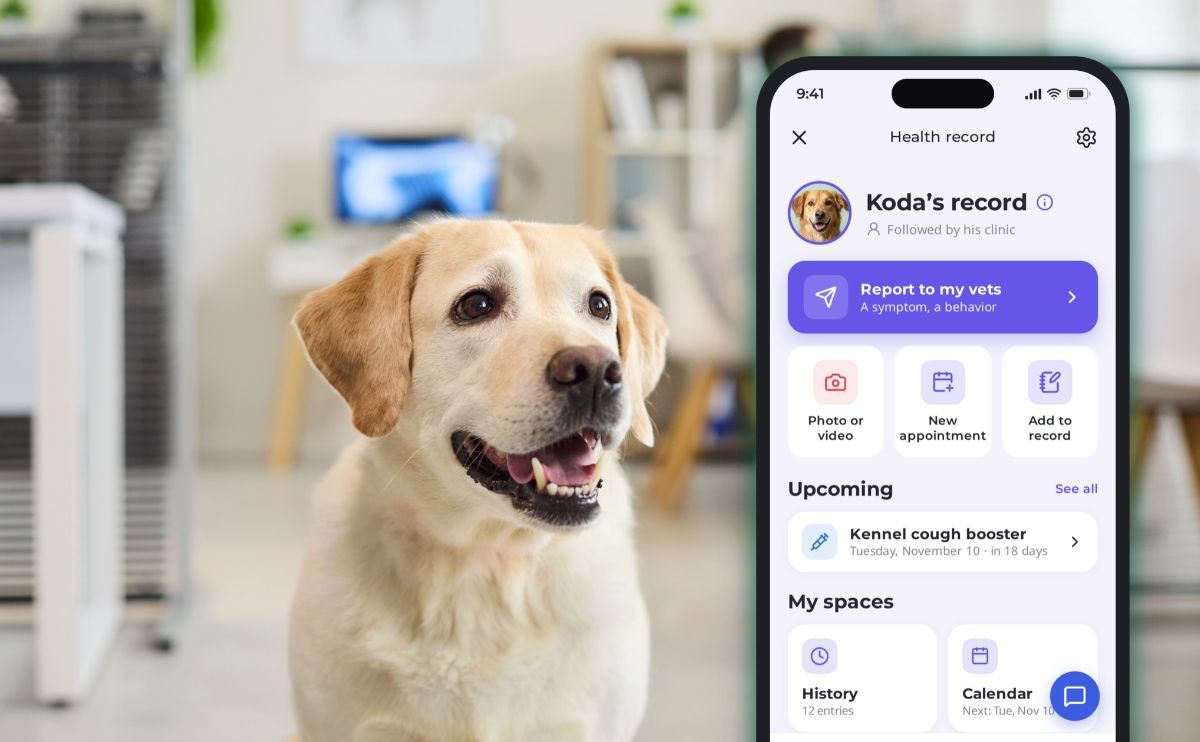
A paper record can be lost, damaged, or left at home on the day you need it. A digital record keeps the same information on your phone and alerts you before due dates.
This is what the Biotracker app now offers with its digital health record: scan the vaccination record to fill in the profiles, receive a reminder before every vaccine or antiparasitic treatment, and report a symptom to your veterinarian with a photo or video. It complements the monitoring provided by the Biotracker smart collar, which measures activity, sleep, and resting heart and respiratory rates.
Still keep the paper record and passport: these are the documents requested by boarding facilities, customs, and some veterinarians.
FAQ – dog health record #
At what age does a dog receive its health record? #
Generally during the puppy’s first vaccinations, at around 6 to 8 weeks. It is often provided by the breeder or veterinarian at the time of adoption.
Which vaccine is mandatory for a dog in France? #
No vaccine is mandatory for all dogs. Rabies vaccination is required for travel abroad and for Category 1 and Category 2 dogs, and it is often required by boarding facilities and canine events.
How often does a dog need a vaccine booster? #
Most often once a year for adult dogs, but the frequency varies depending on the vaccine. The date of the next booster is recorded in the health record, and your veterinarian adapts the protocol to your dog.
Is the health record enough to travel with your dog? #
No. To travel within the European Union, you need the European passport, microchip identification, and a valid rabies vaccination.
What should I do if I have lost my dog’s health record? #
Ask your veterinarian to reconstruct the vaccination history and issue you a new record or certificate. The European passport can also be replaced by a veterinarian.
Is the Invoxia health record for my dog available to everyone? #
No. To use your digital health record in the Invoxia Biotracker app, you must own a Biotracker. The health record and all its features are available without a subscription with the Basic plan. Only the document-scanning feature is unlocked with the Plus plan.