




Before / after
Each dog is its own reference.

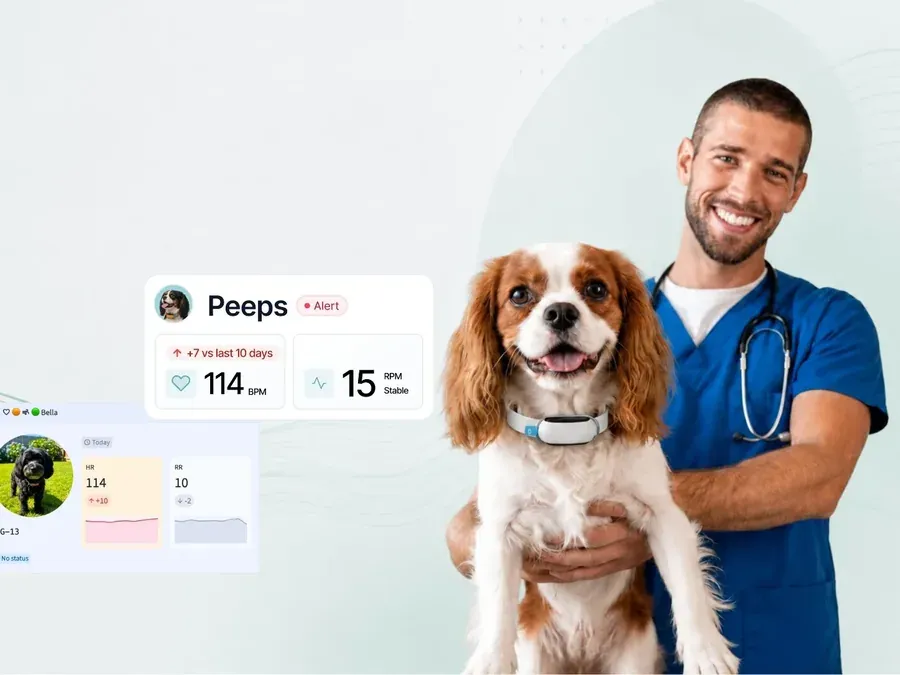
Resting heart rate, breathing, HRV and arrhythmias, recorded by a collar the dog already wears, for the whole length of your studies, and a platform where your team follows the whole cohort.
What is needed: following each dog remotely, every day, for the whole study. Resting vital signs make it possible, recorded at home by a collar the dog wears anyway.
Resting HR and RR are taken where the dog lives, at rest, not on the examination table.
The collar measures heart and breathing rates on its own in 2-minute windows, spread through the day whenever the dog is still, ideally asleep: about 80 minutes a day, more on request for a study.
One series per dog, day after day, from enrollment to the end of the study, instead of one value per visit.
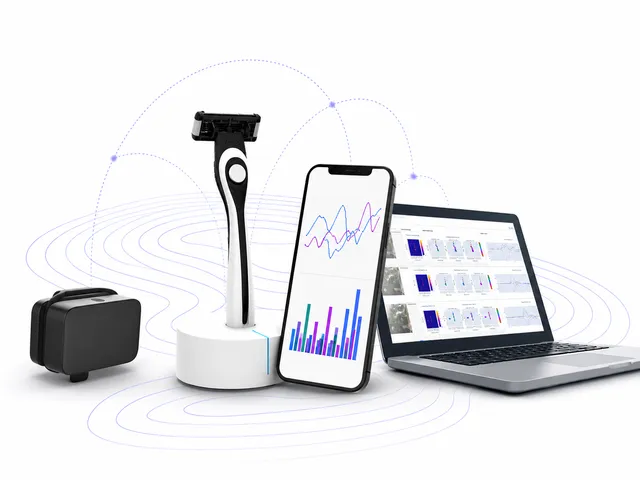
Not a real-time monitor: measurements are recorded on the collar, synchronized in the background, and read as a trend over days and weeks. The chart illustrates the principle; it is not data.
The Biotracker is added to a protocol without changing it: the measurement is automatic, the same for every dog, on the same days in every group.
Each dog is its own reference.
Same measurements, same days, in both groups.
Resting HR, RR and HRV, activity and sleep: several measurements a day for each dog, instead of one value per visit.
The effect on resting HR and HRV, day after day; a decompensation seen coming between two visits.
See the clinical case ›A tolerance signal on HR and RR, and indirect effects: pain, anxiety, recovery show in activity, sleep and HRV.
A dog varies little around its own baseline, much more from one dog to another: the before / after design compares each dog with itself.
For each: what you measure, and what it changes compared with the visits alone.
The collar measures on its own; the data arrives in your dashboard, and you read it when you choose to, or when an alert prompts you. Compliance does not rest on the participant's motivation: the collar stays on for its everyday features (GPS, walks, sleep, the evening report, a conversation with the dog).
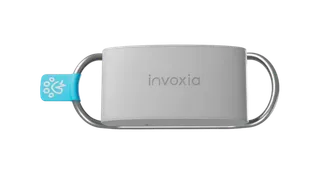
Seismocardiography: one AI on the collar, one AI in the cloud on the raw signal. No contact electrode, no rigid housing, nothing for the owner to do.
99.6%
heart-rate accuracy, against ECG
98.6%
respiratory-rate accuracy, against annotated video
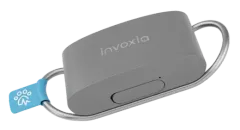
A sensor measures nothing if the dog doesn't wear it. On sale to owners for two years, the Biotracker is kept for the GPS, the walk log, the sleep score and the story of the day: the cardio-respiratory measurement rides on a collar the dog was already wearing.
>20h
a day, every day: how long most dogs actually wear the collar
25%
of dogs wear it more than 98% of the time
331days
on their dog so far, on average, for current users
Invoxia installed base, all generations of health collars.
HR, RR, 8 HRV indices, atrial fibrillation, activity and sleep. GPS included.
Activity and sleep are computed every 5 seconds. Cardio-respiratory vital signs are measured in 2-minute windows, at regular intervals, when the dog is still, ideally asleep: about 80 minutes of measurement a day. For a study, the windows can be brought closer together on request (beyond 80 minutes a day) through a server-side setting.
The Biotracker has its own cellular connection (LTE-M, SIM and data included): no Wi-Fi to set up, no phone to keep nearby. Recorded on the collar, synchronized in the background.
Calibrated for dogs, with published accuracy, and data used in peer-reviewed veterinary studies (Frontiers in Veterinary Science, 2025). The Biotracker is not a certified medical device.
The full list, taken from the Biotrack demo and grouped by family of measurements.
38metrics per dog, day after day
Resting heart rate and respiratory rate (all day, day, night), with their standard deviation, minimum and maximum · AFib, the atrial fibrillation risk (%) · tachycardia and bradycardia, and their number of episodes.
RMSSD, SDNN and normalized RMSSD (all day, day, night and at wake-up) · VVTI · triangular index.
The Poincaré plot, day by day · the Poincaré angles In, Ex, InEx and their ratio · the minimum RR interval (ms) · the number and duration of pauses.
Exercise duration, in minutes a day · duration by gait: walk, trot, run · distance · calories · barking.
Sleep score (0–100) · sleep duration · bedtime · wake-up time · sleep interruptions.
The “Details” table lines these metrics up for every dog, with 10-day averages and the 30-day trend; each curve shows over 10, 30 or 90 days, or the whole history. Eight of them carry alert thresholds set for each dog. All the data visible in Biotrack, and more if your study needs it, can be exported as a spreadsheet for your analyses.
Smart alerts
Prioritized by AI against each dog's own baseline, with email notifications.
Trends, not spikes
A sustained rise in resting RR over days or weeks: you see the drift, and you decide whether a visit should come sooner.
Annotated events
Enrollment, treatment, dose change, visit: the effect reads before and after, dog by dog.
AI assistant and reports
PDF follow-up reports, drafted by AI and editable by the veterinarian.
The Biotracker is evaluated and used by veterinarians and researchers, in published or open-access work, with a scientific board.

59bpm
Frontiers in Veterinary Science, 2025
Led by Prof. Valérie Chetboul (Alfort National Veterinary School) with Invoxia's teams between 2022 and 2025, on the resting cardiac values of 703 dogs in 29 countries.
Read the study ›bioRxiv, 2023, preprint
On 40 dogs: 99.6% accuracy for heart rate, 98.6% for breathing.
Read ›Veterinary thesis, 2025 · Vet IN Tech NUManima 2026 award
Two years of monitoring Malinois from an elite unit, by Alice Ruellan under the supervision of Prof. Valérie Chetboul. A pilot study.
Read ›
Professor Valérie Chetboul
Head of the Cardiology Department at the Alfort Veterinary School (France)

Dr. Daniel Promislow, PhD
Canine longevity researcher at the University of Washington (USA)

Sydney Moïse, PhD
Professor of veterinary cardiology at Cornell University (USA)
Light logistics, nothing to install on your side: the owner sets up the Biotracker at home, like any buyer.
The laboratory creates its account on biotrack.invoxia.ai.
The laboratory orders the study's Biotrackers, on the terms agreed with Invoxia.
Invoxia links the ordered Biotrackers to the laboratory's Biotrack account before shipping.
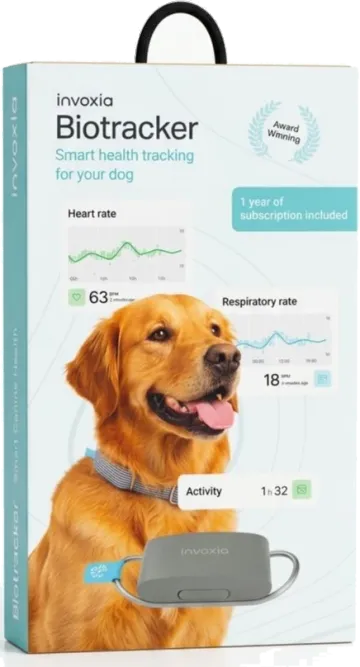
At the enrollment visit, the investigating veterinarian explains to the owner what the Biotracker measures and what they will have to do: set it up, then nothing.
The owner leaves with one of the laboratory's Biotrackers, already linked to the study account.
At home, the owner downloads the Invoxia app and sets up the Biotracker in a few taps, like any buyer. No time taken from your team.
The dog appears on its own in your dashboard: vital signs day after day, alerts when something drifts.
At the end of the period, Biotrack prepares a report for each dog, AI-assisted; the curves stay available dog by dog.
A few minutes at enrollment, then the measurements arrive on their own.
Every study is different: we set a favorable rate with you, based on the number of dogs, the duration and what you measure. The device is the one owners buy, and it is set up the same way.
Based on the number of dogs, the length of the study and what you measure, we set favorable terms together, reserved for research.
Quoted on request: research@invoxia.com
Why a dedicated rate. It is in our interest that the measurement serves research: every published study that uses it strengthens the evidence everything else rests on.
See the clinic offers, for comparison ›Tell us how many dogs, for how long, and what you want to measure: we will offer you a rate suited to your study. You can create a Biotrack demo account right now, in under a minute and with no commitment.