




Irregular heartbeatin dogs
With an arrhythmia, the heart loses its normal rhythm. It may race, slow down too much or beat unevenly. Some rhythm changes are harmless (the heart naturally varies with each breath), while others can lead to fainting or wear the heart down.
Heart disease is often behind them, though not always. Below, you'll find the most common rhythm problems, the symptoms that warrant a call to your vet, and what tracking your dog's resting heart rate can reveal.




Biotracker:heart tracking for every day
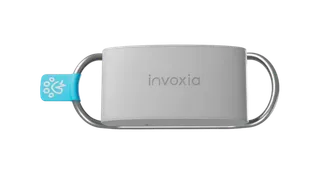
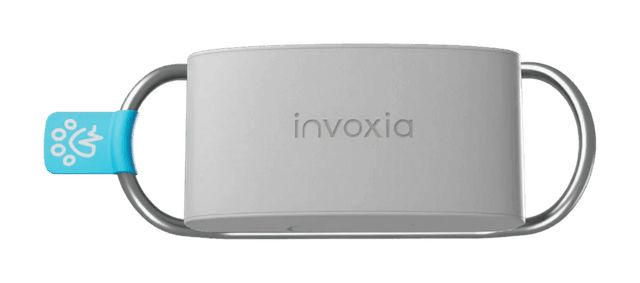
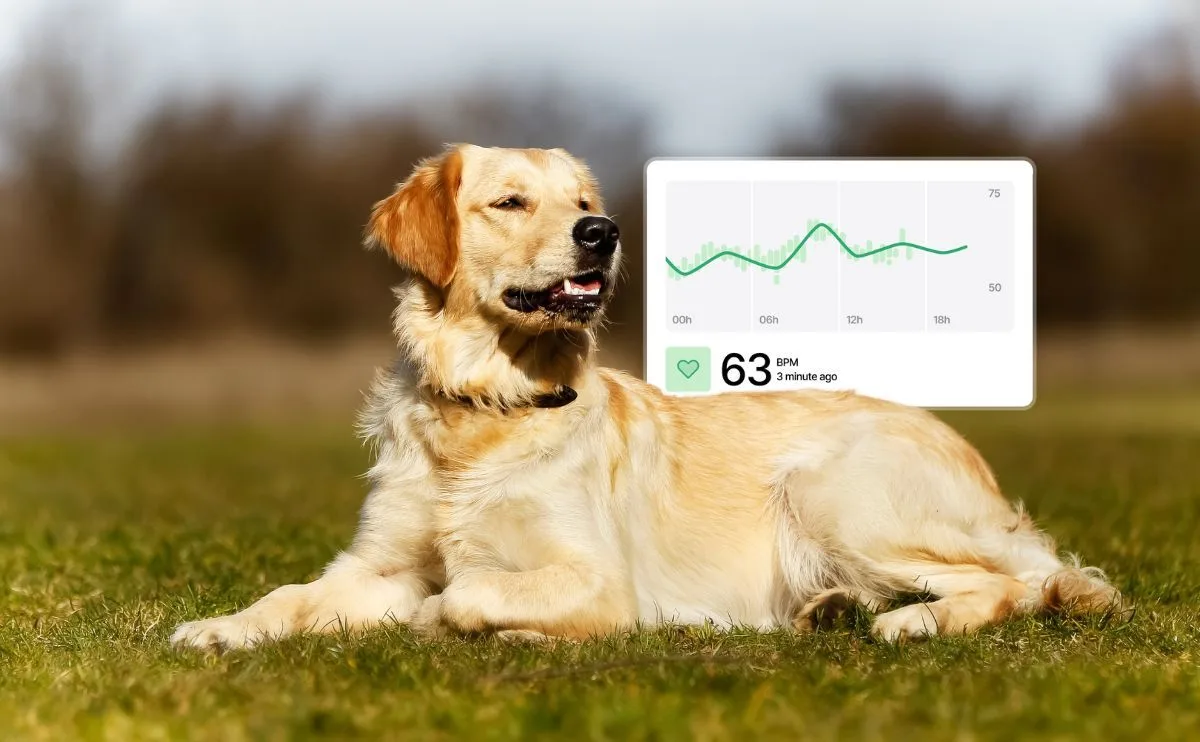
While your dog rests and sleeps, Biotracker keeps a record of their heart rate and breathing rate. It tracks their activity too.
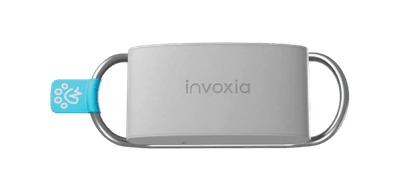
Biotracker
A daily view of your dog's heart
- Heart rate and breathing rate at rest
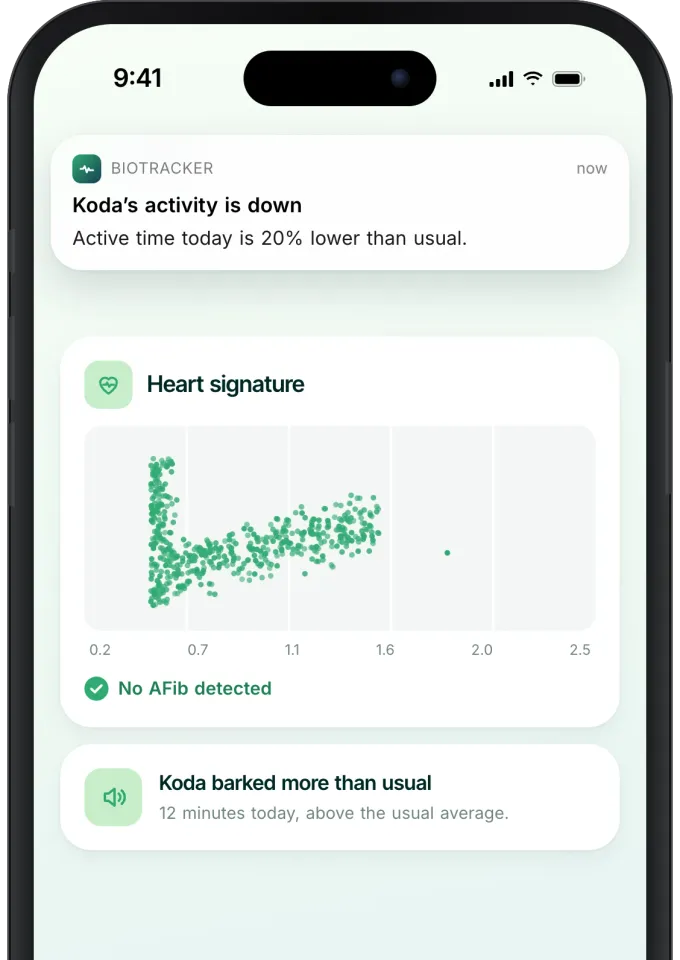
- Detection of atrial fibrillation (AFib) risk
- Trends across days instead of one-off readings
- Battery that lasts up to 15 days
- Vet access to the data through Biotrack
From
Explore
What day-to-day trackingcan help you catch
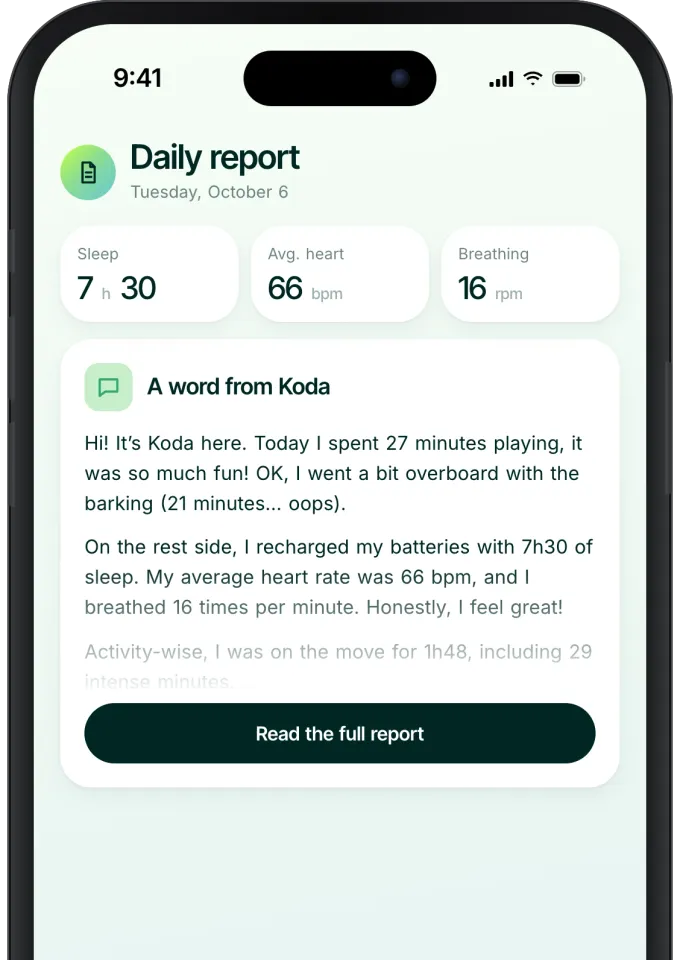
Rhythm problems can be intermittent, so they don't always show up during an exam. Biotracker keeps a record of your dog's resting heart rate in the weeks between visits. Plus and Max GPS subscriptions include the daily report.
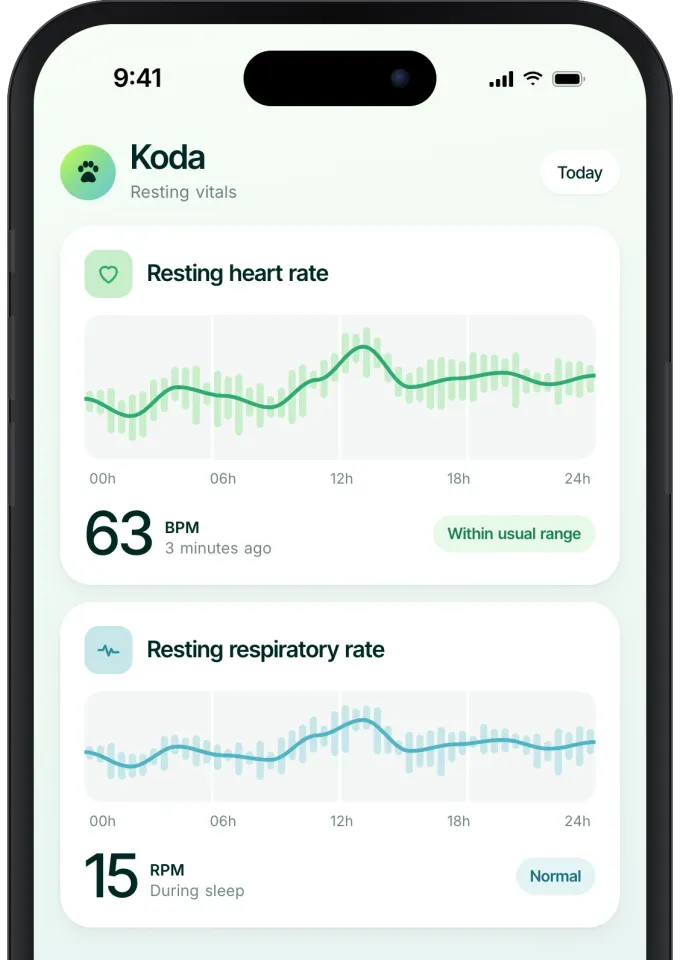
 Resting heart rate
Taken while your dog sleeps, which makes readings easier to compare day to day, then checked against their own values. Biotracker also provides an estimate of atrial fibrillation (AFib) risk.
 Breathing rate
Logged automatically at rest. A rise that persists can go along with worsening heart disease.
 Activity and endurance
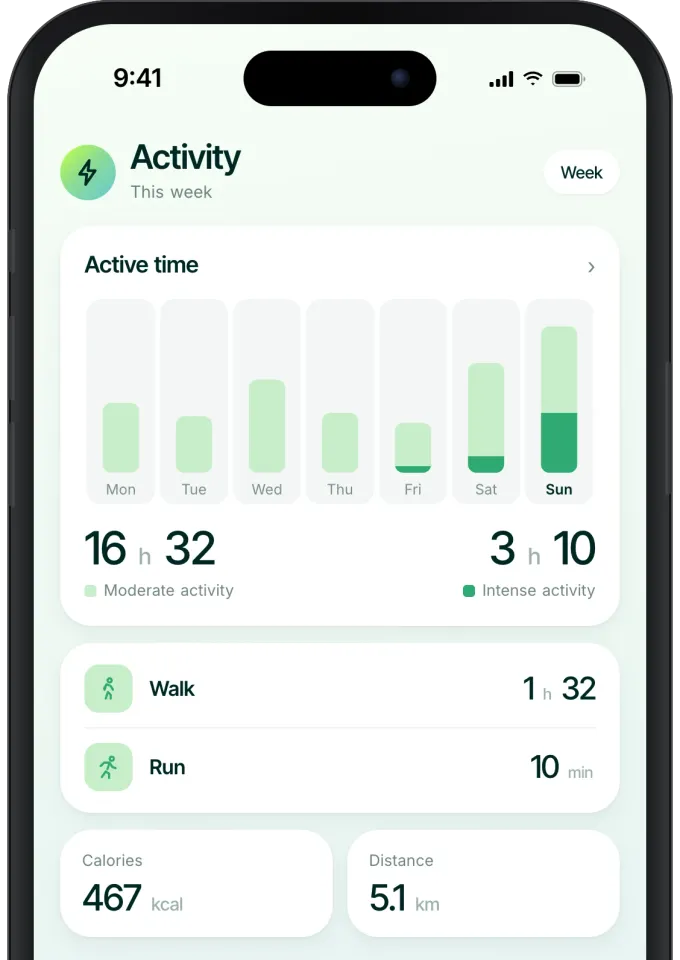
When a dog wears out sooner or cuts walks short, their activity data reflects it.
 Vet report
Clinics using Biotrack can review trends remotely, or you can download a PDF report ahead of the appointment.
From home readingsto the vet's office
Biotracker can't diagnose anything, and it is not a substitute for an ECG or Holter monitor. Its job is to record what happens between vet visits.
Measure at rest
Heart and breathing rates are recorded while your dog rests or sleeps. No shaving or skin contact needed.
Learn what's normal
Over time, the readings reveal your dog's personal baseline, shaped by their size, age and routine.
Flag a lasting change
An alert is triggered by a persistent departure from that baseline, not by a one-size-fits-all cutoff. Alerts come with Plus and Max GPS.
Share with your vet
Use the Biotrack platform or export a PDF from the app, to add context to the ECG or Holter results.
Track treatment response
If medication is prescribed, changes in your dog's resting heart rate help the veterinarian see how they're responding.
Symptoms that callfor a vet visit
Plenty of arrhythmias go unnoticed because they cause no symptoms. When symptoms do appear, it's because the heart isn't pumping blood as well as it should.
Treat it as an emergency if your dog faints, collapses, has trouble breathing or shows pale or bluish gums. Call your veterinarian or an emergency animal hospital right away.

Energy · Weakness and tiredness
Your dog seems down, wears out fast, cuts walks short or won't do things that used to be easy for them.

Emergency · Fainting or collapse
Stumbling, suddenly collapsing or briefly passing out, even if they bounce back quickly.

Breathing · Shortness of breath and coughing
Shortness of breath, a cough or faster breathing at rest. In advanced cases, the belly may also swell.
Why do dogs developan abnormal heart rhythm?
Electrical signals set the pace of every heartbeat. If those signals start in the wrong spot, don't travel properly or fire too fast, the result is a heart that races (tachycardia), slows down (bradycardia) or beats irregularly. Some variation is perfectly normal, though: a dog's heart rhythm naturally shifts as they breathe.
Usually, heart disease
In conditions like mitral valve disease and dilated cardiomyopathy, arrhythmias such as atrial fibrillation are a frequent complication of an already diseased heart (VCA).

Genetics
Certain breeds are predisposed. The Boxer, for example, is prone to arrhythmogenic cardiomyopathy, which can lead to fainting spells (PetMD).

Causes outside the heart
The rhythm can also be thrown off by anemia, infection, toxin exposure, trauma, hormonal conditions like hypothyroidism, or parasites like heartworm (PetMD).

Common types of arrhythmia
Tachycardia (a fast heart rate), bradycardia and heart block (a slow heart rate), premature contractions (extra beats) and atrial fibrillation (a rapid, disorganized rhythm).
Before and after a diagnosis
Before: learn their normal heart rate
Maybe your dog is a predisposed breed, or has heart disease that isn't causing symptoms yet. Their resting heart rate while healthy becomes your reference point.
- • A personal baseline recorded before anything changes
- • A concrete reason to schedule a checkup sooner if the numbers shift
After: keep tabs on treatment
Your dog has been diagnosed and is on treatment. Rechecks can be weeks apart, and tracking fills in what happens in between.
- • An ongoing record of resting heart rate
- • A report to share ahead of every follow-up ECG or Holter
Follow your cardiac patients from a distance
Your client sends you a link, and you can view their dog's data on the Biotrack platform to keep an eye on things between appointments. Your clinic doesn't need any equipment to get started.
What's a normal restingheart rate for dogs?
Size and age are the two biggest factors. Conducted with Prof. Valérie Chetboul, the AI-COLLAR study tracked 703 seemingly healthy dogs resting at home over several months. The values it found are lower than the typical ranges recorded at the vet's office, where stress makes the heart beat faster.
How to read these numbers
| Dog | Median resting heart rate |
|---|---|
| Small dog: 10 kg (22 lb) or less | 65.0 bpm |
| Medium dog: 10 to 20 kg (22 to 44 lb) | 62.1 bpm |
| Large dog: over 20 kg (44 lb) | 59.5 bpm |
| Senior dog | 68.7 bpm |
| Puppy | 78.5 bpm |
A median is not a cutoff for diagnosis. Each dog's heart rate is unique, so the key is how it changes relative to their usual numbers. A rhythm problem can only be characterized with an ECG or Holter monitor.
Sources: AI-COLLAR study (Prof. Valérie Chetboul, ENVA); PetMD; VCA Animal Hospitals.
Breedsat higher risk
An arrhythmia can develop in any dog, usually as a result of heart disease. Body size plays a role, though. Atrial fibrillation is seen almost only in large and giant breeds, whereas some small breeds are predisposed to an abnormally slow heart rate.
The Rottweiler and Bernese Mountain Dog are two more large breeds mentioned in connection with atrial fibrillation.
Sources: VCA Animal Hospitals; PetMD; Merck Veterinary Manual; Société Centrale Canine.
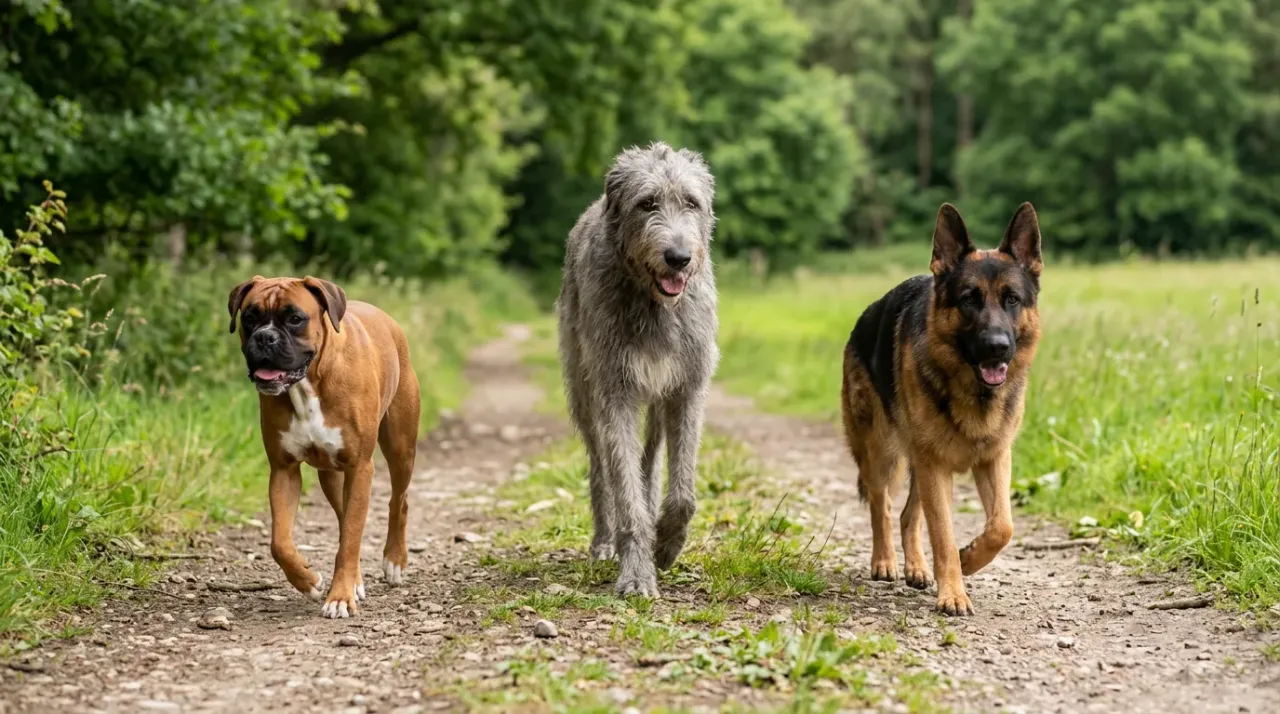
Arrhythmogenic right ventricular cardiomyopathy is so closely tied to the Boxer that it's the reference breed. It causes extra beats, sometimes silently and sometimes with fainting.
For the Doberman, an abnormal rhythm is often the earliest sign of dilated cardiomyopathy, and atrial fibrillation can make it worse.
No breed has been studied more for atrial fibrillation. In these dogs, it frequently appears with no other heart disease.
Atrial fibrillation has been reported in both of these giant breeds, either on its own or alongside dilated cardiomyopathy.
Atrial fibrillation affects the German Shepherd, and young dogs of the breed can have inherited ventricular arrhythmias.
Both the Miniature Schnauzer and the West Highland White Terrier are predisposed to sick sinus syndrome, where the heart beats too slowly and pauses can trigger fainting.
How vets diagnoseand treat arrhythmias
Your veterinarian's goal is to pin down the type of rhythm problem and then what's causing it, since the cause shapes treatment.
Physical exam
Listening to the heart and lungs and checking the pulse often picks up an irregular rhythm, or a pulse that doesn't match the heartbeat.
Rhythm recording
An electrocardiogram (ECG) identifies the arrhythmia. A Holter monitor worn for 24 hours catches the ones that don't happen during the exam.
Finding the cause
An echocardiogram, X-rays and bloodwork check for heart disease or a cause outside the heart.
Treatment
It depends on the arrhythmia: medication to slow or steady the rhythm, treating the underlying cause and, in some cases, a pacemaker.
Prognosis varies with the type of arrhythmia and its cause. Sinus arrhythmia tied to breathing is normal. Others respond well to treatment, and many dogs with well-managed atrial fibrillation go on to live a long time (VCA). Certain forms, especially inherited ones, need monitoring for life.
How can AFib alerts help? Atrial fibrillation can complicate heart disease, leaving an already weakened heart pumping less effectively. AFib risk alerts from Biotracker point out this risk between checkups, which is your cue to call your vet promptly. Any Biotracker signal needs to be confirmed with an ECG.
Biotracker is designed for monitoring. It can't diagnose and is not a substitute for an ECG or Holter monitor. If your dog collapses, don't wait for an alert.
Your dog's whole health picture,in one app.
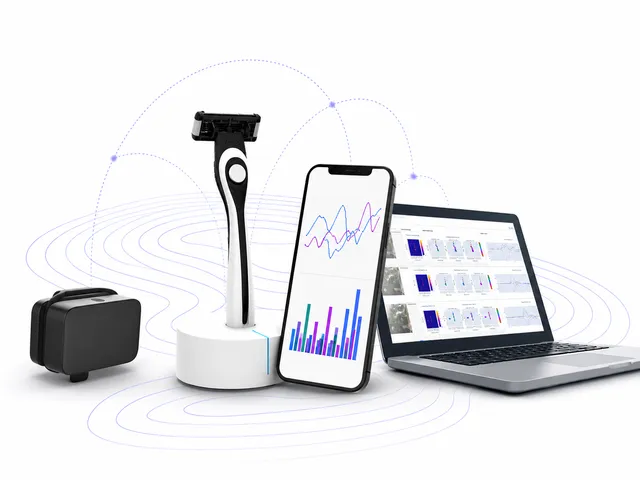
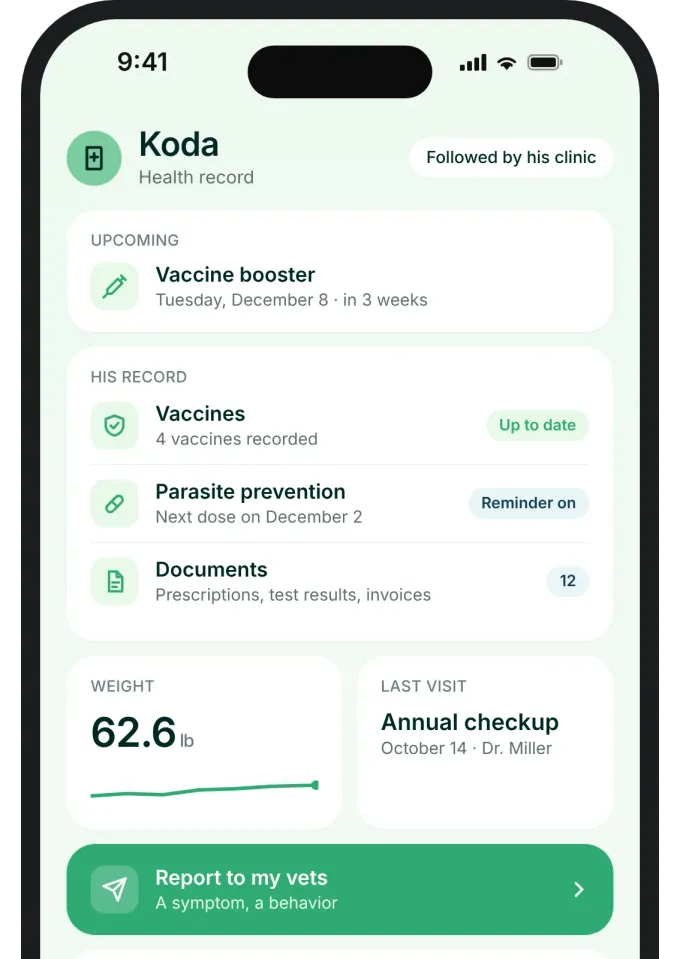
The iOS and Android app brings together resting vitals, trends over time, alerts, vet reports and the health record, so you can keep an eye on your dog's heart. A Plus or Max GPS subscription includes alerts and the daily report.


More reading onyour dog's heart

Atrial Fibrillation in Dogs: Symptoms, Causes, and Monitoring
Normal Dog Heart Rate: Resting BPM Chart by Size
Dog Heart Monitoring at Home: The Complete Guide

Doberman and Dilated Cardiomyopathy: Early Detection to Act in Time
Dog arrhythmia: your questions answered
Get in touch
It means the heart's rhythm is off: too fast, too slow or uneven. Some arrhythmias are harmless and others need treatment. An ECG is the only way to identify which one your dog has.
It may be perfectly normal. A dog's heart speeds up as they breathe in and slows as they breathe out. Called sinus arrhythmia, this pattern is common and seldom a concern, and your vet can tell it apart by listening with a stethoscope.
Tachycardia means the heart is beating faster than it should at rest. Pain, fever, anemia or heart disease can all cause it. If your dog's heart keeps racing while they rest, have a vet check it.
Bradycardia means the heart is beating slower than normal. In an athletic dog at rest, that can be normal; it can also come from a conduction block or a hormonal condition. Fainting alongside a slow heart rate needs a prompt vet visit.
Frequently there are none. When symptoms do occur, look for weakness, tiring with exercise, shortness of breath, coughing, pale gums and occasionally fainting or passing out.
They start by listening to the heart, then run an electrocardiogram. For problems that come and go, a 24-hour Holter monitor records the rhythm. An echocardiogram and bloodwork help find the cause.
That depends on the type of arrhythmia and what's causing it. Many are manageable with medication or by treating the underlying cause, while some conduction problems call for a pacemaker.
Biotracker estimates the risk of atrial fibrillation (AFib), but it does not diagnose. It also tracks heart rate and breathing rate at rest and alerts you to changes from your dog's normal patterns. A rhythm problem can only be diagnosed with an ECG or Holter monitor read by a veterinarian.
Call your vet right away and share your dog's Biotracker data. The AFib alert is a risk estimate, not a diagnosis; confirming it takes an ECG. If your dog collapses, passes out or has trouble breathing, get to an emergency animal hospital immediately.
Alerts are based on a lasting change from your own dog's values, not a single threshold for every dog. A Plus or Max GPS subscription includes health alerts.
Get to know your dog'sresting heart rate
Day after day, Biotracker tracks your dog's heart and breathing vitals and helps you notice anything that strays from their normal. Plus and Max GPS subscriptions include alerts and the daily report.
Biotracker is a monitoring device, not a diagnostic one. It is not a substitute for a physical exam, an electrocardiogram or a Holter monitor.