

A health sensor should do more than display numbers. You also need to know what it measures, how accurately, and what information it gives both the owner and the veterinarian.
That is the angle of this comparison. Unlike our other comparisons, it does not review the two products as a whole (location tracking, battery life, price, app…): it focuses on the quality of the health measurements, their documented accuracy and therefore their usefulness for monitoring a dog’s heart and breathing.
Invoxia Biotracker and Maven both offer resting heart and respiratory monitoring. Three points set them apart: heart rhythm analysis, published results on heart rate accuracy, and the respiratory performance reported in their respective studies.
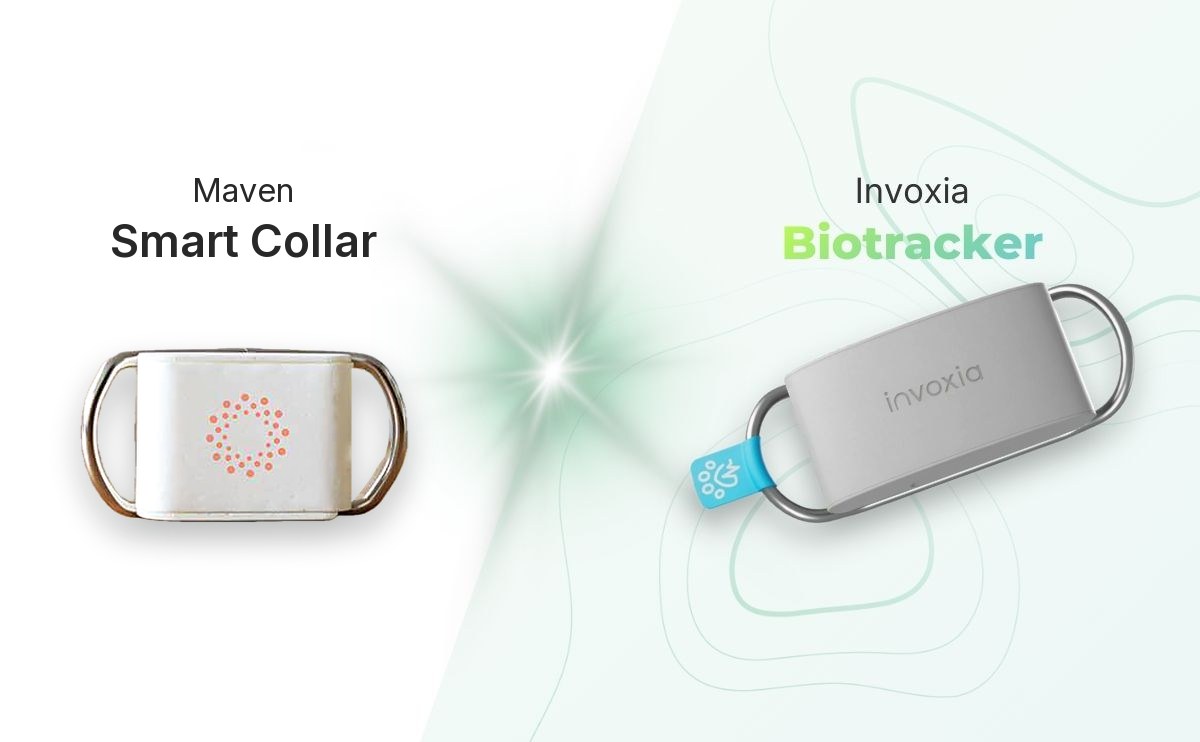
At a glance
- Heart rhythm: the Biotracker measures HRV and screens for patterns consistent with a risk of AFib; Maven advertises neither.
- Heart rate accuracy: Invoxia publishes a mean absolute error of 0.44 beats/minute against an ECG; no equivalent validation has been identified for Maven.
- Breathing: in the Invoxia study, 95% of errors stay below 1.19 breaths/minute; in the Maven study, the limits of agreement range from −6.81 to +5.26 breaths/minute (indirect comparison).
More complete heart monitoring with Biotracker #
Heart rate tells you how many times the heart beats per minute. Heart rate variability, or HRV, describes how the time between two successive beats varies. The two complement each other: an average rate alone does not describe how the beats are organized.
Biotracker measures HRV and screens for patterns consistent with a risk of atrial fibrillation (AFib), drawing in particular on its Heartprint cardiac signature. An alert is a prompt for a veterinary assessment; it is not a diagnosis.[1]
Maven advertises resting heart rate monitoring, but advertises neither HRV measurement nor a dedicated AFib alert feature.[2]
| Feature or published data | Invoxia | Maven |
|---|---|---|
| Resting heart rate | ✔️ Yes | ✔️ Yes |
| Heart rate variability — HRV | ✔️ Yes, on Biotracker | Not advertised |
| Screening for AFib-consistent patterns | ✔️ Yes, on Biotracker | Not advertised |
| Published quantitative heart rate validation | ✔️ Yes, preprint on the Smart Dog Collar | Not identified |
| Published respiratory rate validation | ✔️ Yes, preprint on the Smart Dog Collar | ✔️ Yes, article in AJVR |
AI that identifies heart contractions one by one #
The Biotracker uses seismocardiography: its sensors record, at the neck, the tiny mechanical vibrations produced by heart contractions and breathing movements. Powerful AI models analyze these signals to detect each heart contraction individually and identify breathing cycles.[5]
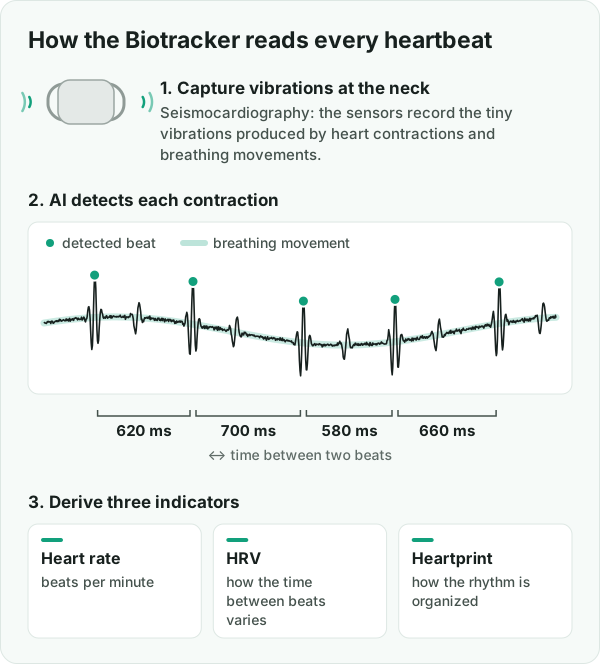
This beat-by-beat analysis gives access to the time between two successive contractions. It makes it possible to calculate HRV and study how the rhythm is organized through Heartprint, which adds information beyond the average heart rate alone.[1,3]
The finer grain of this analysis could contribute to the differences in capabilities and accuracy observed between the solutions. It is a plausible technical explanation; however, the available studies do not make it possible to isolate the contribution of the AI from that of the sensors, the signal processing or the measurement conditions.
Heart rate accuracy: Invoxia publishes figures #
Our 2023 preprint evaluates the Invoxia Smart Dog Collar on 40 dogs, with an ECG reference for the heart and annotated videos for breathing. For heart rate, it reports a mean absolute error of 0.44 beats/minute, along with an F1 score of 98.04% for beat detection with a 50-millisecond tolerance.[3]
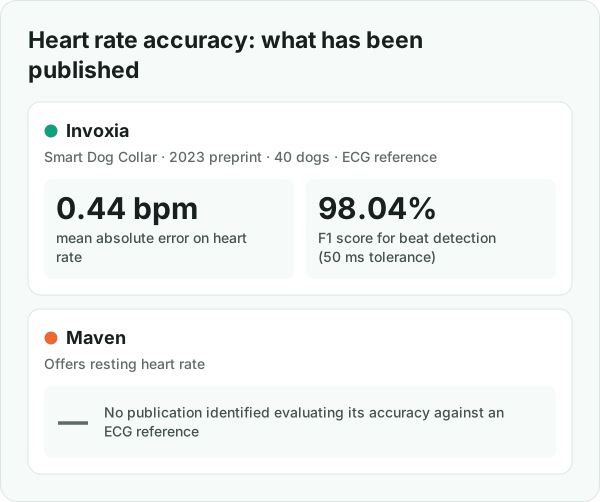
These results document heart rate and the detection of individual beats. On their own, they do not constitute a validation of atrial fibrillation detection.
Maven now offers heart rate, but we have not identified any publication evaluating its accuracy against an ECG reference. The Maven study published in the American Journal of Veterinary Research covers breathing only.[2,4]
Breathing: markedly more favorable published results for Invoxia #
The Invoxia preprint reports a mean absolute error of 0.38 breaths/minute. Above all, 95% of samples show an absolute error below 1.19 breaths/minute.[3]
The Maven study, carried out on 19 apparently healthy dogs and 120 pairs of measurements, reports a mean bias of −0.78 breaths/minute, with 95% limits of agreement from −6.81 to +5.26 breaths/minute.[4]
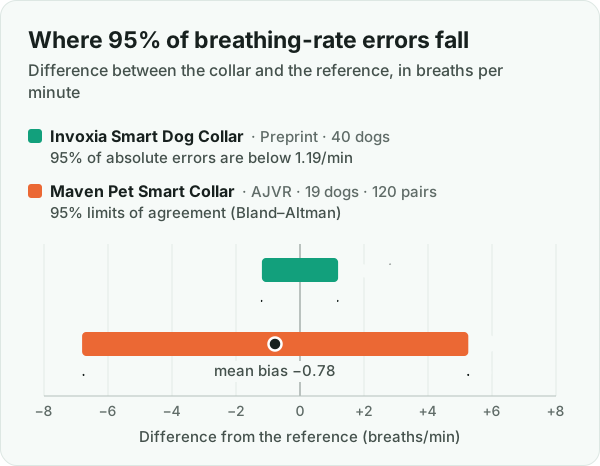
The mean bias may look reassuring, but it describes the average offset between two methods. Overestimates and underestimates can cancel each other out. The limits of agreement show how widely the differences are spread: here, on the order of ±6 breaths/minute around the bias.
Invoxia’s results therefore suggest markedly smaller respiratory errors under the conditions of our study. The 1.19/min threshold containing 95% of the errors is more informative than an average alone.
An indirect comparison
An absolute-error percentile and Bland–Altman limits of agreement are not identical statistics. Protocols, measurement windows and populations differ. The Invoxia preprint, funded and carried out by the company, concerns the Smart Dog Collar, a model that predates the current Biotracker; the Maven study is a peer-reviewed article. A head-to-head comparison of the current devices would make it possible to quantify their difference in accuracy under the same conditions.[3,4]
Reliable measurements to establish new veterinary references #
The reliability of our measurements has also made a scientific milestone possible: publishing reference values for resting heart rate (HR) and respiratory rate (RR) in dogs living at home. The international AI-COLLAR study, published in Frontiers in Veterinary Science, an international peer-reviewed scientific journal, initially enrolled 1,012 dogs. The baselines were established on 703 apparently healthy dogs, after the selection criteria were applied.[5]
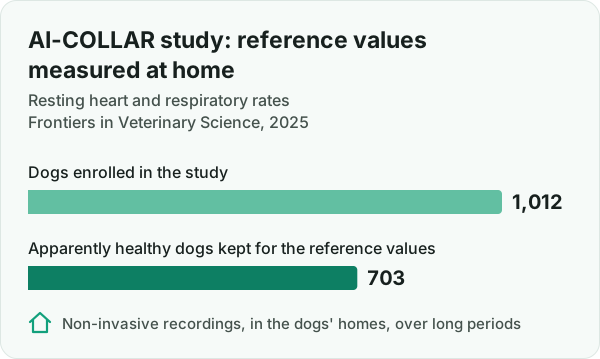
These non-invasive recordings, made in the dogs’ familiar environment, limit the disruption caused by handling and the stress of a clinic visit. They provide reference data unprecedented at this scale, collected over long periods of everyday life.[5]
These baselines are a foundation for veterinary researchers developing more predictive and preventive medicine: knowing the normal physiological variations better helps identify changes that may signal a health problem. Their publication gives the scientific community references for designing and evaluating new approaches to monitoring and early detection.[5]
Choosing documented measurements #
When choosing a sensor, three questions deserve an answer: which indicators are available, has their accuracy been quantified, and what spread lies behind the averages?
Sources #
Comparison compiled on October 28, 2026 from advertised features and accessible publications. “Not identified” means that no corresponding validation was found in the sources consulted.
- Invoxia — Health features: Heartprint, heart rate, respiratory rate and HRV.
- Maven — Heart rate tracking and referenced publications.
- Jarkoff H., Lorre G., Humbert E. Assessing the Accuracy of a Smart Collar for Dogs: Predictive Performance for Heart and Breathing Rates on a Large Scale Dataset. bioRxiv, 2023. DOI: 10.1101/2023.06.09.544347. Preprint, not peer-reviewed; heart and respiratory results in the discussion, pages 18–20.
- Murphy K.E., Benjamin E.J., Leigh R., Adin D. The Maven Pet Smart Collar system shows small bias compared to manually counted resting respiratory rates in healthy dogs. AJVR, published online October 27, 2025, January 2026 issue. DOI: 10.2460/ajvr.25.06.0220.
- Chetboul V., Humbert E., Dougoud L., Lorre G. Resting heArt and respIratory rates in dogs in their natural environment: the AI-COLLAR study. Frontiers in Veterinary Science, 2025. DOI: 10.3389/fvets.2025.1667355. Device description in section 2.1; cohort composition in section 3.1 and scope of the physiological references in the discussion.